Friday, January 14, 2011

Atlanta Snow in the New Year


It snowed in Atlanta on Christmas Day 2010. It was the first time since 1882 (see my post here.) By the time we came back from Nashville the snow had almost melted and within another day, it was gone. It snowed again, this time in the New Year 2011, early on Monday 10th of January. It continued snowing a bit. The snow has not melted yet. It was a heavy snowfall for Atlanta – between 4 and 7 inches. It paralyzed the city and the surrounding areas.


Click on pictures to enlarge

We in the Deep South are not prepared for such weather – Atlanta has only 8 snow plows and the small towns around the city have even less. In our county, Cobb County, there are just two road graders and six sand-and-salt trucks for 2,400 miles of road, so our road was not sanded. When it snows we usually wait one day or two until the snow melts. Not this time. On that Monday morning when we woke up the snow was soft and brilliant under a timid sunshine.


I just went outside briefly to take a few photographs.


Click on collage to enlarge, then click on each picture to biggify

The next day, Tuesday, there were some passing snow flurries. All schools and many or most businesses were closed too. The schools stayed closed the whole week. No mail. At Atlanta's airport, the world's busiest, nearly 2,000 flights were canceled for two days and many the next day . The newspaper said that around the metro Atlanta area hundreds of jackknifed tractor trailers littered the highways and hundreds of vehicles had been abandoned on the roads. This created monumental traffic jams. Some truckers were on the Atlanta highways, without moving, from Monday morning till Tuesday night or even later.


(photos courtesy the Atlanta Journal Constitution)

Removing the snow cost the state of Georgia $2 million a day – the budget has been exhausted now and we are just starting the New Year. Some ice on the road in front of our house did melt but large patches of road stayed encased with thick, slippery sheets of ice – still there on Friday night.. All the black areas on the pictures below have iced over.


On Tuesday we bundled up in warm clothes (although I could not find a hat or gloves) and walked behind our barn and down the hill to our neighbor’s lake. It was chilly, around 29 F (-1½ C) which is quite cold for us since our average daytime temperature in January is 50 F (10 C.) There was no sun. A sheet of ice covered a large area of the lake.


The little stream though was not frozen and looked pretty with the snow on its banks.


We walked back to the main road and then a few hundred yards down past the two old barns. I took many pictures of these old barns, until my hands were frozen. The following days (on Wednesday and Thursday) we walked again on the same route and I took more pictures of the barns. I have 40 pictures of the barns and it is hard to decide which ones to show. I’ll assemble a small mosaic and you can click on it, then again on each photo to enlarge it.


Click on collage to enlarge, then click on each picture to biggify

Then we walked another 100 yards or so to the farm. It is a couple of houses past ours. Again I took many pictures of the field. The first day the snow was soft and a couple of cows were out. We left when it started to snow again. The snow is visible on the picture below showing Lost Mountain in the background (bottom right.)


We went back home, had a nice cup of tea, then I tried to take some pictures of all the birds coming to our bird feeders. As soon as I came near the window they flew away so I used the telephoto on my Sony camera. The pictures are not very sharp but you can still make out the birds. Apart from the cardinals, blue jays, doves, I am not sure what kind of birds they were.


We placed black tubes on the feeder posts which are supposed to prevent the squirrels from jumping on the feeders, but they still do. They scatter the seeds all over the ground to the delight of the little sparrows. I knocked on the window to scare the squirrel. He looked at me then turned his back to me while his mate was busy picking up the seeds on the ground.


There are a couple of pretty yellow birds coming all the time to our feeders and I finally found out that they are called “Pine Warblers.”


About those pretty birds below – they also come to snack at my bird restaurant every day, do you know their names?


This little bird with a red top on its head is in the garden all year long. I saw a picture of a “Flicker” on the web but its beak was much longer.


There is a large gray woodpecker that comes often; he is as large as a dove. The little fellow below comes also all the time. He has a lovely striped pattern on its back and a bright red head. I wonder if he is a “small” woodpecker.


It’s easier for me to take a picture of our stationary “bird” sitting on the window sill. A little bird came out of the snow to take a look at him.


On Thursday we went to see if the ice on the lake had melted. It had – just a little. The resident ducks were gingerly walking on the ice, sometimes falling in.


On Friday we managed to get the car down the driveway even though it was very slippery. We drove to Kennesaw Mountain National Battlefield Park, not far from our home. We tried to walk on the road going to the top of the mountain but it was treacherous – ski poles were helpful for walking as this intrepid hiker demonstrates.


A heavy glaze of ice had hardened on the surface of the snow – it was ¼ to ½ inch thick. You could walk on top of it, it was just like an ice skating rink – your footstep would not even dent it.
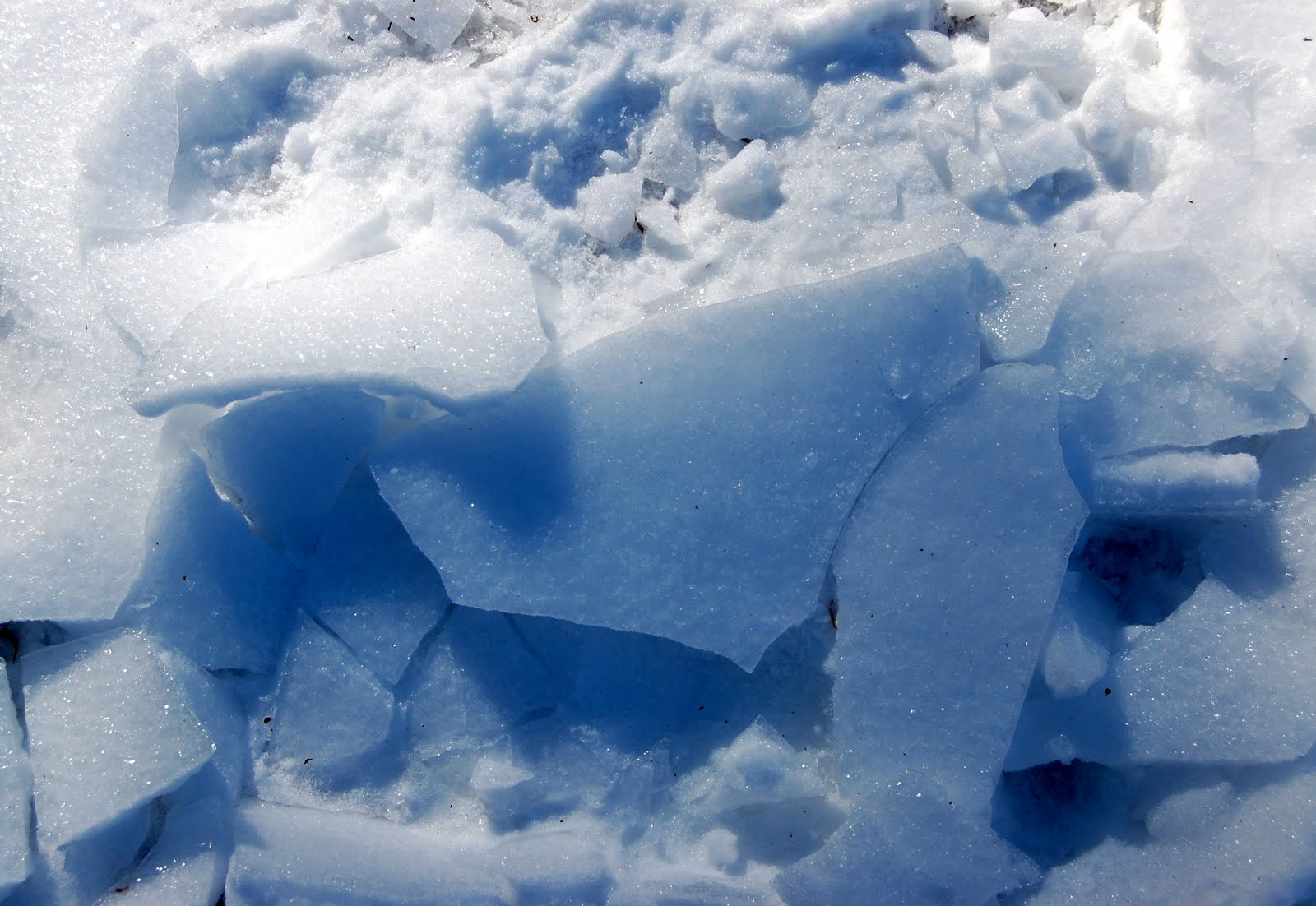


We just walked a few hundred yards to the monument and turned back.


The snow looked very shiny, just like whipped cream with a heavy ice glaze on top. The footsteps made earlier in the soft snow were still there but even my husband in his big boots could not now pierce the surface of this snow.


I had never seen snow frosted with a glassy coating like this before. I tried to take photos to show this glossy effect – trees and shadows glistening on the snow. The Inuit people from the Arctic have at least 67 words to describe “snow.” I wished we had a dozen or so as this snow was not your plain everyday snow – certainly not in the Deep South.


This New Year snow gave us a week of beauty. The snow blanketing our landscape was enchanting and peaceful. For people who live with snow most of the winter this might not be such an event, but for us in Georgia, it was a fairy land.


TO THE NEW YEAR

With what stillness at last
you appear in the valley
your first sunlight reaching down
to touch the tips of a few
high leaves that do not stir
as though they had not noticed
and did not know you at all
then the voice of a dove calls
from far away in itself
to the hush of the morning

so this is the sound of you
here and now whether or not
anyone hears it this is
where we have come with our age
our knowledge such as it is
and our hopes such as they are
invisible before us
untouched and still possible

– W. S. Merwin, American Poet born in 1927
2010 United States Poet Laureate


Monday, January 10, 2011

Recollection: A Silver Spoon from Duke Visconti


The Holiday Season is over. It is time to put all the decorations, cards and presents away. Along the years I have received many presents from family and friends. I have also been given some from other persons. When I came to the USA I received a lovely china cup from the president of the first company where I worked in San Francisco. Years later, after having worked at several part-time positions while my daughters were little, I had my first full-time job at a small company in Atlanta. The majority owner and president was an Italian, Duke Visconti di Modrone. His company owned a dozen “plantations” (meaning large crop farms) in Georgia and Florida. Because I spoke Italian and French I was hired as Office Manager for the small staff. At the time I only knew the name “Visconti” from the well-known Italian director Luchino Visconti. Below is the poster from one of his movies.


“The Leopard” (Il Gattopardo) 1963 movie of Luchino Visconti di Modrone, Count of Lonate Pozzolo (1906-1976)

In the office I had seen a large illustrated book showing all the houses of the Viscontis, starting with one in the 1200s. I had not realized that the Viscontis were aristocrats of great lineage – they were an important Italian noble dynasty of the Middle Ages. Their history is long – the first well known Visconti was elected Pope Gregory the X (1271-1276.) Another descendant, Anna Visconti, was the mother of Pope Gregory the XIV (1590-91.) A cousin of this pope was a forefather of my employer, Duke Visconti di Modrone of Milan. From 1277 to 1500 the Visconti and Sforza families ruled the city of Milan in Italy. The biggest parts of the Gothic and Renaissance masterpieces were created during their rule.


Palace of the Marquesses Castelli, in Milan, Italy. This engraving shows Palazzo Visconti di Modrone in Milan, published around 1745.

This palace in Milan now houses the museum of modern art and the Duomo museum. The above information I had to find on my own as Duke Visconti was very self-effacing, kind and friendly. All the furniture in our office had been imported from Milan. My desk was made of dark wood and stainless steel in a very avant-garde style. The office was in a high rise building in the Buckhead area of Atlanta. I spoke Italian and French with the duke and other European aristocrats who visited him. It was a fun and enjoyable position. One Christmas he gave the ladies in our office (about 6 of us) a lovely marble photo frame. Another Christmas he gave me an antique silver spoon. We had a delicious catered Christmas luncheon with gourmet food – this was also the Duke’s birthday since he was born on December 25, 1927.


The silver spoon from Duke Uberto Visconti di Modrone, Marchese of Vimodrone with a later picture of him.

Later on I was surprised to be offered a position in a large corporation very close to my home. It was with a heavy heart that I gave up my work at the Duke’s company, but the Atlanta traffic was starting to be pretty heavy and it was more convenient to be closer to my home. His gift started me looking for other little silver spoons at flea markets and antique stores and I found several.


Click on picture to enlarge

Over the years, what started as a Christmas gift became a small collection. I have even added some sugar spoons to my collection as shown below


and just last week-end at the Atlanta Scott flea market, I found a jelly spoon, as shown below.


These spoons are an elegant addition to a cup of tea or with a book from the same era.


Click on collage to enlarge, then click on each picture to biggify

Looking for a history on these teaspoons I came upon a blog called “The Five O’Clock teaspoon” where the introduction says “Distinguished from the average teaspoon by its diminutive size, the five o'clock teaspoon was a requisite accoutrement for the afternoon tea ritual that became popular in Britain and America in the second half of the 19th century.”


The Cup of Tea, by Mary Cassatt, American 1844-1926

It is always satisfying to drink a cup of tea in the garden


Afternoon Tea, by Richard Miller, American 1875-1943

or indoor when the weather is not so kind.


Afternoon Tea, by Richard T Moynan, Irish, 1856-1906

I’ll never forget the silver spoon given to me by Duke Visconti and I cherish it. Sadly I found out that the Duke passed away on December 29, 2001. His family donated several millions of dollars to St Joseph Hospital in Atlanta in his and his late wife's memory, the Duchess Antonella. The Visconti Center for Robotics houses multiple, minimally-invasive robotic technologies for cardiac, urology, thoracic, gynecologic and general surgery procedures. It is considered the most comprehensive program of robotic technologies in the Southeast, if not in the whole country.
In my next post I’ll show pictures of another lovely Christmas present I received many years ago.


Tea, by Mary Cassatt, American 1844-1926


o-o-o-o-o-o-o-o-o-o

Note: Several months after publishing the above post I received an email from Duke Visconti’s daughter, Chiara. I was very surprised and so thankful that she would take the time to send me a note. Below is the email –

Hello,

My husband came across your blog randomly yesterday and forwarded it to me.
I was very touched to hear the part about my father Uberto, and it makes me so proud to read years after his death lovely stories such as your own.
I just wanted to drop a line to say thank you, for keeping his memory alive in such a touching and sweet way, I greatly appreciated it.
He was a wonderful man and is very much missed.
Fond Regards,
Chiara


Tuesday, January 4, 2011

Merry Christmas … (again) and a Happy New Year


For most people, at least those who celebrate Christmas here, the holiday is over, but it is not over for a large number of people – the Eastern Orthodox Christians. They celebrate Christmas on the 6th and 7th of January.


Click on collage to enlarge, then click again on each picture

When one lives in a large city, where diversity is the rule, most holidays are known. In my county, Cobb County in Georgia USA, it is easy to forget that not all people are alike, that there are people who follow different faiths – or have no faith. It is taken for granted that everyone worship more or less in the same manner. Where are those Eastern Orthodox Christians? Here in the US and also in Russia, Ethiopia, Eritrea, Egypt, Ukraine, Greece, Serbia, Romania, Bulgaria, Cyprus, Albania, Belarus, Macedonia, the Czech Republic, Armenia and Armenians in the Diaspora and a large percentage of people in other countries like Poland, Kazakhstan and many others – between 225 to 300 million people. For them Christmas is not over yet, so let’s wish them a Merry Christmas.


My father was an Armenian Eastern Orthodox. He was born and raised in Istanbul Turkey in this faith. When he immigrated to France and married my mother he kept his faith and went to the Armenian Church in Paris, the Cathedral Saint Jean Baptiste, rue Jean Goujon. But he did not force his views on my mother who was brought up in a secular home. My father would bring us Armenian delicacies bought in an Armenia gourmet specialty shop in Paris, like “sujukh” and “basturma.” If you would like to look at some more delectable Armenian cuisine please take a look at my Armenian friend’s blog “Notes from Hairenik” and his post “A Moveable Feast” here.
My post, here, is to the memory of my father (Je n’ai pas oublié – I have not forgotten.)


Don't forget to click to enlarge

So why do they celebrate this holiday in January? It is a long story but in short they follow the Julian calendar which is days behind our modern Gregorian calendar. Christmas was actually celebrated by all Christians on the 6th of January from the 1st till the 4th century. However Pope Julius I, a Roman Catholic, deliberately chose December 25th to absorb and Christianize the Yule celebration and override Saturnalia, a pagan feast dedicated to the birth of the Sun - both of these were celebrated on December 25. Emperor Constantine agreed and decreed that the 25th of December was now the official Christmas date so as to bring religious unity to the Holy Roman Empire. The Eastern Orthodox Christians elected not to follow the Roman Catholic Church decision and kept the traditional date till now.


While I was reading up on all this I found out that Ireland also celebrates what they call “Little Christmas” (called Nollaig Bheag in Irish) on January 6th. They celebrate it as the historical date for Christmas. Another area still holding on to their Old Christmas traditions, are the people of the Outer Banks region of North Carolina in the US. When the Catholic European countries adopted the Gregorian calendar in 1582, Protestant Europe took 200 years to agree. In 1752 the people in the colony of North Carolina did not hear about this for quite a while, then resisted the new date, but now still celebrate both dates. They call the 6th of January “Old Christmas.” Some people, who are aware of all this history and respectful of other Christian beliefs, keep their decorations up until the 7th of January in tribute to the original date and to the Eastern Orthodox Christians.

Vintage Russian Christmas postcard


In France on the 6th of January they eat a cake called “Galette des Rois” (it is called “King’s cake” in New Orleans.) The tradition is that inside each galette is a fève (literally means “bean”) which nowadays is a tiny trinket. Whoever gets the fève is the King (if a man) then he places the fève in the glass of his chosen Queen (or vice versa.)


French Galette des Rois


Actually this is also an ancient Roman custom. Saturnalia was ruled by a mock king, chosen by a bean ballot. This mock king called “The Bean King,” usually a servant or slave, became the master and social rank was turned upside down. Eventually this celebration was linked to the Twelfth Night and Epiphany by the Church. So many other traditions come from these Romans times. I Googled “pagans origins of Christmas” and received 187,000 answers, with the query “origin of Christmas” I received 11 million answers and with “history of Christmas” 367 million answers!


The Bean King by Jacob Jordaens, Belgian, 1593-1678
I also found out that some conservative Christians groups, like the Jehovah’s Witnesses, don’t celebrate Christmas. They feel that Christmas is a pagan practice-cross over. Then others feel that religion is not evident enough in Christmas. It is a fascinating subject with different viewpoints. I am not sure how it will progress in the future but I saw a very thought provoking lecture by Eric Kaufmann, a writer and teacher of sociology. His forthcoming book is called “Shall the Religious Inherit the Earth?” His answer is “yes” because of changing demography, here and in other countries, religious fundamentalism is on the increase. A 2 minutes video of Eric Kaufmann from his talk in Australia can be seen here.


But this is not a religious post, this is to wish a Merry Christmas to people who celebrate it on the 6th or 7th of January. I'll continue reading on the subject and by next Christmas I’ll have a more historical post on it. So I’m starting to read …


Poet’s Window by Piotr Konchalovsky, Russian, 1876-1956

I’ll end by also wishing everyone much happiness for the New Year (une Bonne et Heureuse Année.)


I join Mr. Nô and the Enfantastiques to wish y’all a HAPPY NEW YEAR 2011 full of hope, enthusiasm, solidarity and joy.


French children choir directed by Jean Nô


Here are some of the verses they sing in French that I translated

Bonne et Heureuse Année (Good and Happy New Year)

Quatre saisons pour aimer la vie (four seasons to love life….) …

l’heure de résolution vient de sonner (the hour for resolution has come..)

et sourtout n’oublions pas de donner… (and above all let’s not forget to give)

et le meilleur qu’on puisse imaginer …(and the best one can imagine)

pour que se réalisent en triomphant tout simplement nos rêves d’enfants (that all our children's dreams come true.)