
After the Farmers’ Market and the marina (see my post from last week) my daughter Céline took us to the Japanese Garden nearby. First we drove into the large parking lot on the campus of California State University Long Beach. On the side was a door which looked oriental.
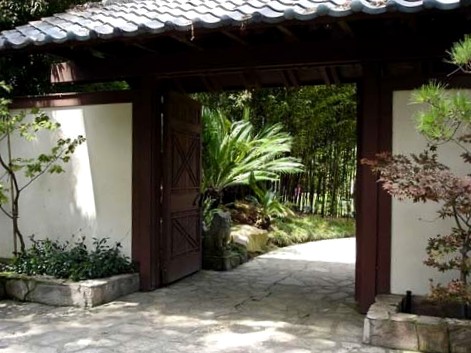
The Japanese garden in Long Beach is small, 1.3 acres (5,000 m²) cozy and beautifully maintained. It is called the Earl Burns Miller Japanese Garden and was dedicated in 1981. Mr. Miller was the late husband of Ms. Loraine Miller Collins who gave most of the funds to establish this garden in his memory. The landscape master plan architect, Ed Lovell, traveled to Japan and was inspired by the Imperial Gardens in Tokyo. At the dedication in 1981 Mr Lovell said : “The garden will mellow in about 30 years. What we are doing is creating something of beauty and value for people we will perhaps never meet." I am very pleased to be able to visit his creation almost 30 years hence and see the beautiful results. It was high noon when we visited, a bright sunny day, so my pictures are a bit washed-out unfortunately.

Just like Lullwater Park on Emory University campus in Atlanta (see post here) the Earl Burns Miller Japanese garden at Cal State Long Beach campus is an environmental gem – a hidden treasure. Founder Loraine Miller Collins contemplated: "I have a dream for this garden. When a person is tired, or anxious, or in a quest of beauty, may they enter and come forth refreshed to meet the problems of the day. There will be music of the wind through the pines, music from the waterfalls and the birds. There will be serenity as you walk around the lake, and joy, I hope, in the beauty of the reflections in that lake… There will be strength and solidity in the rocks and the wooden bridges. And, of course, there will be bamboo, a favorite wood of the Japanese because it is so useful and beautiful. There is an old proverb that says, 'Bamboo bends but never breaks.' It is my hope that as you leave your tour of the garden, you will find in your heart that proverb, and the day will be filled with joy."
 Click on pictures to enlarge them
That sunny Sunday, Father’s Day, many families were at the garden. Children were gathering at the large Koi pond after having purchased fish feed for a quarter at the vending machine. The hungry Koi came almost out of the water to get the food.

The multi-colored koi, some very large specimens, were close to the bank. These are Japanese carp, an ornamental domesticated variety ("koi" is the Japanese word for carp. )


For this post I read up on the history of Japanese Gardens and was astounded by the wealth of information. The history of Japanese gardens goes back to the 7th century. It was in the 15th century that the traditional Japanese gardens were molded to the philosophy of Zen Buddhism. The gardens can be called Japanese or Zen gardens. The style is almost austere but always aesthetic and showing a reverence for nature. Zen gardens were primarily used by Buddhist monks within their temples and have many symbols inspired by nature; they include the natural elements of stone, water and plants. The gardens also include the dry Zen garden, a stroll garden, a courtyard garden and a Japanese tea garden.

The pond represents the sea, river, lake or pond in nature. The passage of the water from the waterfall to the pond is the symbol for human life – birth, growth and death.

This garden has fountains, lanterns, waterfalls, zigzag walks, a tea house, rocks, a moon bridge and beautiful flowers. This Japanese garden is a work of art, and because of the ephemeral nature of a garden, it changes – as the seasons come and go flowers and plants grow and die, water levels vary, rocks are added or moved.
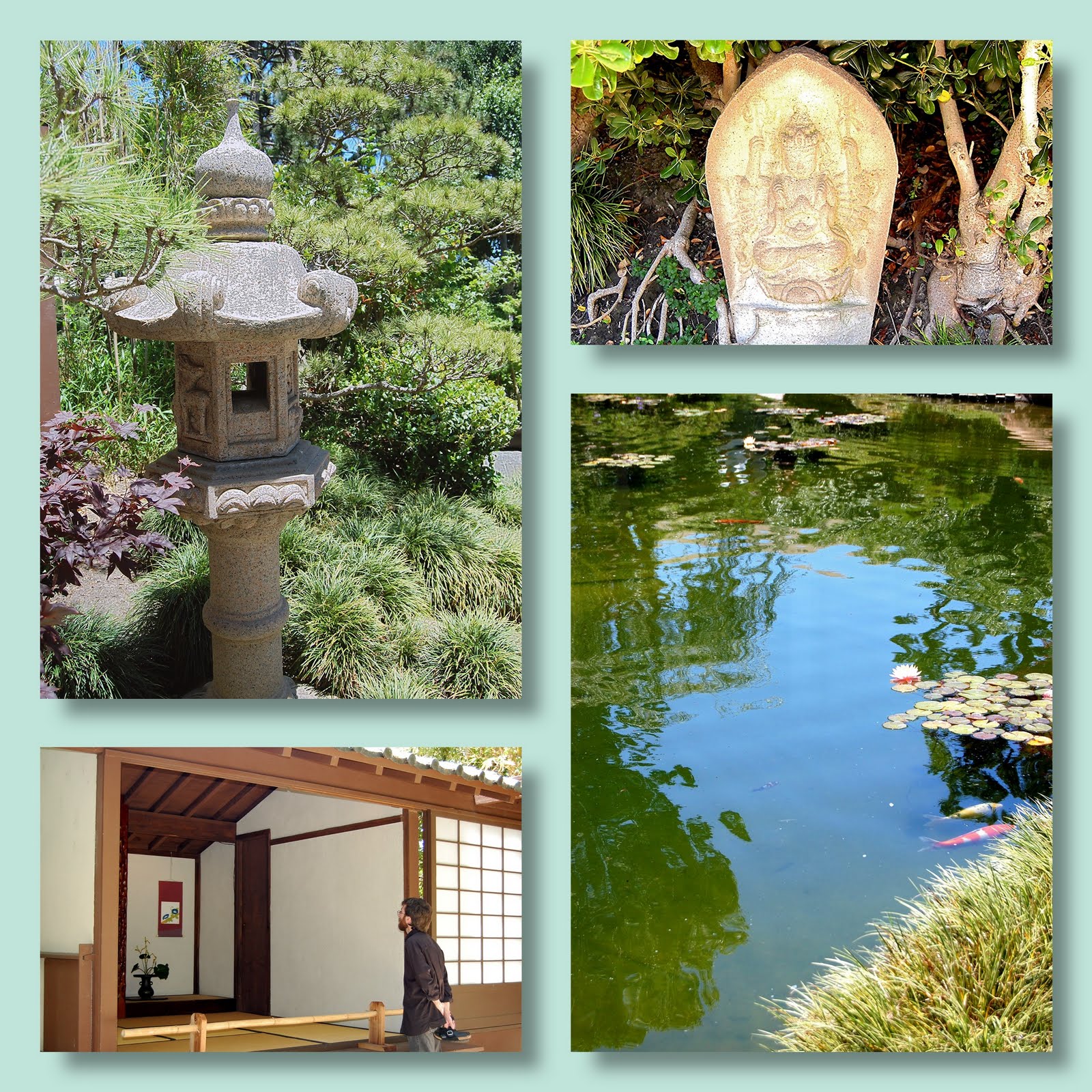 Click on the pictures to enlarge them, then click again to bigify
It was a delight to walk in this gorgeous garden. A small path leads to a bunch of hidden hydrangeas.


Then I decided to go toward the arched bridge but someone was snapping the picture of a very pregnant lady. I waited and they moved to an adjacent bench. But then the lady proceeded to unsnap her blouse showing her large stomach for everyone to see. I was a bit shocked by this in such a serene surrounding and did not feel it was the proper place to disrobe like that. I am not a prude but still, this is quite nonchalant. It could be that I have been reading too many books from the 1800s where proper behavior was de rigueur. Below are the books I just read -

Celia Thaxter (1835-1894) was a very popular writer in the latter part of the 1800s. She lived mostly on the Isles of Shoals, bordering the coast of Maine and New Hampshire. The poet John Greenleaf Whittier visited her often as well as the American painter Childe Hassam (1859-1935.) Her book “An Island Garden” (the green book in my picture) was very successful. It was illustrated by Childe Hassam – here is a page from my book

Childe Hassam was born Frederick Hassam in Dorchester Massachusetts. He embraced the Impressionist movement and was a leader of American Impressionist painting. He came every year to the Isles of Shoals and painted the same vista on his canvas, in front of a mass of poppies.

In the spring Celia planted a large variety of flowers – you can see their names here. I enjoy reading about all these flowers because I do not have the opportunity to plant them in my garden. Actually it is not a garden, maybe a yard, or rather a bit of land. It is almost an acre of trees and very little sun for flowers.

However we have planted herbs, like basil and rosemary, in planters on the back porch, and colorful petunias. We also have a large fig tree which grows all around the roof in front of the house – wherever it can find some sun. It usually gives us a dozen huge figs – pear size – in late June, then the rest of the figs can be harvested later in the summer.

But I am digressing. To return to the Japanese garden, I did take a picture of the arched bridge, partially at least, behind the lantern.

In a garden like this, it is easy for one’s thoughts to vagabond. So I remembered that Claude Monet, the French Impressionist painter (1840-1926) was in Amsterdam in 1871 (trying to escape the Prussian siege of Paris) and purchased some food in a shop where they used Japanese prints as wrapping paper. He purchased the print right away. He went on to collect 231 Japanese prints, which influenced his work and changed his life and painting as it was known until then. Monet was fascinated by Japan and its art and shared the Japanese’ love of nature. When Monet bought his house in Giverny, he built a Japanese garden complete with a pond and an arched bridge. So fascinated was he by the constant change in the reflection of the light in his garden that he painted 272 canvasses of his garden – many of them of the arched Japanese bridge. He would paint twelve works from one single vantage point – his blue-green bridge and the pond.
No one can see their reflection in running water.
It is only in still water that we can see. - Taoist proverb

It is only in still water that we can see. - Taoist proverb

Monet wished to paint not just the bridge, or the water lilies, but the light on them. He wanted to capture the changing light, the impression of that moment. Japanese gardens change constantly according to the seasons. As trees and plants mature the light hitting the pond is ever changing. The gardens are paintings too, but alive.

 Postcard of San Francisco Japanese Tea Garden in Golden Gate Park.
On the web I found several types of Japanese gardens and they always incorporate the same elements.


Before talking about the beach, I’d like to wish you all a Happy Independence Day since the 4th of July is near. I found a short version clip on YouTube of a French choir in Paris singing the Star Spangled Banner, the American Anthem, for Flag Day. I think it is also à propos and include it below for your pleasure.
Below is a vintage postcard dated 1908 from my collection that I send virtually to all of you.

53 comments:
I don't think I've seen gardens quite like these before. Also, I love gardens that have ponds, especially on sunny days like these when the light make the colours of the water so much brighter, making the leaves glow and the water sparkle.
You always seem to take pictures on such beautiful days, Vagabonde! Always a pleasure... And that's again for your support during my yucky body periods.
What a beautiful post, as usual, VB! I love Japanese gardens, and Zen gardens, so the information about them was very interesting to me. But I love, just love the pictures of the water lilies, the group with the pink hydrangeas in the lower corner especially, and I have never before seen the entire plant like you show in one of them. I had to study it to make sure I knew what I was seeing.
Your posts are always so filled with treasures to enjoy. Thank you for sharing the garden with me!
Quel merveilleux jardin japonais.
avec mon petit bassin, ma petite cascade, mes trois Koïs et mes 10 poissons rouges, j'ai bonne mine !
Ce que j'aime ce sont les lanternes japonaise. ici on en trouve de pas belles.
Tes posts sont toujours magnifiquement illustrés.
Ta vielle carte postale est très chouette.
HAPPY INDEPENDANCE DAY !
Bises !
Beautiful!
There are Japanese gardens here, at Royal Roads, and I like to stroll here on a weekday when there are no tourists. It's then that I understand the real worth of such a garden.
We visited some beautiful gardens in Kyoto when we were there in October - the word 'serenity' just comes close to describing the atmosphere.
*** Bonjour Vagabonde ! :o)
J'adore les jardins japonais et chez toi aujourd'hui je suis ravie ! :o)
C'est extrêmement beau et parfaitement détaillé ! MERCI BEAUCOUP et GROSSES BISES ! :o) ***
What a lovely and informative post! I appreciate
my little zen garden down the street even more now. Since it is so close, I will have to take more walks there to contemplate my future. You have inspired me.
Amazing photos in your post. And those gold fish are just so cool. I love the way the Japanese gardens are so carefully laid out. When looking at the works of Monet I wondered, do you know that the bridge in Waterlillys is located in Sandvika Norway just outside of Oslo?? Its true, that is the bridge he used to model, and you can see it yourself at OsloBG if you like. Even though it was in Japanese style he was in Norway in 1895 to paint it among other local motifs.
You shared a delightful find in Long Beach. I didn't realize this garden existed; I shall visit it next time I'm down in California. Enjoy your stay and the weekend.
Maybe I am still low down on the learning curve of taste but I have never really taken to Japanese gardens. Though I can appreciate the care, the work, the artistry, they don't work, somehow, on my soul. They remind me of a cold and an alien world, a world of cold china dolls rather than warm and cuddly teddy bears. Still I can appreciate the loveliness of your blogs, Vagabonde and the beauty of your photographs and the museum mystery of your postcards that bring greetings down the centuries.
I remember that I once, long ago, read a book called Garden of Enlightenment, about Zen gardens and satori and all that Japanese culture going along with it. I also learned Judo at the time and tried to pick up some Japanese and the spirit of judo and zen. So this garden brought back memories for me!
I loved your comment on my blog, as usual, Vagabonde, and will answer you separately on that! So so true what you say! I absolutely agree! Must find a little time first, but this is worth discussing! Cheers to you from Angela
hee hee...
«Louis» likes the way you incorporated the French singing the national anthem into this interesting post!
I love figs but I've never in my life seen one that looks like that.
Enjoyed all the garden pictures. It's a beautiful place.
What a treasure of a garden. I'm sure you left there refreshed in spirit.
That was such an enjoyable trip through the gardens - many thanks - lovely post.
Magique ce jardin!!
Je n'ai jamais visité de jardin japonais,dommage qu'il soit si loin, mais grâce à toi, je peux le connaitre!
Tes figues sont impressionnantes !
Bisous Laurence
Vagabonde - thank you so much for your explanation of why the aircraft manufacturers cam to California. I do find these things fascinating.
Thanks again.
That video could go a long way to healing Franco-American relations. :)
Not that I have issues, Francophile that I am.
It's true that no matter how simple a Zen garden is, it will be well tended. Like your posts. :)
You ever consider writing tour books?
You'd do a bang up job of it. : j
If I had another lifetime I would make a Japanese garden. To my mind nothing is more calming and
uplifting to mind and heart and soul.
Such a beautiful garden that is truly stunning! And I loved seeing your herb garden and figs, too! As always, your photos are magnificent and are a real feast for the eyes! Merci beaucoup for the fabulous tour, cher!
What beautiful posts! I am enthralled by your descriptions. Huntington Beach is one town south of Long Beach and my family goes there quite a lot. So, my mouth watered at the sight of such wonderful produce. I could just taste it. How lazy I am - I never did any research on the area and am amazed to hear oil was discovered there. I love the octopus balloon. And Frederick??? That was a pretty long pier to come and go without notice....
These Japanese gardens are so tranquil and inviting. I love the picture of the water flowing over the rocks. It's almost stop action. And the moss growing close by the water. We were both lucky to experience the Zen of gardening this year. What a gorgeous place.
Celi Thatcher's book has striking art deco (art nouveau?) cover. Old books are so elegant and comfortable to hand. They are a joy. I can imagine you curled up with one of them daydreaming! Your garden is lovely and cooling. It's been 110 degrees + here for a while - so that is a nice sight.
I believe all Japanese gardens look very much alike. Your beautiful photos of the Japanese garden you visited reminded me of my recent visit to a Japanese garden in northern California. I posted a movie of my visit and perhaps you can visit it for comparison.
I was really impressed with your photo of the waterfall. I would like to know what lens you used because I would love to have one that captures the flow of the water with such clarity.
This Garden is so very BEAUTIFUL! You certainly gave us a rich variety of pictures as well as History. There is a Japanese Garden at The Huntington in Pasadena....Next time you come to Southern California, you might want to go see that one. It is quite beautiful, too.
Sad that Musso's was closed when you went there. Indeed, they are closed Sundays and Mondays....a shock in a way about Mondays, but it has been that way for as long as I can remember....
There is always next time....lol!
LOVE that Vintage Post Card, by the way.
Chère Vagabonde,
What is so different about your posts is the lengthy attention you give to your subjects. Not just a few photos and a little bit of text, but a thoughtful and informative picture essay for all these wonderful places you go.
Japanese gardens are wonderful places - without equal in their ability to create serenity and calmness, I think. When I lived on the western outskirts of Paris years ago, we used to go to Giverny and I love it (although one of my most abiding memories of the place was my then 2-year-old daughter throwing a horrendous temper tantrum that must have disturbed everybody visiting there).
Your own garden looks lovely too, and I am amazed by the size of your figs. They grow everywhere here in the south (of France) of course, but I've never seen anything half as big here.
Now that I'm back here, I have more time to read and comment, so will look forward to being with you more!
So wonderful. I imagine the Garden of Eden exactly like that! Ciao. A.
Dear Vagabonde, What a wonderful post you have given us. I am so fond of Monet, I remember buying a book for my daughter : "Monet's garden", she used to read it over and over when she was a child, a few years ago she had the pleasure of visiting the actual garden.
And about your back yard: I think it is just lovely, not bad at all, and that fig is amazing, never saw such a huge one.
Thanks again!
Loveable_homebody and DJan – thank you friends – you always leave such beautiful comments. That means a lot to me.
Claude – alors tu as une pièce d’eau avec des poisons? Même s’il est petit ton endroit Japonais, cela m’impressione. J’ai vu tes fleurs et ton jardin à l’air très beau. Merci pour ta carte de Paris que j’ai bien reçue.
Pondside – you visited Kyoto? I only went to Tokyo for a couple of days and would have love to visit some more. I am sure the gardens in Kyoto must have been outstanding. Thanks for the comment.
Merci Nancy pour ton petit mot – cela me fait toujours plaisir de te lire. Profites de Dakar jusqu’à la limite!
linvininlb – thanks sweetie for your comment. I would not have been able to write about the Japanese Garden if you had not brought us there. It was lovely.
RennyBA’s – This was something I did not know and had not read during my research – that is, that Monet’s waterlillies bridge was Norwegian. I’d love to look at it when I am in Oslo, or at least see a picture or postcard of it. Thanks for the comment.
Lakeviewer – do visit the Japanese Garden when you are in Long Beach next and also the Japanese Garden in Pasadena mentioned by the Lady from the Hills in her comment. Thanks for stopping by.
Fennie – thank you for your honest comment. There are so many different gardens – some for every taste. We also went to a botanic garden which is quite different. I’ll do a post on that soon. I enjoyed reading your comment.
Angela – thanks for popping in. You know you brought back memories to me too. I took judo in France – I went to become a brown belt. I’ll go back to visit your blog soon.
Louis – merci du compliment – mais je n’aurai pas pu incorporer l’anthème national Américain si je ne l’avais pas vu d’abord dans San Francisco Bay Daily Photo! Merci encore.
Dot, Elaine and Spiny Marshmallow – thank you for coming and visiting the garden and taking the time to write a comment.
merci, Vagabonde!
beautiful japanese gardens! but I also love your woods!
I did not know that is how Monet discovered japanese prints!
Warm greetings to you from Plouha, Bretagne!! the emerald coast is incredibly inspiring, I see why artists came here! (I love the artists you feature.) happy juillet to you!!
*** Hello Vagabonde !!! :o) J'ai des soucis d'ordinateur en ce moment mais je viens te faire un coucou grâce à l'ordi que mon fils me prête un peu. MERCI A TOI pour ton message chez moi et GROS BISOUS venus tout droit des tropiques ! :o) ***
Vagabonde, I really appreciate all the time and effort you put into your blog posts. I enjoy history and learning more about an area I visit and this post was so interesting.
There is a beautiful Japanese Hill and Pond Garden as part of the Brooklyn Botanic Garden where I live, and it is one of the oldest and most visited Japanese-inspired gardens outside Japan. It is almost 100 years old! I have done many blog posts about the Brooklyn Botanic Garden and one about the Japanese Garden.
I was also excited to see your information about Celia Thaxter. I youred the Isles of Shoals by boat many years ago and saw her beautiful Appledore Island.
I became one of your followers and added you to my favorite blogs list.
Thank you for writng such an enjoyable blog!
PS: Yes, I make all my photo collages with Picasa. I find it very user freindly.
Ruth, Friko, Linda, Marguerite, OldLady of the Hills, Lunarossa and Pamela - I am happy you enjoyed reading this post. I appreciate your stopping by, I will return the visit.
Lorilaire – D’habitude il n’y a que la première douzaine de figues qui sont si grosses, le reste sont normales. Merci pour la visite.
Alesa Warcan – No I never considered writing tour books. Writing is difficult for me, or rather it is slow going. Thanks for the compliment.
Darlene – I have a Nikon D40 which I used to take most of my photos. It also came with a telephoto lens but I never use it as I don’t like it. Rather than buying extra lenses I have several cameras. For the waterfall I used my Sony DSC-HX1 Cyber-Shot, it has a good photo lens. For my pics behind glass, food, under water, etc. I use my little Olympus Stylus 830 as it takes very good pictures. I also just bought a Canon Power Shot SD980 IS because it is supposed to be good for closed-ups, but I have not used it yet. In a blog I’ll use a variety of shots from the various cameras – I also scan photos that I took with my old Olympus 8 mm film camera. Thanks for the comment.
Deborah – I have not been to Giverny yet, but I hope I’ll get there someday. My figs are only this size at first – the first dozen, then the rest are the normal size. This first flush of large figs has just happened in the last 3 years, and I don’t know why. Thanks for your kind words.
Bowsprite – I have never heard of Plouha. I looked it up on the map and see that it is located in an interesting area of Brittany. I hope you’ll take many pictures to show us on your blog. Thanks for the visit.
Pat of Mille Fiori Favoriti - Thanks for your kind comments. I went to your blog to write a note.
Thank you for the information. I am copying it for future reference. You do take magnifique pics.
Lovely blog. My parents were keen on Japanese gardens and had several books on the subject which I used to read and look at avidly. One day I hope to visit Japan and see the mountains, the temples, the gardens and the blossom. One day I must blog about when we gave a Japanese boy a lift in Scandinavia: very interesting!
Hello, thanks for this great post and wonderful photos. You have an artistic eye, my friend. I really appreciate you coming to my blog too. I'm flattered that you would take the time. Loved your comments and tips on the Welsh Rarebit, i.e., bacon and pale ale, great stuff. I'll be back, I;'m followoing.. thanks, Keri, a.k.a Sam
And to think I was in France over the 4th of July, Vagabonde! It was so wonderful to be in YOUR country and to hopefully see it through your eyes. My next posts will try to do it justice. And it's almost in our backyard here in Holland!
You do know how to weave a post. Thank you, again and again.
There is such rich beauty in this post. I adore all things Japanese, including gardens, and you have so beautifully captured this one. I also loved the texts you shared.
But then I fell in to the max when you spoke of my favorite, Monet, which of course reminded me of my visit to Giverny. You mention the Japanese prints (I found one at Vanves, probably paid too much -- but less than if Tara (Paris Parfait) hadn't helped bargain) and loved it enough that it really didn't matter! My favorite room in Monet's home (though a close tie with the kitchen) was his dining room, which as you no doubt know had an enormous collection of Japanese woodblock prints. Well, not just the dining room, but the blues looked so good with the yellows!
Post a Comment