


Marquis de Lafayette leading American Troops (courtesy Library of Congress)
As written in Wikipedia "French money, munition, soldiers and naval forces proved essential to America's victory over the Crown, but France gained little except large debts. French aid proved vital in the victory of the Americans seeking independence from Britain. However the high debt France accumulated was a major cause of the French Revolution in 1789." Below is a painting by John Trumbull (American, 1753-1843) (who was present at the battle) showing the surrender of the British at Yorktown, Virginia on October 19,1781, with American and French troops on both sides. This battle ended the Revolutionary War.

Without French help I understand that the Patriots rebels and George Washington would have been defeated. I read that even though Americans think that the War of Independence was a revolution, it mostly was a civil war because American Loyalists or "Tories" opposed the war and fought against the American rebel Patriots. Within the 13 American colonies there were at least 500,000 Loyalists or more (up to 30% of the population then.) The Patriots were mostly farmers without military knowledge, equipment and weapons. In all probality, without France's support and financing, the colonies would have remained British, like Ireland or maybe Canada. But would have this been bad? Look at Canada - it is a great and free country with better healthcare, a life expectancy of 82.5 years (US is below Slovenia at 79.8) more openness to immigration and diversity. The people of France gave the Statue of Liberty to the USA "Liberty Enlightening the World" in 1886 as a gift in celebration of the 100th anniversary of America's Independence.

Is the poem on the Statue of Liberty still relevant today?

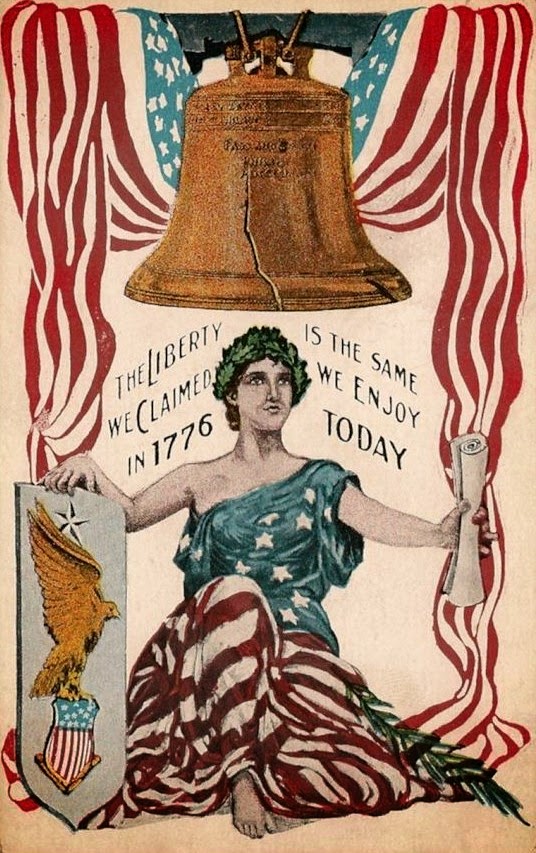
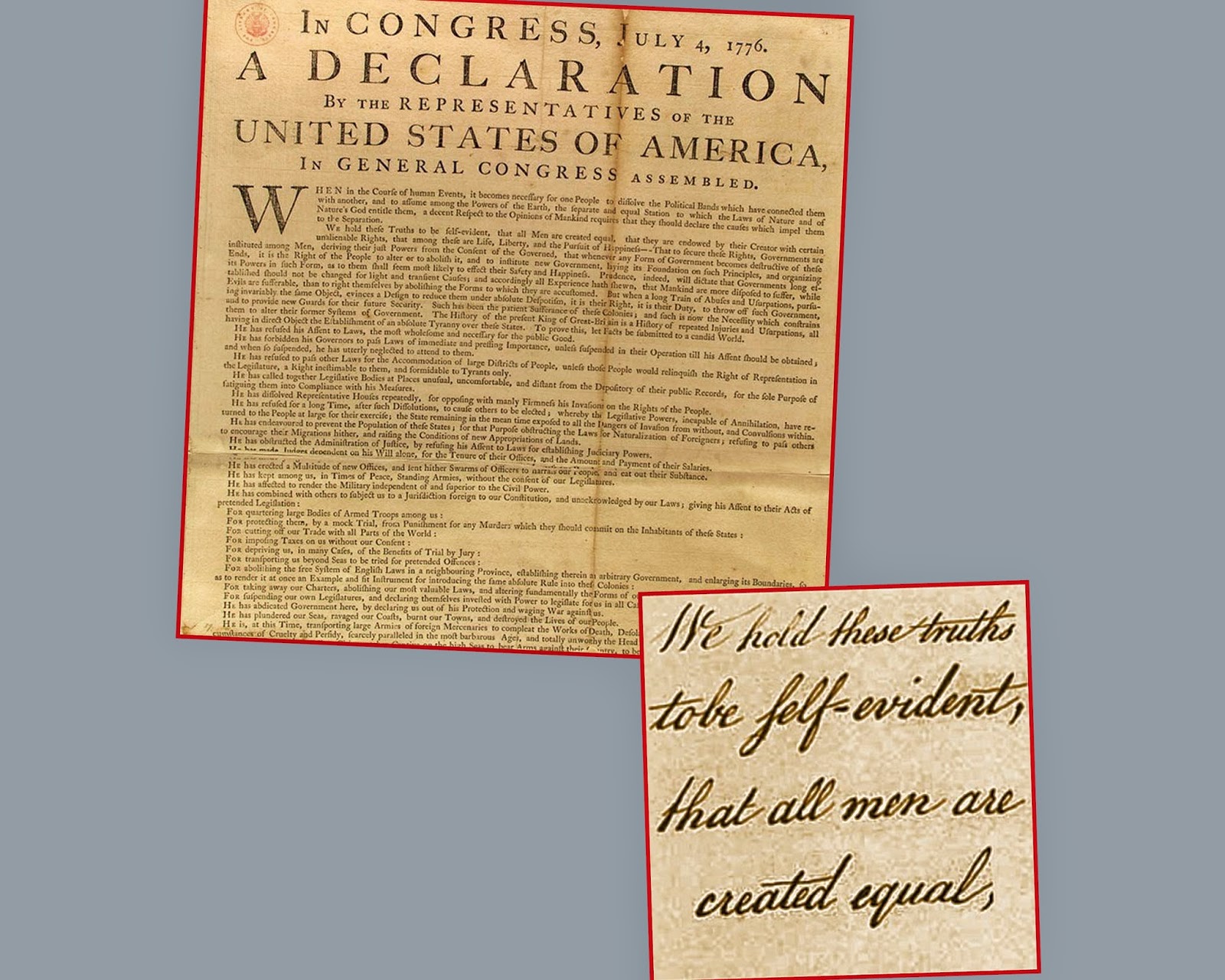
The postcard below says "The Liberty we claim in 1776 is the same we enjoy today." Well, not quite. In 1776 women could not even vote, and let's not mention slavery ...
At least the Civil Rights Act, enacted on July 2, 1964 - 50 years ago - outlawed discrimination based on race, color, religion, sex or national origins. So are we all free now in the USA, free to enjoy all the benefits of citizenship? almost, but not yet. Franklin Roosevelt said "True individual freedom cannot exist without economic security." Look at the chart below, dated 2010 (in 2014 wealth inequality is getting even worse.)

"Freedom from want" - twenty percent of US children live in poverty - and almost 50% of black children (among industrialized countries only Romania has a higher poverty rate.) For every $100 a white family has, a black family has $2. For every $100 a single white woman has, a single black or Hispanic woman has 25 cents. How about freedom to receive a free education in good public schools and affordable colleges? From 1982 to 2007 US median family income rose by 147% and college tuition and fees rose by 439%. For example tuition at the University of Chicago was $45,945 in 2013 and in Canada, tuition at the University of Winnipeg was $11,115. Most college tuitions in Canada are half as those of the USA. The minimum wage in the US is still $7.25 and hour and is trailing most industrialized countries (France minimum wage is $12.68 and Australia is $16.87.)

The vintage postcard above shows the US "Plege of Allegiance" as it was originally composed by Francis Bellamy in 1892. It was re-written during the McCarthy era to add the mention "one Nation under God." So what is "Freedom of Religion" ? It also requires freedom from religion. Nowadays US citizens can attend any church, synagogue, and mosque of their choice but what about citizens who are not religious and just follow other spiritual philosophies, or are agnostics or just atheists? The government should not endorse any religious doctrine over others or take sides or even pass laws based on religious doctrines (as per the recent Hobby Lobby decision where the Supreme Court voted in favor of a corporation freedom of religion to ban contraception for women (while leaving contraception for men - vasectomy) against the 21,000 Hobby Lobby employees' freedom of religion or freedom from religion.) In addition, the Universal Declaration of Human Rights, proclaimed in 1948, does not mention sexual orientation - gay rights do not stop religious freedom, because gay rights are human rights.
What about the "Right to Equal Justice" ? Just as the gap between rich and poor has widened, incarceration rate between blacks and whites has also widened. In 2010 the rate of incarceration for whites was 678 inmates per 100,000 versus 4,347 black men incarcerated per 100,000 (Bureau of Justice Statistics.) Black men are 6 times more likely to be incarcerated than white men and for many of the same violations. This starts in preschool, really, as black kids are punished more frequently and harshly for the same offenses as whites, as shown in the graph below. A Department of Education reports that "Black children represent 18 percent of preschool enrollment, but 42 percent of the preschool children suspended once, and 48 percent of the preschool children suspended more than once."

These are grim statistics for a 4th of July. I enjoy the celebration and I am proud that a French citizen, marquis de Lafayette, helped the US get its independence and freedom, but I would like it to be, in 2014, freedom and equal rights for all.

I feel that every US man and woman is part of this country and also part of the world. Any friend, neighbor or anyone of us is diminished when a man, a woman and/or a child is unable to enjoy the fruits of freedom and equal rights. We should be foot soldiers to retain the freedom - the liberty - achieved on July 4th, 1776, and truly let the Liberty Bell toll not just for some of us but for all citizens and humankind. Happy 4th of July!

18 comments:
C'etait vraiment tres interessant de lire cette partie de l'histoire americaine qui a trace son present et son avenir mais aussi tes pensees chere amie concernant la situation exiatante aux U.S.A Un post enrichissant, je souhaite un Heureux anniversaire et a bientot de te revoir sur blogland.
Amities, Olympia
I don't know what to say that you have not already said, in great detail and with so much of your usual thoroughness. I agree wholeheartedly with everything, and I applaud you for having put into words all that I have been thinking and feeling. I will be sending this you a few of my friends who will understand. Unfortunately, those who would not should receive it, too, but they are not likely to hear what you say here. Blessings to you, VB.
Thank you. A beautiful, thoughtful post. And no arguments here. Sadly those divisions still exist on the other side of the world too. And are getting larger rather than smaller. Which makes my heart hurt.
Vagabonde... Well written and documented as usual! Unfortunately, there are no easy answers to the ills or challenges that we face here in the USA. For every action there are several consequences...and some of them can be problematic. Canada is better at immigration but they don't have the illegal immigration issue that we do. They are very good at encouraging people to immigrate to Canada...people who have skills especially. France was indeed critical to US independence...but the USA was critical to France being freed from Nazi control too. I hope that you had a terrific 4th of July! Take Care, Big Daddy Dave
Vagabonde, you've written an excellent Fourth of July post, and I think that many of your readers will benefit. I know that I did.
It may amuse you to learn that my own Independence Day observation meant a somewhat shortened day at my workplace. Commerce is an important force in this country.
Love to you and yours. xo
Well said!
Some people are good at "forgetting" facts because they are ignorant, racist, opportunist, greedy… and heaven forbid they would acknowledge truth.
Welcome back Vagabonde! I have missed you.
je reviens! lire avec la traduction...
Vagabonde, mes compliments et admiration sur un des plus beaux messages de blog que j'ai jamais vu.
What a come back!
I need to reread everything more slowly.
You have such a gift to put everything together and present it to us.
Well spoke I applaud you for this detailed realistic humanistic piece of writing. There is a lot to be done and it seems indeed that the gap widens more and more. It is a world wide problem but like you did we all should talk about it and not just let it all happen.
Beautifully said and as always---with great heart and thoughtfulness. I'm with you 100%, my dear Vagabonde....It seems, some things never change---which is Heartbreaking......But with posts like yours, one is reminded of all that still is needed in terms of equality in our country.
I hope your 4th of July was a good one. It is wonderful to have you back blogging, my dear.
Je viens juste de voir ce billet si interessant, mais il est 1h25 et mes yeux ferment. Je repasserai lire en detail. J'espere que tu as passe un excellent 4th of July et suis contente de te revoir sur la blogosphere.
Bon Dimanche!
Marie-Anne
How nice to see a post from you again! As always, this post is thoroughly researched and flows very well. There's a good balance of hard-to-accept fact and celebration. Where did you live, when you lived near Philadelphia? We lived in a funny area - mailing address was Malvern, closest town was Phoenixville but everyone called our area Paoli. I loved it!
Good to see you back blogging. I just now read this and was struck how you and I both wrote in similar ways regarding July 4th and Independence Day.
I loved seeing the old postcards.
Welcome back ;o) Your posts are always filled with so much information! And, you always get my mind thinking too! I didn't know there was a poem on the Statue Of Liberty? And, I didn't realize our college tuitions are half of yours? That is a big difference!
Big Hugs ;o)
Welcome back, Vagabonde. you have been missed. And what a marvellous post you've written to mark your return. From this side of the Atlantic I've learned so much and applaud your clear-sighted writing as much as I enjoyed your wonderful old postcards. This post has been bookmarked to reread.
Hello Vagabonde !
Bon retour sur la toile. Désolée, je suis un peu en retard.
Très beau post en images et merci aussi pour l'histoire.
J'aime revoir le film "Revolution" avec Al Pacino.
Bises.
Post a Comment