Showing posts with label Russia. Show all posts

Saturday, March 25, 2023

Don Quixote at the Atlanta Ballet

In June or July 2022 I watched an interview with the dancer and choreographer Mikhail Baryshnikov on the TV show CBS Sunday Morning. The music from the short clip of him dancing sounded very familiar; I did not know from which ballet this was. For the next several weeks I tried to find out on the Internet where this short dance came from. Finally I found out that it was called the Basilio Variation from the Ballet Don Quixote. I really wished to see this ballet that I had never seen. I had attended ballet performances in Paris at the Opera Garnier, at the San Francisco Opera House, Odessa National Academic Opera and Ballet Theatre in Ukraine, and during my first stay in St. Petersburg, Russia, at the Mariinsky Ballet and Opera House, but never seen this ballet. It had been at least 5 years since I attended, with my late husband, the Moulin Rouge ballet in Atlanta, Georgia.
Then I researched for a while to find where this ballet might be performed within the next few months. I checked all the large cities ballets, such as New York, Los Angeles, San Francisco, Miami, Chicago and more. Then I checked Paris, London, Amsterdam, Zurich, Vienna and Venice - It had been performed there in previous years but not in the near future. I almost gave up and then checked Atlanta. Surprise! It was on the Atlanta Ballet season for 2023, in March. I could not believe that it was so close to home. I waited for tickets to be available and quickly bought one last November. Then my younger daughter told me they were all going to San Salvador for spring break and would fly back into Atlanta just a couple of days before the performance, so I was lucky to find two tickets next to me for my daughter and granddaughter for the Saturday March 18, 2023 matinee performance at the Atlanta Cobb Energy Performing Arts Centre, where ballets take place.
Now I had time to do my favorite thing - research the story, history of the ballet, the music, the artistic directors and choreographers, where and when it had been performed for the first time and more. I found some interesting facts. First of all, the Spanish epic novel Don Quixote was written by Miguel de Cervantes in two parts, in 1605 and 1615. It is considered the first modern novel and one of the greatest. It has been translated into 50+ languages and is the best-selling novel of all times (at least 500 million copies so far.) It has had a great influence on Western books, plays, movies and works of art since then. It offers universal truths, commentaries on social life and provides escapism. Below is Miguel de Cervantes (29 September 1547 - 22 April 1616.)
and some book covers of his novels in several languages; the bottom right one one is an e-book. (Click on collage to enlarge.)
Italy in the 17th and 18th centuries was the European country where one should travel to visit Roman ruins, or view statues, paintings and so forth. But starting in the 19th century, around 1820, travelers switched their interest to Spain. Writers like Victor Hugo, Alexandre Dumas and others thought that Spain offered more inspiration and adventures. French and Russian writers, painters, musicians, and choreographers were inspired by Spain. Europe as a whole shared a fascination for Spain.
Alexander III (1845-1894) Emperor of Russia, was a patron of the ballet, and requested a Spanish-themed ballet be shown in Russia. The imperial theatre commissioned Marius Petipa to mount and choreograph a work in the Spanish style. Below photo of Petipa.
I found the life of Marius Petipa fascinating. Victor Marius Alphonse Petipa was born in 1818 in Marseille, France. His father Jean Antoine Petipa was working as principal dancer and Maitre de Ballet in Marseille. Petipa's mother, Victorine Grasseau, was a drama actress playing tragic roles. His brother Lucien became a distinguished dancer and his sister, Victorine, a noted singer. They were a close-knit family. His father began teaching ballet to Marius when he was seven, and at the age of nine he made his stage debut in one of his father's ballets at the Theatre de la Monnaie in Brussels, Belgium. Marius was appointed to the Ballet of Nantes, France, as principal dancer then in Bordeaux. Below is the Petipa family, with Marius on the left, then his brother Lucien, his sister Victorine and mother Victorine.
In 1843 Marius started a 3-year working tour in Spain where he became master in Sevillian dances and castanets. He then began to choreograph his own ballets. He had already spent time in Paris where his brother Lucien was principal dancer at the Paris Opera. Lucien worked also in Russia and provided Marius with an invitation to travel to St. Petersburg, Russia, in 1847 to become principal dancer at the Imperial Ballet. A year later, in 1848, his father joined him there to be a teacher at the Imperial Ballet School (call the Vaganova Ballet Academy of Russian Ballet since 1957, and shown below.)
Marius Petipa signed a one-year contract in St. Petersburg but was to live there the rest of his life. Following his father's path as a ballet dancer he then had a career in choreography where he created more than 60 ballets, reworked 20 old pieces and re-arranged the dancing in over 35 operas. He also prepared galas and divertissements for court performances, royal nuptials, etc. The St. Petersburg's public adored the ballet and expected brilliant performances; news media reported every detail. Petipa had to keep the highest standards of excellence and perfection, and he did. Tsar Nicholas I attended Petipa's debut performance in October 1847 and a week later presented him with an Imperial gift of a ruby and diamond ring, the first Royal gift in Petipa's long career. The Russian Emperor's treasury (who at the time was the world's wealthiest person) - lavished millions of rubles a year on the Imperial Ballet and Opera, and demanded opulent ballets with perfect technique. Petipa became the Imperial Chief Ballet Master and principal choreographer until 1903 - at 85 years of age.
When Petipa in early 1869 was asked by an Imperial Special Commission to mount a Spanish-themed work he suggested that Ludwig Minkus write the music for the ballet he was considering, a tale from Cervantes' Don Quixote. I read on Minkus - he was also an interesting man. Ludwig Minkus was born on March 23, 1826, in Vienna (at the time the capital of the Austrian Empire.) Minkus' father was a wholesale wine merchant and owned in a district of Vienna a restaurant with its own orchestra. Ludwig started playing the violin at age four and made his public debut at a recital at the age of 8. Later he had an orchestra that competed with another Viennese conductor, the young Johann Strauss, II. In 1853 Ludwig immigrated to St. Petersburg to be the conductor of the orchestra for Prince Nikolai Yusupov. He went on to serve as conductor and principal violinist in the orchestra of the Moscow Imperial Bolshoi Theatre, and was then promoted to the prestigious position of Inspector of the Imperial Theatre Orchestras in Moscow. Below photo of Ludwig Minkus (1826-1917) taken between 1865-1870.
Minkus was an excellent choice to compose the music for the Don Quixote ballet. He was a connoisseur of ballet craft. His music bubbling like Champagne invited artists to dance. Petipa and Ludwig worked well together to create cheerful music and dances in the Spanish and Gypsy styles. Ludwig Fyodorovich Minkus (also known as Leon Minkus) became known as one of the greatest ballet composers who co-created with Petipa some of the most famous of classical ballets including La Source (1866, composed jointly with Leo Delibes,) Don Quixote (1869) and La Bayadere (1877.) Today, Minkus' ballet music is still quite popular and performed in the traditional classical ballet repertory. Cervantes' novel had been adapted into a ballet several times: in Austria in 1740, in Vienna in 1780, in 1809 in St. Petersburg, in 1839 in Berlin and in 1843 in Turin, Italy. For this new production Minkus reworked and expanded the score and supplied music filled with a great variety of Spanish-styled flair. The premiere of Don Quixote on 26th December 1869 for the ballet of the Imperial Bolshoi Theatre in Moscow was a resounding success. Below painting of the Imperial Bolshoi Theatre in 1939 by Alexandr Benois, Russian (1870-1960) followed by the current Bolshoi Theatre and interiors.
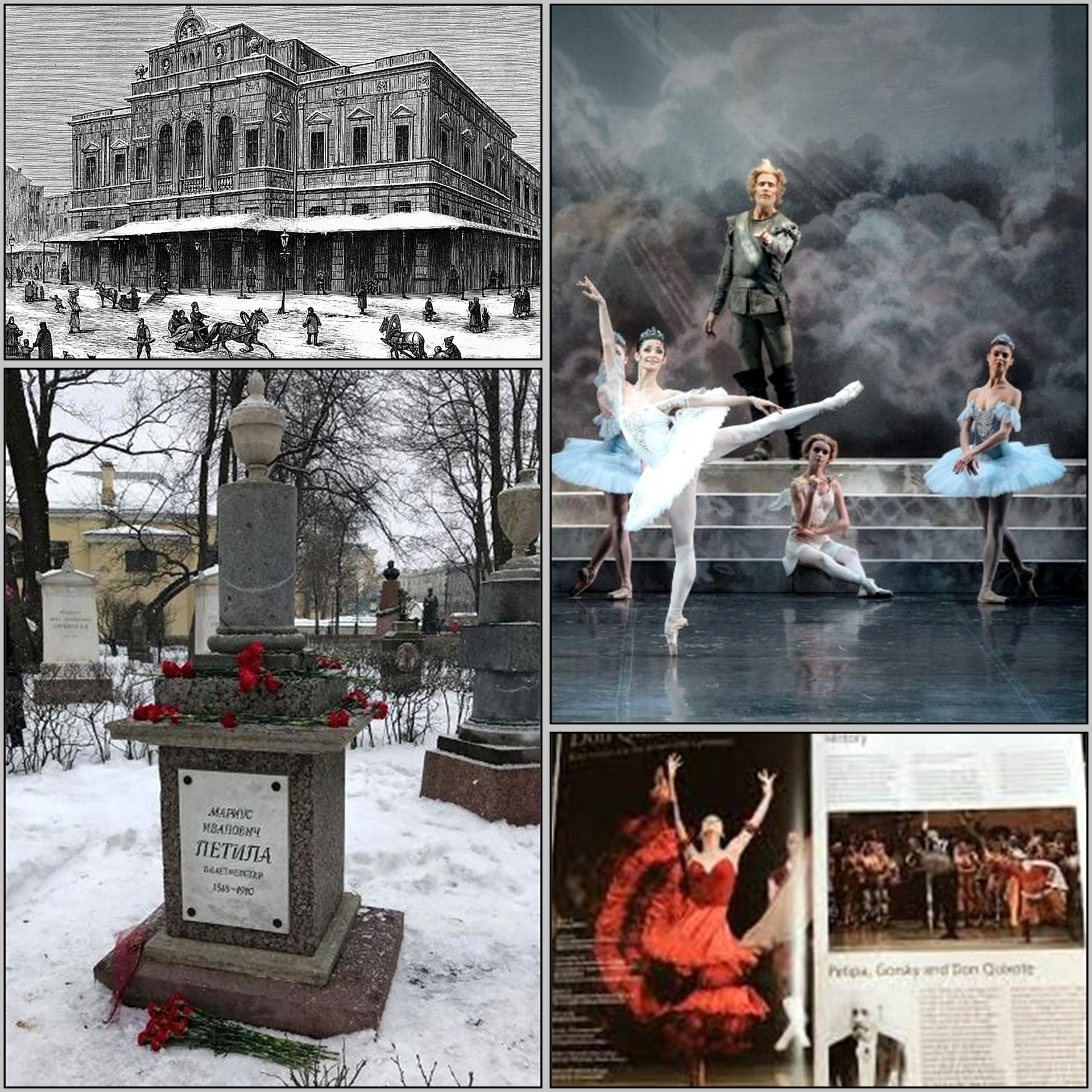
The Don Quixote Ballet was so successful that Petipa and Minkus wrote a revival libretto in 1871 which was shown at the St. Petersburg's Mariinsky Theatre and became a classic. It still enchants the public today and is presented in various productions by different companies all over the world. Petipa went on to create spectacular ballets such as Sleeping Beauty, Giselle, the Nut Cracker, and many others. Petipa married and had 3 children. At the age of 76 he received Russian citizenship while permitted to keep his French citizenship. A year later he worked with Peter Tchaikovsky to stage the ballet Swan Lake. He is a legend, a lord of the dance, and came to be known as "the father of Russian ballet." His work is in the repertoire of most current companies. He retired in 1903 and spent his final years in Crimea where he died on 14 July 1910 at the age of 92. He is buried in the Alexander Nevsky Monastery in St. Petersburg. Below photos of the Mariinsky Theatre circa 1859, Petipa's grave, the Don Quixote's Dream Scene at the Mariinsky and the playbill.
Don Quixote has been staged in many versions, with different music scores and choreography. In 1900 Alexander Gorsky staged a revival of the ballet with music from French composer Antoine Simon. A modern version in 1965 was created by American choreographer George Balanchine to the music of Nicolas Nabokov. In 1966 Rudolf Nureyev danced and choreographed the ballet for Vienna. In 1980 Mikhail Baryshnikov mounted his version of the ballet as well. I always loved watching Mikhail dancing (born in Latvia in 1948.) He truly is one of the greatest dancers of his generation with flawless technique and incredible high jumps. He seems to float across the stage. Misha is a superlative dancer combining balance, control and artistry. He is semi-retired for now as he opened in 2005 the Baryshnikov Arts Center in New York City, where he is active. Below are photos of Mikhail Baryshnikov in his younger years, dancing the Don Quixote ballet and receiving the prestigious Royal Academy of Dance's Queen Elizabeth II Coronation Award at Buckingham Palace on November 16, 2022, presented by Camilla, the Queen Consort (her first solo reception since she assumed her new role.) Camilla, wearing a ballerina brooch on her coat, told him "It's a great honor to be able to give you the award. Nobody deserves it more."
Below is the YouTube clip of Mikhail that indicated to me last summer that I was looking for the Don Quixote ballet. Looking at the Atlanta playbill I was pleased to see that the choreographer Yuri Possokhov (born in Lugansk, Ukraine) and the artistic director Gennadi Nedvigin (born in Rostov, Russia) had based their Don Quixote production of March 17-19, 2023, after Petipa and Minkus.
Saturday March 18, 2023 was a cool but sunny day in Atlanta. We arrived in plenty of time to walk around the foyer and take some pictures. As you can see from the photo of my grandaughter and me walking toward the orchestra seating of the theatre that she is about as tall as me at 9 years old (I am 5ft 3.) She takes after her mother who, in the photograph, is 6 ft tall with heels.
Another lovely scene from the ballet is Kitri's Entrance in Act I. It is danced by the talented Manuela Nunez in the video below. She is an Argentine-British ballerina born in Buenos Aires on March 23, 1982 and now principal dancer at the Royal Ballet in London. Drawn from an episode in Part II of the Cervantes' novel this was a two hour but fast moving ballet. I enjoyed the vintage and cheerful Minkus music. The lavish and colorful costumes, the many male dancers (more than in other ballets.) the flamenco dancers, the cheeky humor and the comedy were delightful. Sancho Panza, the trusted sidekick and squire of Don Quixote, brought many laughs. The horse Rocinante, a puppet manned by two Atlanta Ballet students, was entertaining as well. Don Quixote by the Atlanta Ballet had been a fast-paced production with impressive dancing and amusing comedy. I was pleased to have found this enchanting ballet in Atlanta.
Photos courtesy the Atlanta Ballet, Atlanta Constitution and Arts Atlanta as photos were not allowed in the theatre.

Wednesday, January 18, 2023

Some French customs ... Noël and New Year

Already half of January is gone. I have to hurry up and send my good year wishes to my French family and friends before the end of the month. In France it is the custom to send cards of Bonne Année (New Year) meilleurs voeux (best wishes) during the month of January (not in December because that is considered bad luck.) The wishes have to be sent or given between the start of the New Year and January 31st. Along the years I have received many cards. I'll show some of them below. (Click on collage to enlarge.)
Very few Christmas cards are sent in France, it is not the tradition. They are very hard to find anyhow. Also I have never received cards from France with photographs of the senders like it is done here, more and more. Here I even received some from US businesses, such as from the man trimming my front yard grass (see below.)
My Muslim friends have sent me New Year greeting cards, too.
Usually most holiday stamps in France are just for a happy New Year and best wishes. Those stamps are not religious.
The French post office also issues Chinese lunar New Year stamps.
Another custom from the US which is not followed in France is the outdoor lightning and decorations on people's houses; however, most cities in France are decorarted during the holidays. (Photos below of Paris, Rennes, Strasbourg, Nimes and a town in Brittany.) Also in France you don't usually hear Christmas carols in the shops as you do here.
As you can see in the photos above there are many Christmas trees. Actually in France there are Christmas trees everywhere - from the largest cities to the smalles villages, and in city halls, church steps, public spaces, train stations, and of course shops. Below are some large Paris department stores during the holidays. Top left is Le Printemps, next to La Samaritaine, below left is the Galeries Lafayette next to the Bon Marché. (France is one of the least religious countries in Europe, with only 6% attending church, at least once a month.)
The reason is that Christmas trees are not considered religious in France. They are not called Christmas trees in French but arbres or sapins de Noël (trees or pine trees of Noël.) Noël is not a Christian word, but its origin is from the Gaulish language, even though the Catholic church tried hard to say it is from the Latin (!) You may not know too much about the Gaul Empire. In France, in my first grade elementary class, I learned that it was the origins of France.
We were always taught about "nos ancêtres les Gaulois" (our ancestors, the Gauls.) That saying is quite popular in France. Below is a map of the ancient Gaul Empire and a Paris restaurant named after it.
There are many books on that subject as well.
The Gauls became so popular in France that a brand of cigarettes is called "Gauloises." They came in different flavor, dark, blonde, light and menthol. I knew them well because my father was a chain smoker of the strong dark ones (he died of lung cancer at 65 years old.) Now it is written on the pack: "Nuit gravement à la santé" /seriously damages health. They were manufactured in France but young people don't smoke as much now or prefer American tasting, sweeter cigarettes. Since 2017 they have been made in Poland; however, the "menthol" flavor has been banned since 2020. Cigarettes are only sold in tobacco stores in France. Malboro are the most popular and cost 10 Euros a pack of 20 cigarettes ($11.)
The Gaulish warriors were fierce, tall and muscled. They excelled on the battlefield, terrifying their enemies with their famous "sacred fury." The Greek historian Diodorus Siculus (between 30 and 60 BC) described the Gaul warriors thus: "The Gauls are tall of body, with skin moist and white. Their hair is blond not only by nature but also because they practice to increase artificially the peculiar nature of their coloring. Some of them shave off their beards, but others let them grow moderately. The nobles shave their cheeks, but let their mustaches grow freely so as to cover their mouths. They dress in astonishing clothes, tunics dyed in all colors ..." (Interesting to note that the Gauls/French already bleached their hair 600 years BC!.)
Vercingetorix was the Gaulish chieftain that we knew so well when were were children. He is considered the first national hero of France for his defense of our land. It is said even his enemies greatly admired him and feared him. He was tall, handsome, a charismatic leader and an inspiring public speaker. Below are two paintings about Vercingetorix and two French stamps commemorating him.
Napoleon III (1808-1873) a nephew of Napoleon I, greatly admired Vercingetorix. He paid with his own funds to have a statue of the warrior erected in central France, in Alesia, Burgundy (a site of a Gaulish battle.) The monument sculpted by Aimé Millet, erected in 1865, is in bronze and 22 feet tall. At its base is written: "La Gaulle unie, formant une seule nation, animée d’un même esprit, peut défier l’univers." (Gaul united, forming a single nation, animated by a common spirit, can defy the universe.") There are other statues of Vercingetorix, one of him riding a horse and made by Frédéric Bartholdi (1834-1904) the French sculptor who designed the Statue of Liberty, now in the USA.
Napoleon III insisted that all schools curriculum should start with the history of Gaul. He was the first President of France from 1848 to 1852 and the last monarch of France as Emperor of the French from 1852 to 1870, also the last monarch to rule over France. The Gauls spoke the Gaulish language which became extinct by 1000 AD. Quite a large number of French words came from Gaulish, such as brave/bragos, brosse (brush)/bruskia, cheval (horse)/caballos, manteau (coat)/mantion, sapin (pine tree)/sappos. And we are back to our fir tree with Noël coming from the Gaulish "noio" (nouveau-new) and "hel" (soleil-sun.) More than a thousand years before the Christian era the Gauls had a pagan festival around our December 24, at the time of the winter solstice. It lasted for a week or so. The spruce, tree of birth and symbol of life, was linked to this festival to celebrate the rebirth of the Sun. It was then decorated with fruits, fllowers and wheat. This evergreen tree was a picea abies, or European spruce, shown below around a lake in France and on a botanical plate of 1885.
In 336, under Emperor Constantine, the Church in Rome chose December 25 to celebrate the birth of Christ. It may have been a PR gesture for dethroning the centuries old solstice pagan festival which took place on Dec. 24/25 and replacing it with a Christian referent. It was also to take advantage of this well established pagan festival; people were given a Christian alternative to the pagan festivities. Eventually many of the pagan symbols and actions were re-interpreted in ways acceptable to Christian faith and practice, including the date and name of the festival. All countries switched to these Christian names but not Gaul/France. France kept the name of Noël from the ancient pagan festival and the name of its tree, the only country to do so. Till now they refer to it as Noël and le sapin de Noël (the pine tree of Noël.)
Some old French tree of Noël traditions: in 1521, in Sélestat in Alsace (the town where my grandfather was born and raised and under the German Empire at that time,) a fir tree in the city square was decorated with paper flowers and sweets. Later they added candles (walnut shells filled with oil) chocolate and garlands. The city of Sélestat is celebrated as the capital of the arbre de Noël in France, tradition born there is 1521. In 1738, Marie Leszczynska (daughter of the King of Poland,) wife of Louis XV, King of France, had a Christmas tree installed in the Palace of Versailles, helping to spread the fashion for the decorated tree throughout France. (Photos below: Sélestat cradle of Noël, a stamp, Marie Queen of France, and Sélestat in summer.)
But another country has a secular holiday fir tree - they call it Yolka. After the Russian Revolution, Christmas celebrations were banished in the Soviet Union. In 1935 they replaced it with a secular New Year holiday with a New Year fir tree called "yolka." There were celebrations and gift giving. The Kremlin gave a special New Year party for children with clowns, gifts, dances, songs and more (and I think they still do.)
New Year with decorated yolka tree, gift exchanging, celebrations and singing have survived till now in Russia and former Soviet Union states. Large yolka fir trees can be found in many cities, such as Grozny the capital of Chechnya (mostly Muslim,) Kazan, Ulan-Ude in East Siberia and many more.
So it is now that everyone in Russia and former USSR states celebrate New Year with a decorated fir tree, Christians, Muslims, Jews, Buddhists, Atheists, Agnostics, Sikhs, Hindus, etc. It is not considered a Christmas tree, just like in France, it is a universal tree of light, fun, goodwill and hope. During the Soviet years the Jews were not allowed to celebrate Passover, Hanukkah or any other religous holidays, but they could celebrate Novy God (New Year) with a decorated yulka tree - and they all did. After millions of Jews emigrated from the Soviet Union they continued their yolka tradition and passed it to their children. However, many Jews in Israel cannot accept the concept of a secular decorated fir tree and have been trying to stop that tradition. I even read in international newspapers that some towns in Israel a couple of weeks ago vandalized and or burnt yolka trees. It is quite sad to me that some people leaving their country to escape persecution are not fully accepted in their new country either. At least they can come to France and have a yolka tree (but as in the US, there is anti-Semitism in France, too, alas.)
As I said above the concept of sending Christmas cards is not followed in France. Since living in the US I have changed my customs/traditions and I do send Christmas cards. I also send New Year cards to France (I feel one should not be rigid but flexible with traditions.) In France you should not say "Happy New Year" before the 1st of January - it is considered back luck. But after the first you may wish it to everyone you meet, write it on every email or text! Another French tradition started by General de Gaulle in 1960 is the New Year's Eve presidential message (like the Christmas message of the late UK Queen and new King.) On television, at 8 pm the President of the French Republic speaks to the nation from the official Elysée Palace and gives his "Presidential Greetings." This year President Macron in a 20-minute statement addressed the French people with "wishes for unity, boldness and collective ambition." My wish for you is to have a great year. May the next 12 months be synonymous with joy, laughter and good health.

Tuesday, May 3, 2022

Spring in Nashville and Atlanta ... and the French elections

With the weather so erratic, we had warm days in winter and freezing days in spring. Last January, soon after the Holidays, it snowed in Nashville. I was supposed to drive to Georgia, but waited. A week or so later, it snowed again - which is pretty unusual for Nashville. Below are pictures of the snow from my front porch, on the left, and back porch.
But then in early February it warmed up so much that my three year old's Saucer Magnolia (magnoliaxsoulangeana) in Nashville bloomed nicely.
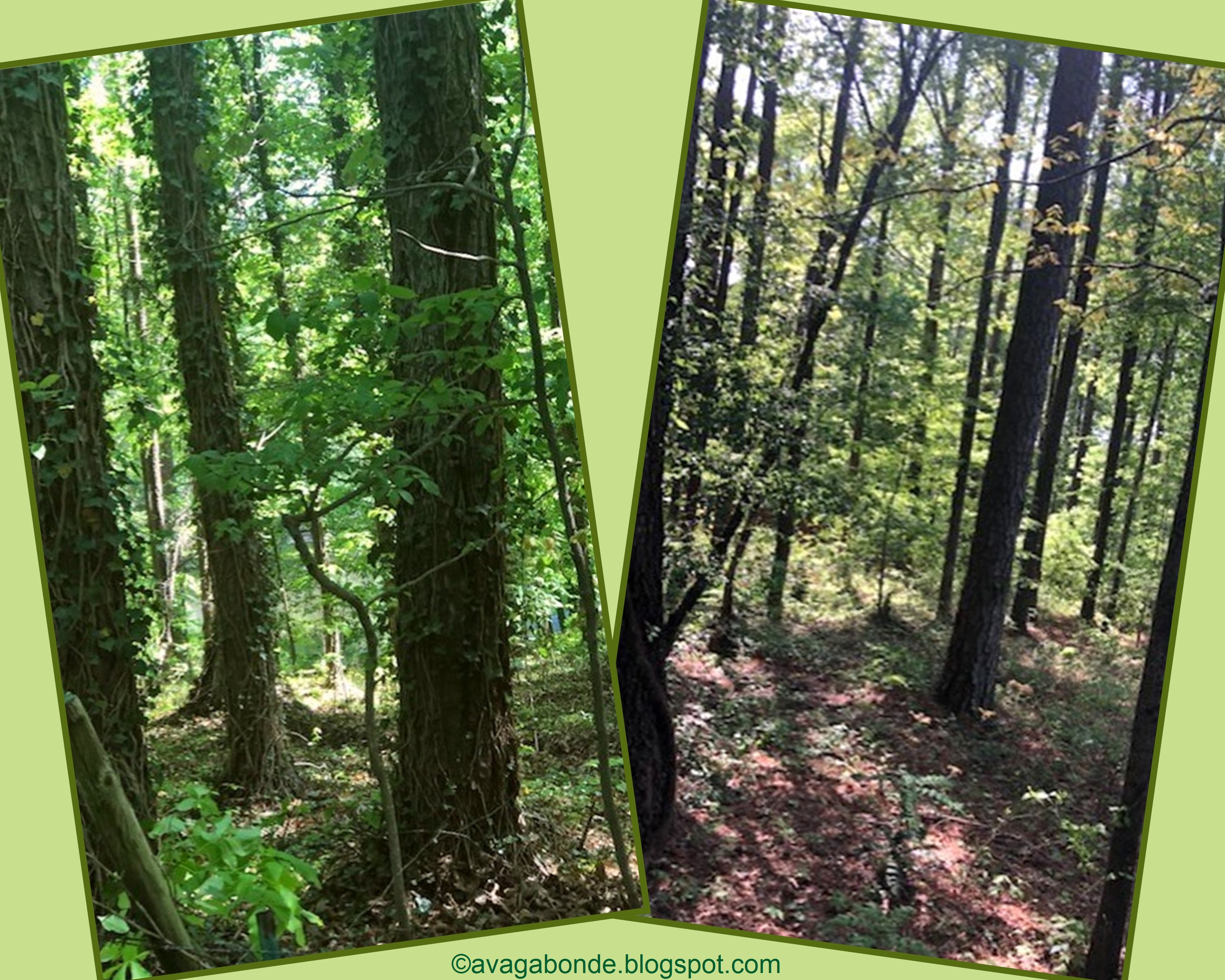
Meanwhile when I returned to Georgia it looked like winter and was very foggy. The woods around the house looked ominous.
Then a couple of days later it was sunny and daffodils could be seen in many Georgian gardens.
Returning to Nashville, spring was gone and it snowed again.
A week later the warmth came back. Trees and shrubs were in bloom such as my Yoshino Cherry Tree and flowering quince shrub.
In Mid-April I returned to Georgia for a couple of weeks as I had to vote at the French Consulate in Atlanta. I could not vote in Nashville as there is no French Consulate there. The blooms on my azaleas were almost gone.
Several years ago my late husband and I found a tiny maple tree, about one foot tall, in our Georgia front yard. We transplanted it to a better area. I was surprised last week to see the tree was now taller than me.
The second tour of the French presidential election was on Sunday April 24, 2022, but because of the time difference the French overseas or living abroad had to vote on Saturday April 23, 2022. The Consulate General of France in Atlanta has jurisdiction over the U.S. Southeast for the states of Alabama, Georgia, Mississippi, North and South Carolina and Tennessee. I already drove the 9 hours round-trip to Atlanta to vote for the US presidential election since I am a dual citizen (and my main home is still in Georgia,) so did it again for the French elections. The Consulate is located in the Buckhead area of Atlanta near the upscale Lenox Mall in a tower adjacent to the Mariott Hotel.
Early on Saturday April 23 I drove to Buckhead Atlanta (a 45 minutes drive.) Already there was a long line of voters waiting in the lobby of the tower. French IDs or passports were verified then small groups of voters were led to an elevator. Once on the 11th floor there was another line. Two small pieces of paper were given, one reading Macron and the other Le Pen. You proceeded into a small booth and placed your choice into an envelope. Then you inserted your envelope in a large clear box. Your name was crossed off the list of registered voters. Voila! Easy peasy. (Click on collage to enlarge.)
I had not seen so many French people in a long time. The French Consulate showed how many French people living abroad are registered to vote. The highest number is in Switzerland - 174,820, a small country the size of Vermont and New Hampshire combined. In the whole USA there are only 136,533 registered French voters - a small number considering that almost 200,000 US citizens live in France, which is smaller than the state of Texas.
This is the first time since I have been in the US that I have heard so much about a French election in the US news and media. I guess it was because of Marine Le Pen, the extreme far-right candidate. Here is a sampling of her platform: No more Muslim headscarves in public, to be sanctioned by the Police. All schoolchildren to be in uniforms. Catholic nativity scenes to be shown in all public places and only Catholic Holy Days to be allowed. Generous social services unavailable to foreigners unless they've held a job for five years and if not, they are to be returned to their home countries (bye bye long time Brit and US residents.) Limit French nationality to French born from French born parents only.
Le Pen would pull France out of NATO's military command, leave the Euro zone and reinstate the Franc, weaken the Western military alliance, get out of the EU, make a strategic rapprochement with Russia (oppose sanctions against Moscow) and "away from the US sphere of influence." An admirer of former President Donald Trump, Marine Le Pen copied his MAGA (make American great again) into "make France sovereign again." Her political brochures had showed her with Vladimir Putin; she obtained millions in loan from Russia for her campaign. She told the BBC: "The main lines that I defend are those defended by Mr. Trump and Mr. Putin." Below are some cartoons on Marine Le Pen. (Courtesy Franc-Tireur, Timeslive za, Charlie Hebdo and Irish Trinity News.)
The French Embassy in Washington, DC, showed the French election results per each French Consulate in this country. In Atlanta the results were Macron 87% le Pen 12%. The highest were in Boston, Macron 95.48% Le Pen 4.52% and the lowest in Miami, Macron 75% Le Pen 24%. It was a nice election spring day in Atlanta.
The Miami, Florida, results go with the territory where that state has one of the most extreme right wing government. My friends overseas may not know that lately Ron DeSantis, the Florida Governor, had a law passed, House Bill 1467, which allows books and textbooks to be banned in schools and school libraries. Anyone or a librarian providing "prohibited" material to a student could be charged with one felony per book. So far 200+ books, including classic or a book like "Who is Barack Obama?," have been banned in Florida and 74 math textbooks. When books are banned, students are curious and seek them out. Tennessee banned the Holocaust novel "Maus" from the classrooms and its sales went way up. Last Wednesday, Tennessee Representative Jerry Sexton said he would burn books that were considred inappropriate for school libraries. In 2021 more than 1,500 books were banned in the US. I have not heard of any library book killing a child, but since the Columbine High School shooting in 1999 more than 300,000 students have experienced gun violence in schools. In 2021 alone 34,000 students were exposed to gun violence = so, why are guns not censored instead of children books?
There are no answers to such nonsense. But it is springtime, flowers are blooming again, days are getting longer, grass and plants are vibrant once more, birds are abundant, and trees are turning different shades of green. After two weeks clearing the Georgia house I would have liked to visit a public garden - maybe next time. Trees and weeds have grown so much in the backyard in Marietta since I partly moved to Nashville that you can barely see the lake in the backgrouond - see photo on left.
Pine trees have been a symbol of strength, steadiness, resilience and wisdom. Maybe to share such benefit I often sat in my backyard in the sun watching nature taking over the land and smelling the southern pine trees.