Monday, September 19, 2011

A visit to Ohio State University and the Thompson Library – part one


Recently we stayed in Ohio for 10 days to visit family. Arriving at the Columbus Airport we knew we were in the right airport as so many people were wearing tee-shirts saying “Ohio State” or “OSU” or “Buckeyes.” For the benefit of my blogging friends from overseas I’ll explain that Columbus is the capital of the state of Ohio (located in the Midwest of the country.) The original and main campus of Ohio State University (OSU) is located in the center of town. Yesterday I went to a postcard show and found some vintage postcards on Columbus and OSU. Here are two views of Columbus. The postcard from High Street is circa 1909 and the other one circa late 1930s.


Ohio State University or OSU was founded in 1873. I read that it is now the 3rd largest university in the USA. It is ranked in the top 20 public universities in the country and the top 130 universities in the world. In 1878 six men were the first to graduate from OSU and in 1879 the first woman. Below is a picture of University Hall in 1899.


This university has certainly grown since those early days. Now there are 55,000 students enrolled in the 14 different colleges on the Columbus campus which is on 1,700 acres (688 hectares) with 457 buildings. Here is a 1940 era postcard showing four of the buildings.


There are close to half million living alumni from OSU (which is why OSU tee shirts can be seen on people in many other states – I saw one man wearing a red OSU shirt yesterday after the postcard show in Smyrna, Georgia. I also saw one in Paris last May.) My late father-in-law was an alumnus. My husband as well as our nephew attended and graduated from OSU. Below is a postcard showing the campus circa 1960.


My sister-in-law who also graduated from OSU became a professor there for decades and my daughter and son-in-law completed their medical internships and residencies at the OSU Medical Center. Here is a postcard of the Medical Center circa 1950 – It may look quite different now, or may not….


The name of the state, Ohio, comes from the Iroquois Indian word ohi-yo’ which means great river. It is known at the “Buckeye State” because of the Ohio buckeye tree. Ohioans are known as “Buckeyes.”


Old print of Ohio Buck eye [Ohio Buckeye or American Horse Chesnut.] (1841-1849)

Growing up in Paris I don’t remember colleges having football teams, but it may have changed now. Here college football is big business. I am talking about American "football" which is played mostly in the USA and Canada. The US calls “soccer” what 200 other countries call football (a game played by 250 million players worldwide.) The first OSU football team was formed in 1890 – they later were called the “Buckeyes.” Below is a photograph of OSU stadium in 1920.


If you are in Columbus during a game you will see an innumerable amount of people wearing red tee-shirts or other clothing saying “OSU” or “Buckeye” as red and grey are the football team colors. Every seat in every game is sold out!


Babies, youths and adults wear these colors – they are also on cars, bags and a multitude of items.


I think that most people living in Ohio are fans of the Buckeyes but the team is also known nationwide. I read that in 2006 the OSU versus University of Michigan game was watched on TV by 22 million people. The University of Michigan is known as the archrival of OSU in football. The first OSU-Michigan football game was played in 1897 (Michigan won.) Below is OSU first football team, in 1890.


During a football game intermission the Ohio State University Marching Band executes a march that forms the name Ohio in script. It is well known. What is not so well known is the fact that the music they use was originally a French military march called “Le Régiment de Sambre et Meuse.” I wrote a post on it last year. If you would like to see videos of the French march and the Script Ohio march click here. Below is a photograph of the first “Script Ohio” in March 1936.


During this visit to Columbus my sister-in-law suggested that we visit the new Thompson Library on campus – this is the main library there. So, the morning after we arrived, my husband and I accompanied my sister-in-law and a friend (who is a retired OSU administrative Dean) to the OSU campus. I had been to Columbus numerous times before and driven by all the different college buildings but never walked on campus. I enjoyed walking under the large old trees. They must look gorgeous in their autumn golden colors.


Click on picture to enlarge

I don’t think that classes were in session as only a few students were around walking, or bicycling.


We saw University Hall from a distance. This is the replica of the old University Hall which I showed in an 1895 photo above. The old building was torn down 40 years ago as it was considered a fire hazard. The new building, which was a replica on the outside, but modern inside, was opened in 1976.


Among the trees I could see a tower. I was told this is the bell tower of Orton Hall, the oldest building on campus.


I like that type of spooky looking building. It was built in 1893 in a Romanesque castle style. The 24 columns encircling the tower look like mean gargoyles but I could not distinguish them well. They used 40 different types of Ohio stone in this building.


The building was named for Edward Orton, who was the university’s first president from 1873 to 1881. It houses the Geology Department and a museum where Jeff, the campus dinosaur can be seen. I only saw Jeff from a distance as the museum was closed. But I liked the beautiful stain glass windows and ceiling.


There was a glass cabinet displaying old pictures on the history of the building. I tried to snap them with my camera but they did not come out too well. The picture below of Edward Orton is from OSU Archives (as well as the other old photographs.) It is said that he haunts the building. In the last years of his life he spent many hours reading by lamp light in the top of the bell tower. Some visitors have said that they have seen the light of his flickering lamp through the slats around the tower…. eery.


It certainly was a lot more cheerful outside near some pretty flowers.


Leading the way, my sister-in-law was entering her old building, Medenhall Laboratory, where she taught English Literature and Writing for many years . She taught in other buildings too, some quite far away. The walk was good exercise but not too much fun in the snow.


Entering the lobby I admired the “fossil like” design on the floor and was impressed by one wall covered with various sized stones, giving it an interesting texture.


From habit, my sister-in-law went behind the lectern in her old classroom. I don’t think the two “students” in attendance were teachable though…


The view from the class windows was quite nice. I wonder how many students looked outside searching for the best word to use or right sentence in their exam papers.


Next we were going to visit the library. But this post is getting long, so it will be in part 2.


More to come later...

Saturday, September 10, 2011

A Cancelled Trip


My husband and I just came back from our trip to Ohio. Everything went well – we did not miss our flights and our luggage was not lost which happened in our last trip to Paris in May (see this post.) But ten years ago, in September, our trip was cancelled.

Every year I would go to France to visit my mother usually late in September and also in March. My husband would take his vacation in October hunting with family and friends either in North Dakota or Saskatchewan, Canada. That year though we decided that we would go together to France earlier as my husband had not seen my mother in years. Before going to Paris we were to stop in England for a few days to visit the York National Book Fair. The Fair started in 1974 and had grown as the largest antiquarian and out-of-print Fair in the UK with over 100,000 books for sale. Below is the poster for the Fair this year, 2011. In 2001 the fair started Friday Sept. 14. We had booked our flights for Sept. 12, 2001.


It took weeks to make our travel arrangements – reserve the hotel in London, book the bed and breakfast in York, buy the train tickets to York, the train tickets to Paris and so on. My vacation was starting at lunch on Tuesday September 11 so I would have time to finish packing the suitcases. But then early on that Tuesday someone close to me at work told me that a plane had taken a wrong turn in New York and there had been an accident. We searched the Internet but could not get any news until I went to the BBC news site - and then we saw what was happening. The rest of our office clicked on the BBC site and watched in horror the images of the World Trade Center transmitted from the US. I left as planned for home at noon, but kept watching the TV as I packed our bags. Then when all the airports were closed, I started to make the calls to my mother and to cancel all our reservations.

I did go to France in March and September 2002, but my husband could not come. My mother died in December 2002 and my husband never saw her again. After that September 11, I watched television news for hours and read many newspapers, like the French Le Monde which stated in its editorial “We are all Americans.”

Nous sommes tous Américains

éditorial publié le 13 septembre 2001 (editorial published September 13, 2001)


“In this tragic moment, when words seem so inadequate to express the shock people feel, the first thing that comes to mind is this: We are all Americans! We are all New Yorkers, just as surely as John F. Kennedy declared himself to be a Berliner in 1962 when he visited Berlin.”

I listened as the government here told us to travel to New York and spend money. Many tourists were afraid to go there. Hotels, restaurants and theatres were almost empty. So I decided to go to New York as soon as I could. I flew to New York six weeks later on Friday 26 October 2001 – alone. I stayed at the Gershwin Hotel for four days. It is located on East 27th Street and had a special rate then under $100 (which is unusual in New York.) Their standard rooms are simple but clean. Below are their unusual store front and a standard room.


I had been to New York numerous times before and had seen the Twin Towers. I purchased several postcards, too – here are some below. (Postcards photos courtesy Konstantino Hatzisarros, Lee Marshal and Jeff Prant.)


That first afternoon in New York City I visited the Pierpont Morgan’s 1906 Library at the Morgan Library and Museum . That evening I took advantage of the “Relief Prix Fixe” (a fixed price meal benefiting 9/11 charities) dinner at the Oyster Bar and Restaurant in Grand Central Station. I had the New England clam chowder, the scrod filet broiled and a succulent chocolate mousse (I still have the ticket!) It is an historic restaurant which opened in 1913. It has beautiful arches and marble columns – here is a picture of it below. (Photo courtesy Where to Eat.)


The next morning, Saturday, I took the subway to Ground Zero. Below is a postcard I bought on a later trip to New York in 2004.


I was not sure where Ground Zero was but I walked toward the smoke I could see ahead. It had been several weeks since the attack but there was still a lot of ash and smoke making your eyes water and throat raw. I did not have a digital camera then, but I took several (not so good) pictures with my film camera.


You could not get close as the roads near the site had been closed.


There were many trucks driving by, carrying debris.


I sat briefly on a building ledge to take a picture. A worker came close by to sit, too – he looked exhausted. I took a picture of people watching a truck drive by with a large piece of steel – the worker’s face is in the foreground.


I went to another street to see better


but still could not get too close. There was water everywhere.


I stayed around a long time, walking, looking at all the photos of lost ones on walls and flowers pinned to the gates. My heart was filled with grief.


Going shopping did not feel right so I spent my money on some souvenirs – postcards to send to family, friends and for my collection.


I also purchased a star pin and a special edition of a small Statue of Liberty figurine draped with a flag (you can see the Twin Towers on the box) and a little pewter souvenir figure of the World Trade Center.


For my husband I purchased a tee-shirt and a key chain with the profits going to the New York Fire Department.


I purchased a red white and blue scarf which I wore all the time those few days. I placed it now around my little painting of the frog, which I purchased later – proceeds going to 9/11 charities.


Leaving this tragic area


I walked in the neighborhood some more. I saw the bronze Charging Bull sculpture – I think near Wall Street. I am not sure about all the streets I took.


I arrived at the Staten Island Ferry Terminal. A ferry was ready to leave the pier, so I went on it. I made the round trip without walking on Staten Island. On the way back I took a couple of pictures showing Manhattan, and the empty area where the Twin Towers of the World Trade Center would have been located.


Many theatres on Broadway and other places were offering extremely reduced tickets. I took the subway and purchased a ticket at the Imperial Theatre. That evening I saw “Les Misérables.” It is a spectacular musical inspired by Victor Hugo’s book.


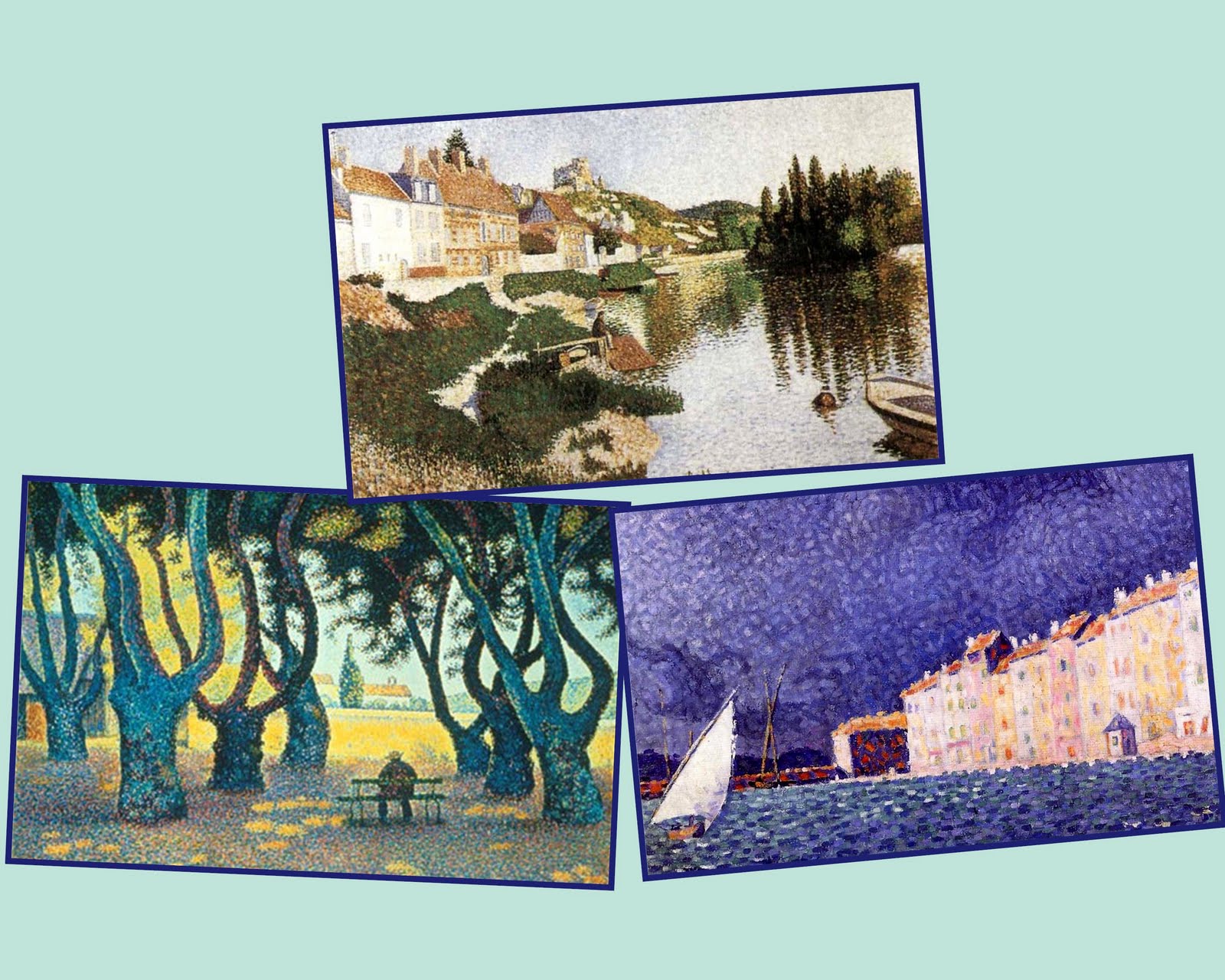
The next day, Sunday, I went to the Metropolitan Museum of Art. There was a special exhibition of Paul Signac’s paintings. (Luckily I wrote all this down on my pocket diary, that is why I can remember it well.) Paul Signac (French, 1863-1935) had met Monet and Seurat in 1884 and liked their painting methods. Signac was a friend of Vincent Van Gogh and went on painting outings with him many times. Signac developed the pointillist style (paintings made of little points) with Georges Seurat. Below are some representative paintings.


Outside the museum were artists selling their art. I purchased for my husband a small drawing of stark trees from an Oriental artist. The picture below shows the artist and the painting in its larger size.


For lunch I went back to the East Village and ate at Angelica’s Kitchen. It is a vegetarian restaurant serving seasonal food. I shared a large table with several other women. I don’t remember what I ordered but it was very good. What I do remember though is that I started speaking with a couple of the women in front of me. They were from New York and asked where I came from. I told them I came from Atlanta to show my support to New York City. Everyone at the table stopped eating and smiled at me and said “thank you.” I still get teary eyes when I think about it.


Photo courtesy Civil Eats.

Then I walked to The Strand bookstore and stayed there browsing books for a long time. On Monday I wandered into Indian Village and ate lunch there. Someone in the street was passing out some pamphlets. I took one. It was called “Fallen but not forgotten.” Inside it had pictures of 9-11.


The introduction article said “hate cannot win.” (My scanner is old and shows a yellow line on the picture.) The introduction ends by saying “gazing upward our hearts were broken.” They were.


Our hearts were broken for all the loved ones who lost their lives – not just Americans as there were twenty-two different nationalities in the Towers. Since that trip I have been to New York several times, twice during September 11, in 2004 and 2007. I saw remembrances of the day such as paintings by children.


One September 11th in New York I watched Mayor Bloomberg on television paying tribute to the fallen.


I just read an article by James Der Derian, professor at the Watson Institute for International Studies at Brown University in Providence, Rhode Island, in the 9 Sept. 2011 issue of the German newspaper Der Tagsspiegel : “Ten years on, there is much to remember about 9/11, of the loss of innocent lives, the sacrifice of the first responders, the coming together of communities – from the local to the global level – against the terrorist attack on the US. But there are also moments we might wish to forget, forged in fear, trauma, and vulnerability, of a disastrous, unnecessary war in Iraq, indefinite detention of prisoners at Guantanamo Bay, illegal wiretaps, surveillance and suspension of civil liberties in the US, an abiding suspicion of the non-American, and a search for justice that became indistinguishable from a desire for revenge.”


postcard photo courtesy Charles Ziga

Ten years later I have forgotten my cancelled trip, but I have not forgotten what I saw in New York City that October 2001. Even if we did not know anyone personally who lost their life that day, we felt we lost family members. In our corporation one of our co-workers was a passenger on one of the fatal planes with his wife going on vacation to Los Angeles, but I did not know him. Our office sent contributions to his family. I think that the legacy of the 9/11 events will stay with us – they will for me, always. But I hope that the sense of unity I felt in New York City that October 2001 can also be recovered and be with us in the future.


Postcard photo Alfred Mainzer, Inc.


Monday, September 5, 2011

Blog Intermission (entr’acte) no. 15 – The Seine Meets Paris


Jacques Prévert was born in Paris in 1900 and died in Normandie in 1977. He was France’s most popular poet of the 20th century. I remember buying his book of poetry called Paroles (Words) when I was a teenager and reading it again and again until I could recite many of the poems by heart. I also would read some of his poems to my friends. Many of his poems are about life in Paris – they are taught in schools in France and are published in many French language textbooks internationally.


Vintage style Paris poster, courtesy Steve Foreny

Prévert was a great screenwriter during the 1930s and 40s. He wrote the classic screenplay for the film Les Enfants du paradis (The Children of Paradise, 1945) which is one of the greatest films of all time. Some of his poems were set to music such as Les Feuilles Mortes (Autumn Leaves) and were made popular by famous singers like Yves Montand and Juliette Gréco. (See my post here to listen to Yves Montand singing this song.) Young people loved him I think because of his humour, his free spirit, anticlerical and satirical attacks on French institutions. He criticized stupidity, hypocrisy and war. His words were simple but powerful. All his life Jacques Prévert was a peace activist. By the mid-1960s more than one million copies of his poems were in print because many people who usually don’t read poetry would read his poems.


Jacques Prévert photographed by Brassaï in 1948

The American poet Lawrence Ferlinghetti, born in 1919, translated Prévert book Paroles into English. The book is published by San Francisco’s City Lights Booksellers & Publishers. Ferlinghetti who was raised by his French aunt was a co-founder of City Lights.


Sunflowers on the Banks of the Seine, Gustave Caillebotte, French 1848-1894


La Seine a rencontré Paris

Qui est la
Toujours là dans la ville
Et qui pourtant sans cesse arrive
Et qui pourtant sans cesse s’en va


Notre Dame from the River Seine - 1879, James Webb, English 1825-1895


C’est un fleuve
répond un enfant
un devineur de devinettes
Et puis l’œil brillant il ajoute
Et le fleuve s’appelle la Seine
Quand la ville s’appelle Paris
et la Seine c’est comme une personne
Des fois elle court elle va très vite
elle presse le pas quand tombe le soir
Des fois au printemps elle s’arrête
et vous regarde comme un miroir
et elle pleure si vous pleurez
ou sourit pour vous consoler
et toujours elle éclate de rire
quand arrive le soleil d’été


La Tour Eiffel et la Seine, Michel Henry, French contemporary born in 1928


Il était une fois la Seine
il était une fois
il était une fois l’amour
il était une fois le malheur
et une autre fois l’oubli

Il était une fois la Seine
il était une fois la vie


- Jacques Prévert, 1900-1977


Le Pont de la Concorde, Bernard Buffet, French 1928-1999


Ferlinghetti as I said above translated many of Prévert poems, but I could not find this one, so I translated it myself.


The Seine meets Paris


Who is there
Always there in the city
And yet constantly arriving
And yet constantly going


Les Quais de la Seine, Eugène Galien Laloue, French 1854-1941


It is a river
responds a child
a guesser of riddles
then with a twinkle in his eyes he adds
and the river is called the Seine
When the city is called Paris
and the river it’s like a person
Sometimes she runs she runs quickly
She hastens the pace at dusk
Sometimes she stops in the spring
and looks at you as if a mirror
She cries when you cry
or smiles to comfort you
and always bursts out laughing
when the summer sun arrives


Notre Dame et la Seine, Michel Henry, French contemporary born in 1928


Once upon a time there was the Seine
once upon a time
Once upon a time there was love
Once upon a time there was bad luck
and another time oblivion

Once upon a time there was the Seine
Once upon a time there was life


- Jacques Prévert, French 1900-1977


Le Quai du Louvre, Claude Monet, French 1840-1926


0-0-0-0-0-0-0-0-0-0-0


Note: Blogger Break - Post pre-programmed. Top picture taken in Paris last May 2011.