Tuesday, May 4, 2010

Traveling to The Farm in Tennessee


 We have been planting many petunias and impatiens in pots in our backyard. I took a picture of the pots facing our kitchen window – the pots look good.


Then this morning some of the pots had been dug out and turned over again – this has happened several times already. We do not know which critter does this maneuver on our pots. In our backyard we have seen rabbits, squirrels, raccoons, possums and chipmunks many times – but which one is the culprit? I post this hoping that someone will tell us what we should do to prevent the responsible animal from hurting our pretty planters.


Click on collage to enlarge, then click on the pictures to enlarge again
Last week we came back from Tennessee where our friend and his wife live in a place called The Farm Community where they have been since 1972 when it was started as a commune. We had met our friend in San Francisco, California, in the mid-sixties. My husband attended San Francisco City College part time and our friend attended San Francisco State College (now university.)

Picture of San Francisco with Golden Gate Bridge taken with my 35mm camera in July1967
We spent many hours talking – about everything and our friend was an usher at our wedding in June 1967. My husband and I left San Francisco in a truck across country with our newborn baby girl and all our belongings. We arrived in Marietta, Ohio in January 1970 where my husband could finish his degree at Marietta College.


Picture of my husband and infant daughter one month or so before we left San Francisco

Our friend left San Francisco too, but with a caravan of buses, which became known as The Caravan. The picture below is from the back of the book The Caravan by Stephen Gaskin (copyright the Book Publishing Co.)


At San Francisco State College (SFSC) our friend had started to attend lectures given by an English professor named Stephen Gaskin. My husband had gone to a couple of the lectures but he had to attend his classes in the evenings. Stephen Gaskin, a former US Marine, started giving the lectures in 1966-67 in a SFSC hall. The lectures became so popular that he had to move to a church, then a theater and finally the rock hall The Family Dog. Up to 1000 to 1500 young seekers attended the lectures – a variety of high school, university students and hippies from the Haight-Ashbury district in San Francisco. The teachings were discussions on politics, love, acid, peace and a blend of eastern and western religion.


In 1969 a group of theologians attending a convention in San Francisco went to the Family Dog on a Monday Night and heard Stephen’s high energized talks. They invited him to speak at their churches and colleges. Later that year, on Columbus Day 1970, our friend joined Stephen Gaskin in a caravan of 20 to 30 converted school buses that left San Francisco to tour the country and visit 42 states.


From the Web – Caravan Buses, picture copyright The Farm ( photo Gerald Wheeler, Cliff Figallo and John Coate)

At that time we were in Marietta, Ohio, where my husband was finishing his Bachelor of Science degree.


Some of the buses were as old as the 40’s and all the roofs were painted white so as not to be mistaken for regular school buses. They stopped at many congregations and colleges for Stephen’s speaking tour and picked up more people who wished to join the Caravan. A year later when the Caravan returned to San Francisco it counted more than 100 vehicles made up of 60 buses, a dozen step vans, VW campers, bread trucks and an assortment of bright colored painted vehicles.


From the Web – Caravan Buses, picture copyright The Farm ( photo Gerald Wheeler, Cliff Figallo and John Coate)

"You're either on the bus or off the bus."
-Ken Kesey, American author who wrote One Flew over the Cuckoo's Nest -1962

At first the returning group wished to buy land in California but it was too expensive. They decided to pool their money and return to Tennessee with the buses and buy land somewhere close to Nashville for a permanent utopian community. In December 1971 they were able to put a down payment on a 1050 acre farm in Summertown, about 1 hour south of Nashville, where they created a commune which they called The Farm.


Graphic - Utopian Farm Land (reworked from free Solis,NZ)
Two years later they purchased another 750 acres. There was only a building or two on the property so they really were like pioneers living on the land. The group of hippies had to make do without running water, electricity, etc. They farmed the land, built shelters (some of them as addition to their buses), built a sorghum mill, pooled all their resources and energy to make the commune survive and it did. By 1982 1200 members (half of them children) lived on the property and received up to 10,000 visitors. They created a band, soy dairy, a midwife center, a book publishing company and other businesses. They even created a nonprofit organization called Plenty International to help people in other countries. You can read more about Plenty International here.

Below is a picture of some of the books sold by The Farm that I have


However, in 1983, because farming had not brought in enough funds and also because of the recession the settlement was reorganized; they called this “The Changeover.” They went from being a commune, where everything was held and shared in common, to a cooperative. The land is still held in common now but the members pay monthly dues for general expenses. Many left the Farm Community and now the population is stable at about 200. The businesses are doing well although they no longer farm their land.


There is a lot more I could tell about The Farm but this was just to give you background information on our visit to our friends who live there. You can also find more on the Farm on their own websites: http://www.thefarm.org/ and http://www.thefarmcommunity.com/ .In my next post I’ll have some pictures of our visit.


Love is but a song to sing
And fear's the way we die.
You can make the mountains ring
Or make the angels cry.
Though the bird is on the wing
You may not know why.

C'mon, people now
Smile on your brother
Everybody get together
Try to love one another right now.

- Everybody Get Together, lyrics by Chet Powers,
early 60s, member of Quicksilver Messenger Service
Collage graphics from free fractual wallpapers

Addendum: Just received an email from my friends at The Farm - they are on high ground and did not get any flooding, unlike many people in Tennessee.

Note: This is a pre-programmed post. If your comments take longer to be published, it is because I could not get close to a computer while on this trip.

Monday, April 26, 2010

Festival of Native Peoples


This will be my final post on our stay at the Cherokee Indian Reservation last July where we attended the Festival of Native Peoples. I have been delayed in posting because we went on a trip to Tennessee and also because I searched for copyright laws on the Internet. Some of my pictures were published on a commercial site without my consent. I placed a copyright statement on the side of my blog and urge everyone who has a blog to do so. I hope that the advertising agency that provided my pictures to their client will work with me on this. If not, I hope that the website will cease using my pictures, like the one below.


Click on picture to enlarge it

This was the 5th year the festival took place at the Cherokee Indian Reservation. This event ended with a performance of native dances, songs and music from several tribes of the Americas. In addition to the traditional Cherokee dancers there were dancers and performers from other states like New Mexico and Hawaii and countries like Canada and Peru. The festival took place in Cherokee, the main town of the Cherokee Nation which is home to the Eastern Band of Cherokee Indians and is nestled in the beautiful Smoky Mountains of North Carolina, near Asheville.


Earlier in the afternoon, we went to the Cherokee Art Market – this market was the subject of my post of April 4h. It was a lovely day to have a festival, but after walking for a while in the Art Market we enjoyed sitting and listening to the program. I took so many photographs that it will be difficult to make a choice for this post.


The Cellicion Zuni Dancers from southwest New Mexico have performed since 1983 all over this country and internationally – Europe, the Middle East, Southeast Asia. They were the first Native American dancers to perform in Mongolia.


Click on pictures to enlarge them

Their dances included the Pottery Dance. The dance tells the story of women carrying water jars on their heads to the river while dancing and singing to give thanks to the Creator for water. There are less than 15 women left in New Mexico to perform this ancient dance. The Zuni Pottery dancers first showed us that the clay pots were not attached to their heads, then danced and sang.


The five San Carlos Apache Crown Dancers from Arizona have white tainted chests with drawings showing lightning – lightning is a powerful Apache symbol. The dancers represent Mountain Spirits – four of them are the four directions and the fifth is the protective clown that drives away evil spirits with the sound of his humming bull-roarer.


Miss Cherokee 2008-2009 was watching intently


As well as the audience


A large First Nation family from Canada came on the stages and danced.


The wee children were so cute – and so serious.


Unfortunately I was so busy watching or taking photographs that I did not take good notes and I did not record the name of some of the groups, like the one below.


Then came the graceful Hawaiian hula group, the Halau Palaihiwa of Kaiouwai. They demonstrated ancient hula, chants and dances. “These are chants and dances that have been part of ‘aiha‘a since time immemorial. It’s rare (ancient Hawaiians) would include observers outside the halau,” said Kumu Hula the director of the group. “‘Aiha‘a means to internalize humility,” she said. “The ‘‘ai’ means ‘to internalize,’ and the ‘ha‘a’ means ‘low, bent knees.’ Our teachings remind us we pull our energy from the ground. The lower to the ground, the higher the frequency (connection to the ancestors).” “Hula is about regenerating life cycles. The dancer... becomes that living altar of hula and the circle of the lei, a symbol of that ongoing cycle. Hula is the healing of the land and environment.” “Our ancestors understood our earth was suspended. They observed, respected and internalized nature.” (from The Garden Island,com)


The ancient Hawaiian hula and drum dances were once a mainstay of Hawaii's ancient temples. An Hawaiian elder came to perform an ancestral chant.


The show on the stage stopped so the audience could go back to the fairgrounds and watch the Totonac Pole Flyers one more time. My last post was devoted to these fearless artists; see my post of April 13th.


The Git-Hoan Dancers performed the song and dance of the Native people from the Pacific coastal areas of northern British Columbia and southeastern Alaska.


The dancers now live in the Seattle area but can trace their roots to the Tsimshian village of Metlakahtta in southeast Alaska. The Tsimshian people, depended on deep-sea codfish and halibut for subsistence, just like the Klingit and the Haida, who are other seafaring coastal people. Tribal leader and culture bearer David Boxley founded and directed the group to preserve his culture which was on the verge of extinction. He is also a renowned totem carving artist.


The dancers of Git-Hoan, which means People of the Salmon in the Tsimshian language, use hand-carved masks as they tell their story through dances. They also perform with headdresses, skin, wood drums and other handmade instruments.

Raven Dance by People of the Salmon


A company of National Peruvian Folk dancers came on the stage in their colorful garments and danced joyfully


They were part of the award-winning band Inca Son – which means “Sound of the Incas.” Their music was lively and the old Andean songs sounded just right in the mountains of North Carolina. César Villalobos, the founder of the group, plays the “Sikus” or panpipes. His happy music can sound like a bird in flight of like the sound of the wind from his homeland, the Andes of Peru.


Playing the centuries-old music of the Peruvian Andes


And they kept playing and dancing until dark.


Then it was over and time to leave. But maybe later on this year, who knows, we may go to another event at the Cherokee Indian Reservation.


Tuesday, April 13, 2010

Totonac Flying Dance at the Cherokee Indian Reservation


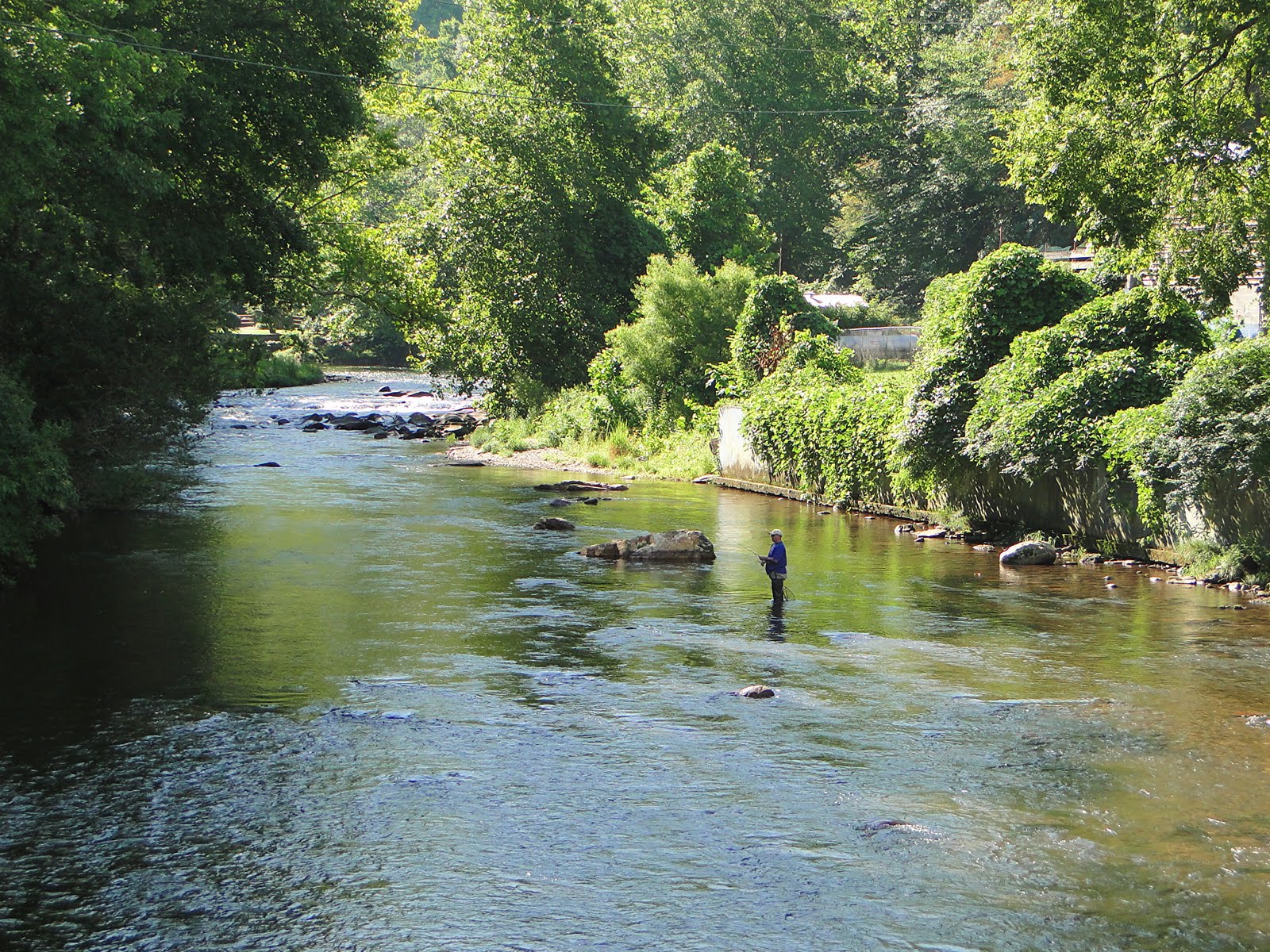
In my last post of April 4th I referred to four other posts I had previously published on our stay at the Cherokee Indian Reservation. Being located adjacent to the Great Smoky Mountains National Park the scenery in and around the Cherokee Indian Reservation is stunning. A river runs through it called the Oconaluftee River.


Click on picture to enlarge it

We walked along the river then admired a sculpture in the center of town. The town called Cherokee is picturesque. There are many borders full of vibrant flowers, including lavender.


Nearing the Cherokee Indian Fairgrounds we could see a crowd waiting near a very tall pole. We came closer to look. A little Cherokee girl was also looking, but at me. Her parents let me take her photograph.


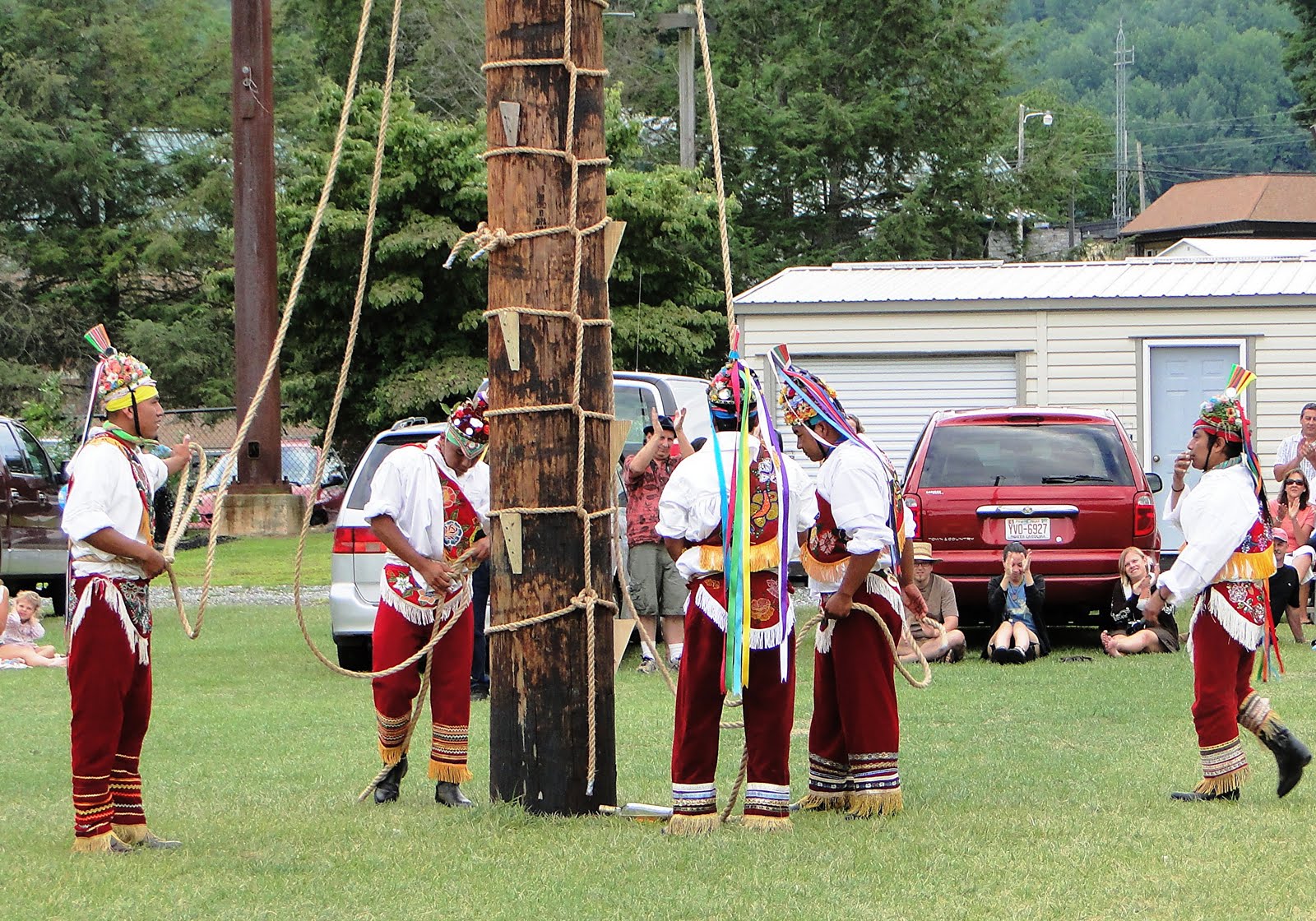
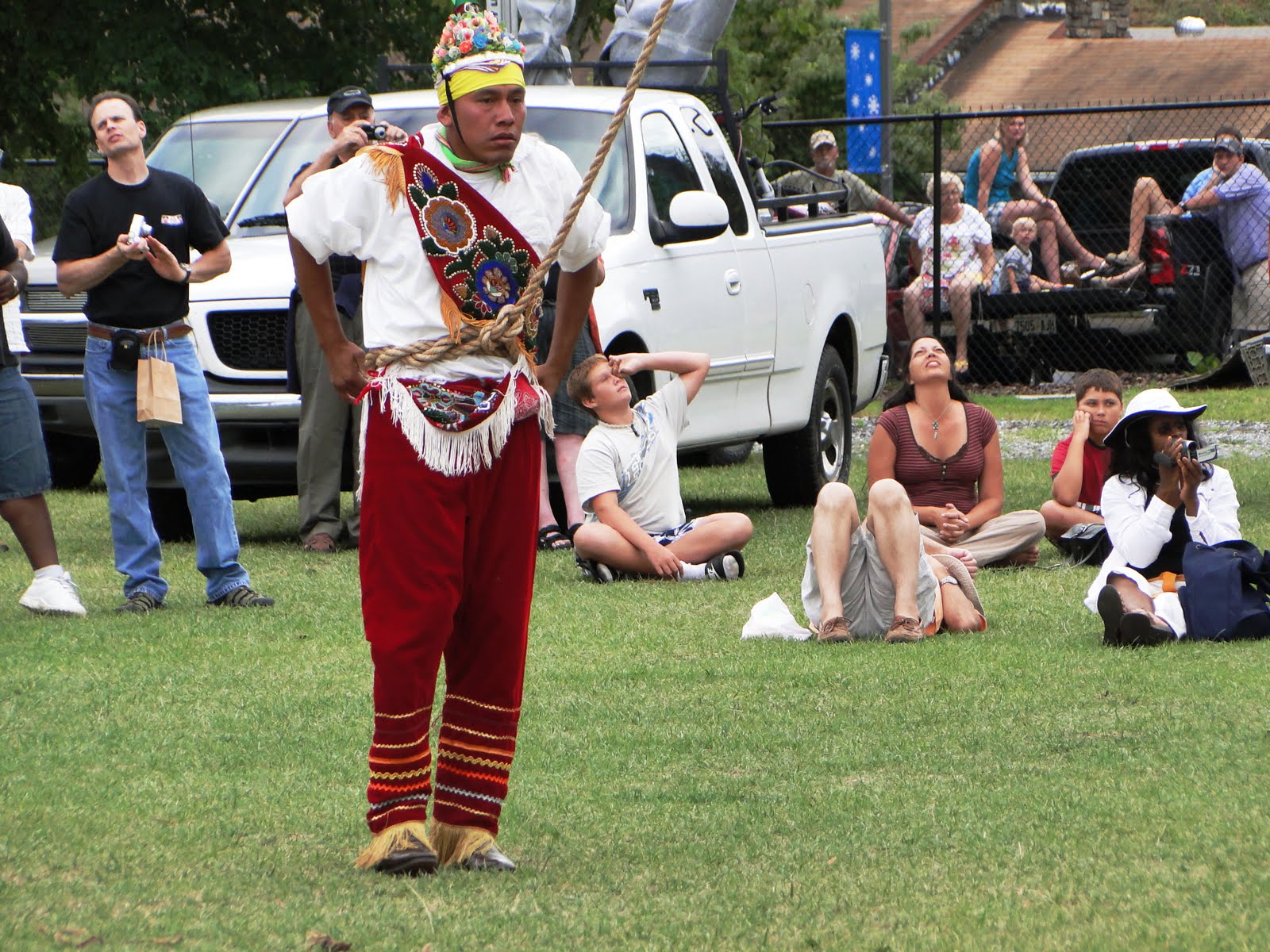
The Totonac Pole Flyers from Mexico were getting ready for their dance. They were scheduled to perform the dance twice, once in the evening and once in the afternoon of the following day. We watched it both times and I took photographs – some in the sun, and some at sundown.


I did not know much about this dance of the “voladores” - which means “those who fly” in Spanish – and researched it a bit. The tradition of this ceremonial flight was almost lost when the invading Spanish conquerors in the 16th century destroyed many records and the Church tried to silence native rituals. Fortunately historians and archaeologists reconstructed this ancient religious dance from oral history and early writings left by visitors to New Spain. Over time this ritual almost died out and survived only among the Totonac people of the Papantla area (eastern state of Vera Cruz) of Mexico. In pre-Hispanic times the participants were impersonating birds and some might be dressed as parrots, macaws, quetzals and eagles to represent the gods of earth, air, fire and water.


Quetzal

Now, this dance reflects the Totonacs’ tradition to dance to please the gods so that rain will nurture the soil and crops will flourish. The ceremony begins with a team of 5 flyers, each representing the five elements of the indigenous world, wearing heavily embroidered and decorated red pants, white shirts and hats. They dance around a 100 ft (about 30m) tall pole to the tune of a drum and flute played by the chief or “caporal.” The caporal followed by each flyer slowly ascends the pole then takes his place on a small platform perched atop the pole.


The caporal then plays the flute and drum to invoke the ancient spiritual offering. He turns to face each of the four cardinal directions and four winds, bending his head back to his feet, balancing on one foot. Each of the other four flyers, or voladores, neatly winds a rope thirteen times around the pole. This represents the number 52 (13x4) which is the numbers of years in a Mesoamerican solar cycle.


To acknowledge the sun, the caporal bends backward as he continues to play.


The four voladores represent the four elements: earth, air, fire, water as well as the four cardinal directions. The caporal represents the sun.


After the invocation the four voladores fell backwards, as we gasped, flinging themselves off “into the void.” Tied to the platform with long ropes, they hung from it and spin as the ropes unwind.


This creates a moving pyramid shape and mimics the motions of flight. The flyers, their feet looped around the rope, fly upside down while spinning around the pole gracefully descending toward the ground.


We kept looking up as they soared through the air with their streaming ribbons as if in a supernatural flight. We only heard the haunting sounds of the pounding drum and shrill flute.


Click to enlarge pictures

We watched silently as they lowered themselves to the ground, their circle widening as they kept descending.


When they were finally back on solid ground they held the rope so the caporal could descend.


The caporal finished his song of good-by and lowered himself down the rope to the ground.


The Totonacs people perform their ritualistic “Danza de los Voladores” to keep a part of their traditional culture alive and to provide additional income to their families. In the festival we attended they were invited by the Cherokee Indians in a spirit of friendship and to celebrate their heritage. The whole atmosphere was respectful and joyful and we enjoyed it very much.

In October 2009 UNESCO inscribed the Ritual ceremony of the Voladores on the Representative List of Intangible Cultural Heritage of Humanity. According to UNESCO "Intangible cultural heritage is the practices, expressions, knowledge and skills that communities, groups and sometimes individuals recognize as part of their cultural heritage. Also called living cultural heritage, it is usually expressed in one of the following forms: oral traditions; performing arts; social practices, rituals and festive events; knowledge and practices concerning nature and the universe; and traditional craftsmanship."

Here is a clip of the Totonac Flying Dance as it took place at the Texcoco Fair