Showing posts with label Cycling. Show all posts

Tuesday, July 26, 2022

July 14 Paris celebration and some sights along the Tour de France 2022

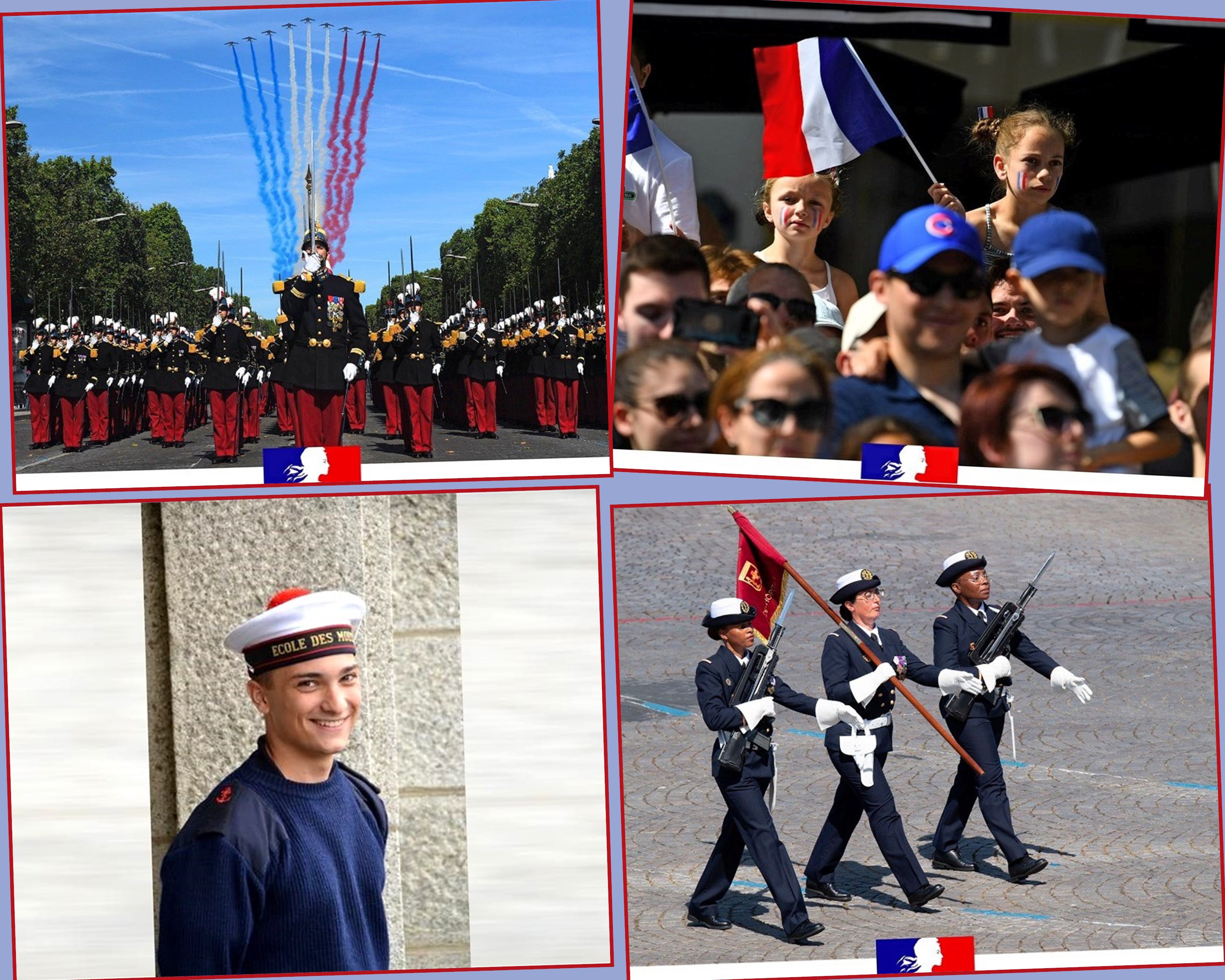
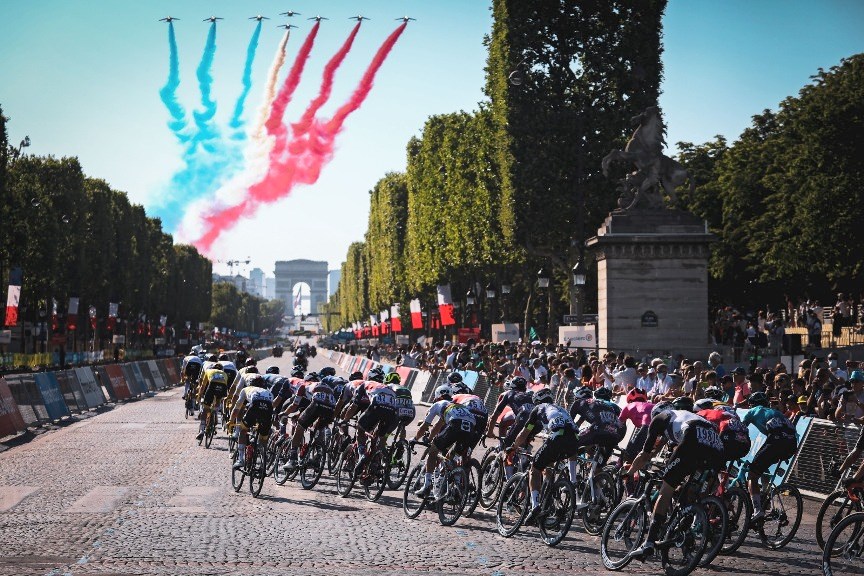
The Patrouille de France (French Acrobatic Patrol) of the French Air Force is shown above. It has been active since 1931 and is one of the oldest and considered one of the best in the world. It traditionally opens the military parade in Paris on the 14 of July /French National Holiday (also known as Bastille Day in anglophone areas.) Then about two weeks later, it flies over the Champs-Elysees Avenue at the close of the Tour de France. Nine pilots fly the Dassault/Dornier Alpha Jets with a team of 32 mechanics for support.
A 14 of July military parade down the Champs-Elysees Avenue in Paris has been a tradition since 1880. The parade starts at 10:00 am and lasts two hours. This year's theme was "Sharing the Flame" - a reference to the flame of the Resistance, and to the Olympic flame of which France is now the custodian until the Olympic Games in Paris in 2024. Olympic and Paralympics' medalists were part of the procession. This year French President Macron wished to honor Eastern European nations and invited their troops to open the parade (photo shown below courtesy Ministère des Armées.) The units and flags of the Baltic States, Poland, the Czech Republic, Slovakia, Romania, Bulgaria and Hungary opened the parade with troops on foot, followed by the soldiers of the French regiments engaged within the framework of NATO on the eastern flank of Europe, such as the alpine hunters deployed in Romania and Estonia. (France's Rafale fighter jets are also helping to protect the Polish sky.)
The parade included 6,300 soldiers on foot, 71 aircraft, 25 helicopers, 221 vehicles and 200 horses of the Republican Guard. Louis, a 17 years old ship's boy and future ship's mate, was the youngest soldier in the parade. He is pictured below, courtesy Le Ministère des Armées.
In the evening of July 14, Parisians, French people and foreign visitors were invited to gather near the Eiffel Tower to watch the fireworks at 11 pm, for about 30 minutes. The theme this year was "Carpe Diem" (seize the day - take advantage of life.) The fireworks paid tribute to Ukraine, projecting the Ukrainian flag on the Eiffel Tower, the blue and yellow rockets drawing hearts in the sky, on the song "Stefania" by the Ukrainian group Kalush Orchestra, winner of the Eurovision contest. (Photo of the Ukraine colors in the first left photo below, courtesy Le Parisien.) This was followed by a public concert then popular dancing in various streets.
Most large towns, small cities and villages in France display fireworks for the national holiday, the 14 of July. However, this year to minimize the risk of fire linked to the ambient dryness and extreme heat, some municipalities canceled their traditional fireworks. One of the cities still with great fireworks was Carcassonne, shown below, courtesy Aude Tourisme. The Tour de France stopped to rest in this town, but on July 18, 2022.
The Tour de France 2022 started on July 1st and ended on July 24, 2022, including two rest days. It covered a total distance of 3,328 kms/2081.4 miles, about the same distance as Helsinki, Finland to Lisbon, Portugal or Washington, D.C. to Las Vegas, Arizona. There were 176 international riders from twenty-two teams (8 riders in each team.) The 21 stages covered 6 flat stages, 7 hilly stages, 6 mountain stages and 2 individual time trial stages. Apart from France the Tour visited 3 foreign countries, Denmark, Belgium and Switzerland. The cyclists rode into 39 stage towns. The Tour attracted 12 million spectators and was broadcasted into 190 countries. Founded in 1903, the Tour de France is the most prestigious bike race on the planet. Below is the 2022 route.
If you click on the Tour de France link on the right side of my blog you will see 21 entries. Along the years I have given the Tour's history, explained the stages, the colors of the jerseys and more. Please check any of these posts. It is quite fitting that the Tour started in Copenhagen, Denmark. Copenhagen is the world's most bicycle friendly city where the number of bicycles outnumbers the number of cars. If the US is known for having more guns than people, Copenhagen is known for having more bikes than people - 745,000 bikes for 602,000 people, and just 120,000 cars; the number of SUV vehicles, unlike in the US, is at a minimum. The first time we were in Copenhagen we stayed in a central hotel. I was so surprised to see more bikes during rush hour than cars, with business people in suits and some women in dresses and heels.
Accordingly, the Climate Change Performance Index's for 2022 shows Denmark as the top-ranking country in the world for global climate policy. Out of rankings of 60 countries and the EU, the US trailed the pack in 55th place. It could be the US's obsession with SUV vehicles. On average, SUVs use about a quarter more energy to move than a standard-sized family car, because they are larger, heavier and create more drag. A quarter might not sound like much, but between 2010 and 2018, the proliferation of SUVs on the road resulted in an increase of 3.3 million barrels of gasoline used per day. This created an uptick of 0.55 gigatons of CO2 over one decade, to 544 million tons of CO2, making SUVs "the second-largest contributor to the increase in global CO2 emissions since 2010 after the power sector." To put it another way, it means SUVs are producing more emissions than the entire aviation industry. The IEA forecasts that if conventional SUV purchases continue at the same pace, by 2040 they will have offset the emissions savings of close to 150 million electric cars. But, in the US, SUV sales continue to grow regardless. In Denmark there are twelve freeways just for bicycles.
The Grand Depart started in Copenhagen and stayed three days in the country. Fans came out to cheer the Tour in incredible numbers - thousands in every town. The Tour is truly international. One of the reasons I really enjoy it is because fans cheer the racers regardless of their nationalities. Of course I am happy if a French or American racer wins a stage but I am as happy to see a deserving racer win from another country. It was so sad at the Atlanta Olympic Games when most of the public left the indoor bike racing event when there were no US bikers left but just racers from the UK, Australia and Italy. Only a handful of people watched the winners get their medals - truly a shame.
If I could, I'd fly back home to France every July to watch the Tour. But since I can't, watching this most famous race live on TV is a highlight of my summers here. I love the high drama of the race so physically challenging as well as the passion of the riders. Watching the hundreds of thousands of spectators from many countries is also fun. Of course, the scenery along the route or from the helicopters and drones over all the cities, towns, villages and hamlets is a joy; many castles are shown. I visited two of the castles below - the castle of Chillon in Switzerland (in center of collage) when I went twice to Lausanne and the castle of the Malmaison (bottom left) which is only 15 kms from Paris (about 9 miles) and visited it several times with my mother.
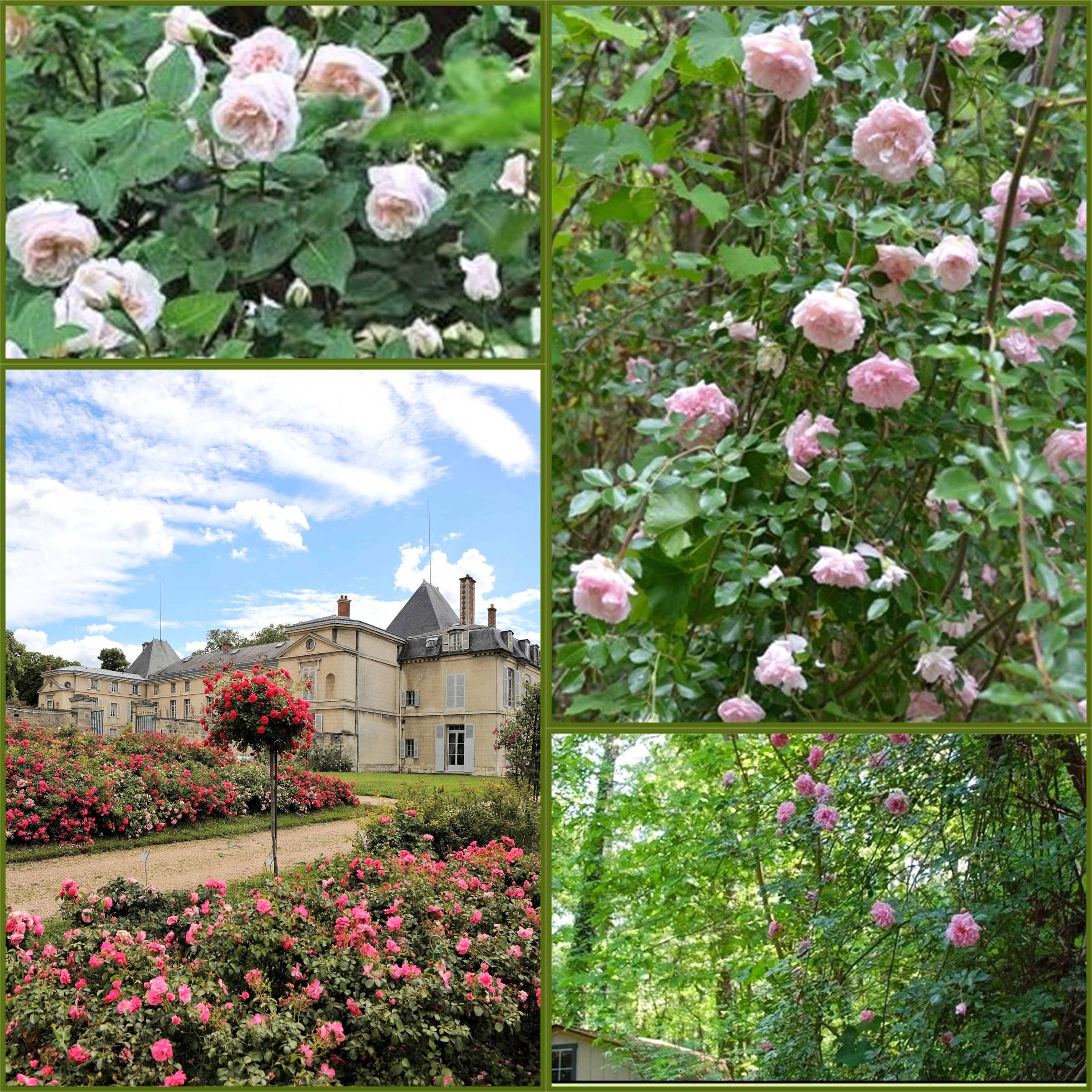
Since 1905 the Malmaison Castle has been a French National Napoleonic museum. Bonaparte had bought it for his wife, Josephine de Beauharnais (1763-1814) in April 1799. Napoleon lived in it several years and Josephine died there in 1814. The interior of the castle is one of the few places in France to exhibit a homogeneous set of furniture from the Napoleonic Consulate and First Empire. My mother and I loved to visit the rose garden there. One of their old antique Bourbon roses is called "Souvenir de la Malmaison." Originally it had been called "Queen of Beauty and Fragrance" but when one the Grand Dukes of Russia obtained a specimen from the Malmaison gardens for the Imperial Garden in St. Petersburg it was renamed "Souvenir de la Malmaison" as a remembrance for him. It produces light pink color blooms with a delightful fragrance; it is a climbing rose. I grew one in my garden in Georgia, shown below.
I even drew one of my Souvenir de la Malmaison roses.
The Tour racers drove by numerous lovely and historic towns. To mention and show even some of them would take pages and pages. Stage 13 ended on July 15 at Saint-Etienne. It is the only French city designated Creative City of Design by UNESCO. In 2020, Saint-Etienne also received its second UNESCO label as an "Inclusive City of Design." Saint-Etienne with all its museums and buildings is a permanent design experience, in architecture as well as in every day life. In 1915 the mayor of the city ordered a replica of the Statue of Liberty. Stage 19 ended in the town of Cahors. This city is famed for its wine and gastronomy and holds the label "French Town of Art and History." The famous medieval Valentre Bridge here is part of the pilgrimage path to Santiago de Campostela. The 14th century bridge took 70 years to complete, from 1308 to 1378 (in center of collage below.) Two new cities on the Tour were Lacapelle-Marival with its blue lake (bottom left) and Rocamadour (top left below.) From the Middle Ages on Rocamadour has been visited by pilgrims as it is also on the route of El Camino de Santiago. The population of 600 rises to 1.5 million tourists in summer.
The 21 stage ended in Paris as usual. The winner of the Tour this year was the Danish rider Jonas Vingegaard. He is the first Danish rider to win this race since 1996. At the start of the race in Copenhagen, 35,000 paying fans had packed into the Tivoli Gardens to greet the riders. They must have been deliriously happy to have one of their own win this grueling race. The 25-years old Vingegaard showed an impressive display of strength. He is below with his little daughter Frida.
Another thrilling Tour de France has ended. Now we have to wait for the 2023 rendez-vous in Bilbao, the Basque country of Spain, for the Grand Depart of the Tour de France 2023.

Wednesday, July 28, 2021

Tour de France 2021 and the 14th of July (Bastille Day)

The days flew by since my last blog post. I traveled back to Georgia twice in June as I knew I would not go in July. In July I stayed with my eldest grandson while the other three grandchildren attended a summer day camp in another state. Then I traveled to that day camp when my daughter had to come back. I just returned a few days ago. For the first time in years I was unable to watch the Tour de France very much. There was no television access where I was staying. I went back to the official Tour web site and watched highlights. Most of the photos here are courtesy the official Tour de France site. Below is the Tour route for 2021.
The route of the Tour de France is planned several years in advance. The start of the 2021 Tour (known as the Grand Depart) was to take place in Copenhagen, Denmark's capital. But, because of the COVID-19 pandemic it was tranferred to the port city of Brest, Brittany, France. Brest has been a military harbor since 1631. The 108th Tour started there on June 26, 2021 and concluded in Paris on July 18, 2021. The Tour covered 3,414.4 km or 2,122 miles during the 21 days of bicycling. At the start of Stage 1 in Brest there were 23 teams with eight riders in each team for a total of 184 international cyclists. There were 8 flat stages, 5 hilly stages, 6 mountain stages (with three summit finishes) and 2 individual time-trials (plus two days of rest.) As usual the cyclists rode through warm and cold weather, fog and rain. (Click on collage to enlarge.)
Each year I believe I have written a blog post on the Tour de France, giving its history, explaining the stages, the jerseys and so on. For more information please go to Tour de France on the right of my blog under Categories. As I explained in my blog post "Summer of 2017 and the Tour de France", a caravan of decorated vehicles rolls ahead of the Tour. It was founded in 1930 as a warm-up act for the arrival of the cyclists. These promotional vans come blaring down the roads with horns and music. Young people in them wave to the crowd and throw key chains, hats and other promotional gifts from the gaudy floats. Fans, who have been waiting for hours to see the Tour, look forward to catching a free souvenir from them. This year there were 150 promotional vehicles throwing 12 million recyclable gifts to the crowd.
Below are some publicity vehicles from prior years.
One of my favorite sprinters, Peter Sagan from Slovakia, had to abandon the Tour due to a knee injury. But another favorite sprinter, Mark Cavendish from the UK, won four stages. Now with 34 Tour de France stage wins, he has equaled the legendary Belgian Eddy Merckx, former professional bicycle racer (born in 1945.) Cavendish is one of the greatest field sprinters of all time.
In Europe alone 150 million watched le Tour de France 2021 on television. Along the route, spectators were asked to wear a face mask, and most of them did. It is estimated that the number of spectators along the route was between 10 and 12 million.
With so many fans along the narrow roads, some of them can cause accidents. This year a spectator holding a hand-written sign for her German grandparents, caused a massive crash during the first stage of the Tour. She stood with her back turned towards TV cameras, and blocked part of the road. Tony Martin, the German rider, hit the cardboard sign then a bridge. This caused a huge pile-up behind him with 80% of the peloton crashing on the pavement. A total of 21 riders were injured, some with broken bones and head injuries. Three riders were forced to abandon the race at this early stage, a German, a French and a Lithuanian. The Tour de France is such a tough endurance event where injuries are frequent that an accident caused by a spectator is a terrible shame (and infuriating!)
The helicopters above the Tour always offer great views of the surrounding landscape. Below are photos of some of the French towns the Tour visited. From top left to right: la Maison Carrée, an ancient Roman temple in Nimes that inspired the church of the Madeleine in Paris, and Thomas Jefferson's design of the Virginia State Capitol. Then the Nimes Roman arena, Saint Lary Soulan, Sorgues, Carcassonne, Brest, Malaucene, St Emilion, Libourne, St Paul Trois Chateaux with its lavender fields and St. Gaudens.
This year Stage 15 of the Tour finished in Andorra La Vella, the capital of the Andorra principality. Andorra is a landlocked sovereign microstate, the sixth-smallest in Europe. It is bordered by Spain and France. It is believed to have been created around the year 780 by Charlemagne (768-814.) The population of Andorra is 77,000 and about 10 million tourists visit it each year, mostly during winter sport and also for its countless duty free shops and boutiques and for its ancient monuments. Andorra has the highest life expectancy in the world at 83 years for males and 85 for females (life expectancy is 77.3 years in the USA.)
After going up hills and down dales...
... the most popular and prestigious event on the international stage race ended in Paris. The winnmers of the 2021 Tour de France were: Tadej Pogacar of Slovenia, who won last year as well. The second winner was Jonas Vingegaard of Denmark and third Richard Carapaz of Ecuador. The sprinter green jersey went to Mark Cavendish of the UK, the mountain polka-dot jersey went to Tadej Pogacar as well as the white young rider jersey. The combativity jersey went to Frank Bonnamour of France; the winning team was Team Bahrain Victorious.
On the 14th of July, French National Holiday (Bastille Day) I was still away. Later I watched the traditional two-hour Paris parade on the French ministère des Armées (Ministry of the Armed Forces) video. This year the parade theme was "Winning the Future" which, according to General Christophe Abad, Military Governor of Paris - referred to the nation's collective ability to overcome the difficulties associated with the health crisis. For the armies, it referred to the fact that they are geared towards tougher engagements by relying on high-tech equipment. The center photo shows the men from "Operation Barkhane" an anti-insurgent mission led by the French military against the Africa's Sahel region's Islamists. This French force mission started in August 2014 in N'Djamena, the capital of Chad, with 5000 men. It will end in 2022.
July 14th fireworks in Paris, courtesy La Ville de Paris (official City of Paris site) that I had watched later.
P.S. I bought some of the face masks shown in the heading collage at the Red Bubble Market Place, https://www.redbubble.com/ Also, I'll try to finish part 2 of my mother's during WW2 post at a later time.

Sunday, May 23, 2021

Recollection: My mother during WW2, part 1

My younger daughter asked me to return to writing blog posts about my early recollections of Paris and my family. My mother's birthday was in May, French Mother's Day is the last Sunday in May or May 30,2021, so I'll write a very old memory about my mother during the war years. In 2009 I wrote a post about my mother's childhood "Mother's Birthday" you can read it here. It was followed in 2010 with a post about her youth and work in Paris and on the French Riviera "Mother's Youth and the House of Worth" you can read it here. For many years I gave my mother a hydrangea plant for Mother's Day; this is why I show some here.
As time passes, our memories fade and the visual information on them becomes vague. But some memories seem etched in the mind for ever. There are different types of memory: short term memory, sensory memory, long term memory that includes explicit memory, semantic memory and episodic memory. Episodic memories are generally about specific moments in one's life, with sensations and emotions associated with the event. Subsets of these are autobiographical memories including "flashbulb" memories which are highy detailed vivid "snapshot" of an exceptional and often emotional circumstance. The story I'm going to relate belongs to this type of memory as I was just past 4 years old but I still remember it. I don't have many photos of that period, of course, but I have photos showing me at the time.
One thing I remember about that time is the sound of the sirens urging us to go down to underground shelters as bombers were in the area. Some afternoons we would also go to public garden squares where my mom would sew and I would play. Once in a great while we would take a bus around Paris - I liked to stand in the very back of the bus in the open air.
From the bus I could see the rare cars (as gasoline was unavailable to private people,) bicycles, bike-taxis or tandem taxis as well as horse carriages. (Click on collage to enlarge.)
Mother must have left me with a neighbor when she went food shopping as I don't remember going with her then. Queues were long.
The Germans occupied Paris from June 1940 through August 1944 and seized about 80 percent of the French food production. There were acute food shortage and malnutrition amongst children, the elderly and in large cities where people could not maintain a vegetable garden. (Only 3/4 pound of meat with bones a week per family, if you could find it.) French food rationing was more stringent than that of any other occupied country in Western Europe. Ration books were issued for everything: food, clothes, coal, etc. until 1949. I don't remember eating much as food access was not normalized until the early 1950s.
Farmers raised rabbits to sell to city folks as they reproduced quickly. Some city people even raised rabbits on their balconies or cellars. My mother had been a "première d’atelier" or head seamstress in high fashion houses in Paris. She presided over the "atelier" (workshop) overseeing up to 30 seamstress and apprentices. She was the right-hand of the designer and had to be able to translate the designs into the right fabric, cut, etc. She could work with furs as well. She had a friend, Sarah, who worked in a fur shop, not far from our apartment. We would stop there often and my mother would make rabbit vests or other small garments that she would barter with farmers for one egg a week for me. I remember the little shop well; it was about 1/2 mile down the street Rue de Rochechouard. Several years ago while in Paris I tried to find where the fur shop used to be, but it was no longer there. I think it was located in Rue Lamartine. Below are maps of Paris arrondissements or quarters. We lived at the top of the 9th, below the Sacré-Cœur Basilica, that is located at the top of Butte Montmartre, the highest point in Paris. Below, on the top right is shown in blue the 1/2 mile walking trip from our apartment to where my mother's friend worked, a 10 minute walk.
My mother's friend wore a yellow star on her coat. At the time, I did not know why. Later, of course, I read about it. In May 1942, on the advice of Nazi propagandist Joseph Goebbels, Adolf Hitler ordered all Jews in occupied Paris to wear this yellow ID badge on the left side of their coats. Two months later, on July 16-17 1942, the Nazis had the French Police make mass arrest of 13,000 foreign Jewish families in Paris and suburbs. This was called "La Rafle du Vel d'Hiv" an abbreviation of the Rafle du Vélodrome d'Hiver. The victims were sent to Auschwitz concentration camp. (In 2017, French President Emmanuel Macron apologized and admitted the responsibility of the French State in this raid.) (Photos courtesy French Wikipedia.)
I don't have photos of the various capes, hats, jackets, vests and manchons (hand warmer) my mother made with the rabbit fur, but years later she made a white rabbit cape for my eldest daughter, shown below. I also found examples of rabbit vests as she used to sew (she made one for my late husband to wear outdoors.)
My memories of that time are rather vague, but I was 4 years old at the time. However, the following event I remember well. We had walked to Sarah's shop and my mother was upset. I remember she was arguing with Sarah - I don't remember the words, but Sarah kept saying no and my mother yes. Then Sarah took her coat (with the yellow star) and my mother threw it away. Then I remember trying to keep up with them as they walked up the street toward our apartment. My legs were not very long as seen in the photo below, in a dress my mother had made for me.
We proceeded to walk up to our apartment, which was on the 6th floor (without an elevator.) Then I played while Sarah and my mother went up the 7th floor where my father had his jewelry workshop (he was an artisan jeweler, diamond dealer.) I am not sure how long Sarah stayed there - days? weeks? Later I remember going up when Sarah had left. There was a small bed on the side and heavy navy blue blankets on the window to keep the lights out. In old Paris buildings the seventh floor used to have single rooms for the maids, with one or two toilets in the hall. Mother would be careful to make sure no one was around when she took food up to Sarah. In the collage below you see the entrance to the Cité on top left, next to our building, below on the left with window ajar is where my father's workshop was, then the main courtyard. We kept this apartment until the mid 1970s.
Several days later, or a couple of weeks, I am not sure, there was a loud knock on our front door. My mother opened the door and was pushed forcefully out of the way by two or three scary looking tall men. I remember they were loud with mean voices. Then my father arrived and they pushed him against the wall. They were looking for gold they said (I was told later) because my father was a jeweler. My father, an Armenian, had his business name changed at the time - he had the 3 last letters taken off, ian, that showed his Armenian name; he was stateless then. The Nazis sent many "stateless" people to concentration camps, too - they wore blue ID badges. Anyway, I remember that I wanted those men to stay away from my mum and dad and kept telling the men "I know something... Where someone is hiding..." Later my mother told me she had been petrified that they would listen to me and find Sarah upstairs. But I was annoying them and one of them walked on my feet with his heavy boots and I howled and kept howling. The men shouted at my mum to keep me quiet then they took my father away. It turns out that they were the Gestapo. My father returned a couple days later and went to bed for a while to recoup.
For those who may not know, the Gestapo, abbreviation for Geheime Staatspolizei (German: "Secret State Police",) in partnership with the Sicherheitsdienst(SD "Security Service") were responsible for rounding up the Jews throughout Europe for deportation to the extermination camps. I don't remember what they looked like but I do remember the boots that were so loud on our hardwood floor, and so painful on my feet. I think that for several days afterwards my mother had to carry me down the six flights of stairs and then down to the cellar during air raids. This is my "snapshot" memory - I'll never forget these loathsome men. Then I don't know what happened to Sarah. I think my mother's cousin worked with or had a friend in the French Resistance who had told him about the roundup of Jews in our Paris quarter. He also was able to get Sarah out of Paris and to a safe location or overseas. Both my parents never talked about it. But my father had our front door secured after that. The outside view looked the same but the inside was in metal. It was an armored door with a bar (in case the Gestapo would come back.) I found a couple of pictures that give example of the outside and inside door - our door was a double door.
All this happened a long time ago. The Nazis are gone (well, maybe not everywhere, as seen in the white supremacist rally in Charlottesville, Virginia, by supporters of Donald Trump.) Germany has given reparation to the Jews and the Jews have moved to Israel. Although, there again, the citizens of Israel of nowadays are not the old citizens of after the war. I have been reading articles by the late Maurice Rajsfus (1928-2020.) He was a writer, journalist and militant. He wrote numerous essays on the Jewish genocide in France, the police and politics. His parents were Jews from Poland who had moved to Paris in the 1920s. His parents were rounded up in the Vel d'Hiv rafle of 1942 and sent to Auschwitz. His elder sister and he survived as they were born in France. 75% of French Jews survived to the end of the war (many were hidden like Sarah) in contrast with countries like Poland and the Netherlands where a lot more perished. It is said that the French Police collaborated with the enemy and denounced foreign Jews to save French Jews, but I don't absolve the French Police anyway - they were not innocent. (Below, Paris under German occupation - 1939-1944.)
Maurice Rajsfus wrote several books and I'll look for them when I go to Paris, in particular the book he wrote when he returned from a trip to Israel. I'd like to read what his feelings, as a Holocaust survivor, are about current Israel. I did read a remark he made, in French, and I'll translate: "...Israel is not my problem. It was a country like any other, to visit perhaps, if the opportunity arose. Once there, I modified this assessment ... I have always distanced myself from this state - since 1948... The world looks at Israel, judges its actions, admires or condemns them. As far as I am concerned, I refuse to bear part of the burden of this Jewish country which subjects the Palestinians to conditions of oppression that some of its citizens experienced in the past, elsewhere. I don't want anyone to think I am an accomplice - to any degree - of those who consider it normal to make the Palestinians pay for the crimes commited by the Nazis."
After my mother died in 2002 I found out that she had saved more Jewish people, when I was a baby. This will be for the part 2 of this post... more to come...
"Peace has no borders." - Yitzhak Rabin, Prime Minister of Israel (1922-1995)

Tuesday, September 29, 2020

Postponed Tour de France 2020 ... and Slovenia


The month of July came and went and no Tour de France to watch.  For a while we were afraid it would be cancelled because of COVID-19, but it was postponed until September.  I watched it on television or by streaming on my iPad.  As you can see from the heading photo (courtesy Nice Matin) the 2020 Tour de France started on the French Riviera in Nice.  Below is the route.

The 107th Tour started in Nice on August 29, 2020 and concluded in Paris on September 20, 2020.  It ran for 23 days with two rest days.  The total distance was 3,484 km or 2,165 miles.  There were a total of 176 riders from 22 teams (8 riders per team.)  The 21 stages included 9 flat, 3 hilly, 8 mountain stages and 1 individual time trial.  For more information on the Tour de France in general, please go to Tour de France on the right of my blog under Categories.  It was odd to see the riders wearing masks.  Below in black is Colombian Egan Bernal who won the Tour in 2019 and in green my favourite rider from Slovakia Peter Sagan.

This year I did not watch the Tour as carefully as in previous years because there were many riders I did not know.  But as usual the landscape views along the route were outstanding.  I took more pictures of the sights than the riders and with 21 days of viewing I ended up with over 200 photos.  The commentators give facts on culture, castles, churches, villages, history and natural sights of each area of the stages.  Some of my friends watch the Tour just to see the landscape and listen to the cultural information.  Two helicopters follow the Tour and four motorbike photographers along the route capture all these lovely shots.  You can see the helicopter above the mountainous road below, at 12 o'clock, and the motorbike photographers.

Below views from stages 1, 2 and 3 - please click on collage to enlarge.
 

From stages 4 through 6 -

From stages 7, 8 and 9 -

From stages 11, 13 and 14 - 

As the helicopters were flying over the western central area of France the commentators mentioned that near the city of Vasles was a sheep reserve.  I was intrigued and looked for it.  It is called "Mouton Village" (mouton is sheep in French.)  It is a large protected park planted with more than 4,000 trees: araucaria, eucalyptus, etc. to house the sheep in their original habitat.  It is the first park in France to host twenty-two sheep breeds from around the world, such as the "rabbit-headed" sheep (Border Leicesters,) the Racka sheep from Hungary with their unusual spiral-shaped horns and the Romanov from the Upper Volga in Russia.  Below are some of their sheep (the park can be visited by the way) -

The small town of Vasles (population 1,100) also counts two castles: an old medieval one built between 1467 and 1471 and a private one, called Castle of the Sayette.  I checked this last one and found out that it has been the home of 26 generations or seven centuries of de la Sayette family.  They opened a small hiking trail on the castle ground last year and the sheep from Mouton Village used it to move to higher fields during the summer.  Below is the Chateau de la Sayette.

The helicopters often take close-ups of the castles below.  The commentators seem to be working for the French Tourist Office because they immediately enumerate all the pertinent historical details of the various landmarks - such a great variety of castles to stare at from my den sofa ...

Photos from stages 15, 16 and 17 - 

There were fewer spectators along the route this year but those present were following recommendations to wear masks and to keep safe distancing.  The riders themselves, when not in the race, were wearing masks.  The devil was also wearing a mask (this devil fan has been in the sidelines of the Tour since 1993.)

Ready for more castles?

The castle in the center of the collage above is the Castle of Virieu.  It was built in the 11th century by Wilfrid de Virieu.  In the 18th century it was remodeled and extended.  Some of the interior rooms can be visited as well as the main courtyard displaying cannons given by King Louis XIII in 1622.  The family also hosts fairs and festival on the castle grounds.  Since the 13th century the de Virieu family has also owned another castle nearby, the Castle of the Pupetieres, shown in the extreme bottom left of the collage below.

Below is a painting of the Castle of Virieu by British artist Richard Cole.

Photos from stages 18, 19 and 20 -

Toward the end of the Tour it was obvious it would be won by either of the two Slovenian riders.  Slovenia? It was not a country I studied when I was in school back in the days, so I checked.  A Balkan country, the Republic of Slovenia was the first republic that split from the former Yugoslavia and became independent.  Its population is only 2 million.  It is located in central Europe and bordered by Italy, Austria, Hungary and Croatia.  It is shown in red in the map below.

Slovenia is a stunning little country with glacial lakes, spectacular mountain peaks, clear blue rivers and extended forests.  Rick Steve, the American Travel Writer, says of Slovenia: "...It is an underrated gem in the heart of Europe ... Located where the Germanic, Mediterranean and Slavic worlds come together, Slovenia enjoys a happy hodgepodge of cultures while also presenting plenty of its own unique character.  And much like the country as a whole, its capital city of Ljubljana is a delight to explore, yet remains relatively undiscovered... Tiny, overlooked Slovenia is one of Europe's most unexpectedly charming destinations..."  Below are some photographs of Slovenia courtesy Rich Steve and the Slovenian Tourist Bureau.

On Sunday morning September 20, 2020, my cat Mitsouko and I watched TV for the conclusion of the Tour de France.  It is always a treat to see the riders arriving in Paris along all the favourite landmarks.  The City of Paris had only allowed 5,000 spectators; the streets were almost empty.

Then it was over.  This is the general ranking: overall first place winner - Tadej Pogacar of Slovenia for the team UAE.  He also won the polka dot jersey as best climber and white jersey as best young rider.  2nd overall place - Primoz Roglic of Slovenia, 3rd place Richie Porte of Australia.  The green jersey (fastest runner) went to Sam Bennett of Ireland.  The most combative went to Marc Hirschi of Switzerland.  The winner, Tadej (pronounced TaDay) born on September 21, 1998, was the youngest cyclist to win the 2019 Tour of California.  He also won 3 stages in this Tour de France.  He is the first Slovenian winner of the Tour de France and at 21 became the second youngest winner since 1904.


I took a last picture from my TV screen as the sun was setting over Paris.