In June or July 2022 I watched an interview with the dancer and choreographer Mikhail Baryshnikov on the TV show CBS Sunday Morning. The music from the short clip of him dancing sounded very familiar; I did not know from which ballet this was. For the next several weeks I tried to find out on the Internet where this short dance came from. Finally I found out that it was called the Basilio Variation from the Ballet Don Quixote. I really wished to see this ballet that I had never seen. I had attended ballet performances in Paris at the Opera Garnier, at the San Francisco Opera House, Odessa National Academic Opera and Ballet Theatre in Ukraine, and during my first stay in St. Petersburg, Russia, at the Mariinsky Ballet and Opera House, but never seen this ballet. It had been at least 5 years since I attended, with my late husband, the Moulin Rouge ballet in Atlanta, Georgia.
Then I researched for a while to find where this ballet might be performed within the next few months. I checked all the large cities ballets, such as New York, Los Angeles, San Francisco, Miami, Chicago and more. Then I checked Paris, London, Amsterdam, Zurich, Vienna and Venice - It had been performed there in previous years but not in the near future. I almost gave up and then checked Atlanta. Surprise! It was on the Atlanta Ballet season for 2023, in March. I could not believe that it was so close to home. I waited for tickets to be available and quickly bought one last November. Then my younger daughter told me they were all going to San Salvador for spring break and would fly back into Atlanta just a couple of days before the performance, so I was lucky to find two tickets next to me for my daughter and granddaughter for the Saturday March 18, 2023 matinee performance at the Atlanta Cobb Energy Performing Arts Centre, where ballets take place.
Now I had time to do my favorite thing - research the story, history of the ballet, the music, the artistic directors and choreographers, where and when it had been performed for the first time and more. I found some interesting facts. First of all, the Spanish epic novel Don Quixote was written by Miguel de Cervantes in two parts, in 1605 and 1615. It is considered the first modern novel and one of the greatest. It has been translated into 50+ languages and is the best-selling novel of all times (at least 500 million copies so far.) It has had a great influence on Western books, plays, movies and works of art since then. It offers universal truths, commentaries on social life and provides escapism. Below is Miguel de Cervantes (29 September 1547 - 22 April 1616.)
and some book covers of his novels in several languages; the bottom right one one is an e-book. (Click on collage to enlarge.)
Italy in the 17th and 18th centuries was the European country where one should travel to visit Roman ruins, or view statues, paintings and so forth. But starting in the 19th century, around 1820, travelers switched their interest to Spain. Writers like Victor Hugo, Alexandre Dumas and others thought that Spain offered more inspiration and adventures. French and Russian writers, painters, musicians, and choreographers were inspired by Spain. Europe as a whole shared a fascination for Spain.
Alexander III (1845-1894) Emperor of Russia, was a patron of the ballet, and requested a Spanish-themed ballet be shown in Russia. The imperial theatre commissioned Marius Petipa to mount and choreograph a work in the Spanish style. Below photo of Petipa.
I found the life of Marius Petipa fascinating. Victor Marius Alphonse Petipa was born in 1818 in Marseille, France. His father Jean Antoine Petipa was working as principal dancer and Maitre de Ballet in Marseille. Petipa's mother, Victorine Grasseau, was a drama actress playing tragic roles. His brother Lucien became a distinguished dancer and his sister, Victorine, a noted singer. They were a close-knit family. His father began teaching ballet to Marius when he was seven, and at the age of nine he made his stage debut in one of his father's ballets at the Theatre de la Monnaie in Brussels, Belgium. Marius was appointed to the Ballet of Nantes, France, as principal dancer then in Bordeaux. Below is the Petipa family, with Marius on the left, then his brother Lucien, his sister Victorine and mother Victorine.
In 1843 Marius started a 3-year working tour in Spain where he became master in Sevillian dances and castanets. He then began to choreograph his own ballets. He had already spent time in Paris where his brother Lucien was principal dancer at the Paris Opera. Lucien worked also in Russia and provided Marius with an invitation to travel to St. Petersburg, Russia, in 1847 to become principal dancer at the Imperial Ballet. A year later, in 1848, his father joined him there to be a teacher at the Imperial Ballet School (call the Vaganova Ballet Academy of Russian Ballet since 1957, and shown below.)
Marius Petipa signed a one-year contract in St. Petersburg but was to live there the rest of his life. Following his father's path as a ballet dancer he then had a career in choreography where he created more than 60 ballets, reworked 20 old pieces and re-arranged the dancing in over 35 operas. He also prepared galas and divertissements for court performances, royal nuptials, etc. The St. Petersburg's public adored the ballet and expected brilliant performances; news media reported every detail. Petipa had to keep the highest standards of excellence and perfection, and he did. Tsar Nicholas I attended Petipa's debut performance in October 1847 and a week later presented him with an Imperial gift of a ruby and diamond ring, the first Royal gift in Petipa's long career. The Russian Emperor's treasury (who at the time was the world's wealthiest person) - lavished millions of rubles a year on the Imperial Ballet and Opera, and demanded opulent ballets with perfect technique. Petipa became the Imperial Chief Ballet Master and principal choreographer until 1903 - at 85 years of age.
When Petipa in early 1869 was asked by an Imperial Special Commission to mount a Spanish-themed work he suggested that Ludwig Minkus write the music for the ballet he was considering, a tale from Cervantes' Don Quixote. I read on Minkus - he was also an interesting man. Ludwig Minkus was born on March 23, 1826, in Vienna (at the time the capital of the Austrian Empire.) Minkus' father was a wholesale wine merchant and owned in a district of Vienna a restaurant with its own orchestra. Ludwig started playing the violin at age four and made his public debut at a recital at the age of 8. Later he had an orchestra that competed with another Viennese conductor, the young Johann Strauss, II. In 1853 Ludwig immigrated to St. Petersburg to be the conductor of the orchestra for Prince Nikolai Yusupov. He went on to serve as conductor and principal violinist in the orchestra of the Moscow Imperial Bolshoi Theatre, and was then promoted to the prestigious position of Inspector of the Imperial Theatre Orchestras in Moscow. Below photo of Ludwig Minkus (1826-1917) taken between 1865-1870.
Minkus was an excellent choice to compose the music for the Don Quixote ballet. He was a connoisseur of ballet craft. His music bubbling like Champagne invited artists to dance. Petipa and Ludwig worked well together to create cheerful music and dances in the Spanish and Gypsy styles. Ludwig Fyodorovich Minkus (also known as Leon Minkus) became known as one of the greatest ballet composers who co-created with Petipa some of the most famous of classical ballets including La Source (1866, composed jointly with Leo Delibes,) Don Quixote (1869) and La Bayadere (1877.) Today, Minkus' ballet music is still quite popular and performed in the traditional classical ballet repertory. Cervantes' novel had been adapted into a ballet several times: in Austria in 1740, in Vienna in 1780, in 1809 in St. Petersburg, in 1839 in Berlin and in 1843 in Turin, Italy. For this new production Minkus reworked and expanded the score and supplied music filled with a great variety of Spanish-styled flair. The premiere of Don Quixote on 26th December 1869 for the ballet of the Imperial Bolshoi Theatre in Moscow was a resounding success. Below painting of the Imperial Bolshoi Theatre in 1939 by Alexandr Benois, Russian (1870-1960) followed by the current Bolshoi Theatre and interiors.
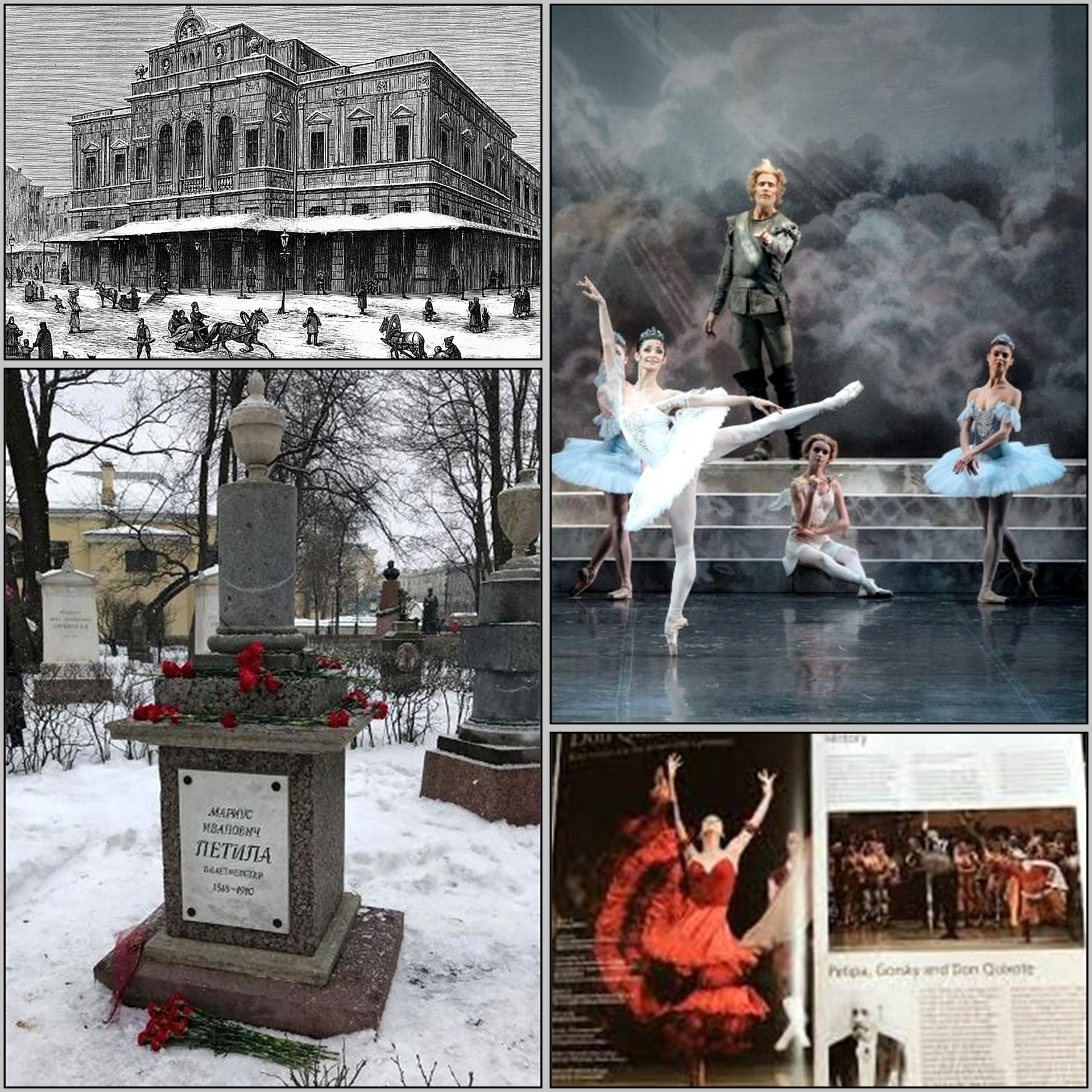
The Don Quixote Ballet was so successful that Petipa and Minkus wrote a revival libretto in 1871 which was shown at the St. Petersburg's Mariinsky Theatre and became a classic. It still enchants the public today and is presented in various productions by different companies all over the world. Petipa went on to create spectacular ballets such as Sleeping Beauty, Giselle, the Nut Cracker, and many others. Petipa married and had 3 children. At the age of 76 he received Russian citizenship while permitted to keep his French citizenship. A year later he worked with Peter Tchaikovsky to stage the ballet Swan Lake. He is a legend, a lord of the dance, and came to be known as "the father of Russian ballet." His work is in the repertoire of most current companies. He retired in 1903 and spent his final years in Crimea where he died on 14 July 1910 at the age of 92. He is buried in the Alexander Nevsky Monastery in St. Petersburg. Below photos of the Mariinsky Theatre circa 1859, Petipa's grave, the Don Quixote's Dream Scene at the Mariinsky and the playbill.
Don Quixote has been staged in many versions, with different music scores and choreography. In 1900 Alexander Gorsky staged a revival of the ballet with music from French composer Antoine Simon. A modern version in 1965 was created by American choreographer George Balanchine to the music of Nicolas Nabokov. In 1966 Rudolf Nureyev danced and choreographed the ballet for Vienna. In 1980 Mikhail Baryshnikov mounted his version of the ballet as well. I always loved watching Mikhail dancing (born in Latvia in 1948.) He truly is one of the greatest dancers of his generation with flawless technique and incredible high jumps. He seems to float across the stage. Misha is a superlative dancer combining balance, control and artistry. He is semi-retired for now as he opened in 2005 the Baryshnikov Arts Center in New York City, where he is active. Below are photos of Mikhail Baryshnikov in his younger years, dancing the Don Quixote ballet and receiving the prestigious Royal Academy of Dance's Queen Elizabeth II Coronation Award at Buckingham Palace on November 16, 2022, presented by Camilla, the Queen Consort (her first solo reception since she assumed her new role.) Camilla, wearing a ballerina brooch on her coat, told him "It's a great honor to be able to give you the award. Nobody deserves it more."
Below is the YouTube clip of Mikhail that indicated to me last summer that I was looking for the Don Quixote ballet.
Looking at the Atlanta playbill I was pleased to see that the choreographer Yuri Possokhov (born in Lugansk, Ukraine) and the artistic director Gennadi Nedvigin (born in Rostov, Russia) had based their Don Quixote production of March 17-19, 2023, after Petipa and Minkus.
Saturday March 18, 2023 was a cool but sunny day in Atlanta. We arrived in plenty of time to walk around the foyer and take some pictures. As you can see from the photo of my grandaughter and me walking toward the orchestra seating of the theatre that she is about as tall as me at 9 years old (I am 5ft 3.) She takes after her mother who, in the photograph, is 6 ft tall with heels.
Another lovely scene from the ballet is Kitri's Entrance in Act I. It is danced by the talented Manuela Nunez in the video below. She is an Argentine-British ballerina born in Buenos Aires on March 23, 1982 and now principal dancer at the Royal Ballet in London.
Drawn from an episode in Part II of the Cervantes' novel this was a two hour but fast moving ballet. I enjoyed the vintage and cheerful Minkus music. The lavish and colorful costumes, the many male dancers (more than in other ballets.) the flamenco dancers, the cheeky humor and the comedy were delightful. Sancho Panza, the trusted sidekick and squire of Don Quixote, brought many laughs. The horse Rocinante, a puppet manned by two Atlanta Ballet students, was entertaining as well. Don Quixote by the Atlanta Ballet had been a fast-paced production with impressive dancing and amusing comedy. I was pleased to have found this enchanting ballet in Atlanta.
Photos courtesy the Atlanta Ballet, Atlanta Constitution and Arts Atlanta as photos were not allowed in the theatre.
While I was still in Georgia before the Holidays I visited again the historic antebellum mansion Bulloch Hall as it was decorated for Christmas. I took many pictures and was going to write a post in early January, but as you'll see below, something happened and I could not. January started well, though. On Thursday, January 2, 2020, my daughter, son-in-law and I went to a movie matinee to see the modern but faithful adaption of "Little Women" directed by Greta Gerwig. I had read Louisa May Alcott's classic book, translated into French and titled "Petites Femmes" or "Les 4 Filles du Docteur Marsh" when I was eleven years old. I did not remember it very much. We all enjoyed this period drama, so beautifully acted. (below photos from the film, courtesy Sony Pictures and LA Times.)
Later I watched a PBS documentary on the 350 years old Orchard House (the home of the Alcott family in Concord, Massachusetts.) It was full of interesting history and information. Louisa May Alcott (1832-1888) wrote her two-part novel in this house in 1868 and 1869. Her book was successful from the start. It was translated into 50 languages and has never been out of print. The virtual tour of the well-maintained house, with its original furnishings, was quite moving. I have gathered several postcards of the house and its interior. (Please click on collage to enlarge.)
While looking at vintage postcards of Concord, Massachusetts, I came upon one featuring Ephraim Wales Bull - so had to find out who he was. It turns out he was a farmer in Concord, also in the 1800s, and a neighbor of the Alcott family. Around 1849 Ephraim planted seeds from the wild vine Vitiz labrusca. After evaluating more than 22,000 seedlings he decided on the ideal one and called it "Concord Grape." The Concord Grape won first place in 1853 in a Boston agricultural exhibition and was introduced commercially in 1854. I had no idea. In the fall if I can find fresh Concord grapes I always buy them as I like their sweet but slightly acid taste. The Concord grape is popular for jellies, juice and more. Poor Ephraim Wales Bull (1806-1895) never obtained any money for his grape discovery. On his grave it reads "He sowed. Others reaped."
On the following day, Friday 3, 2020, my daughter and I went to Nashville's first "Salute to Vienna" New Year Viennese style celebration. Maestro Bernhard Schneider, from Vienna, conducted the Strauss Symphony of America as well as dancers from the National Ballet of Hungary, Ballroom Dancers, a soprano and a tenor. The program included waltzes, polkas, with The Blue Danube towards the end. The lyrics of the classic "Auld Land Syne" were printed in the back of the program so the audience could sing along.
This concert was performed at the Schermerhorn Symphony Center in downtown Nashville. I had never seen it before and thought it was an old building. But no, construction had begun in 2003 and the building formally opened in 2006. It is named in honor of Kenneth Schermerhorn, the late maestro of the Nashville Symphony. It has a neo-classical style with modern acoustic features and has won several design awards. Coming out of the dark parking area, the brightly lit symphony building looked imposing. Once inside I was surprised to see spectators seated behing the orchestra, under the large custom-built organ. It is a special choral loft that can be available during non-choral performances.
This Salute to Vienna concert had been touring the US close to New Year for many years. There are performances in major cities, but in the South, only some cities in Florida and for the first time in Nashville. The concert included mostly Johann Strauss, Jr. (Austrian, 1825-1899) waltzes but also a couple from Franz Lehar's. I knew all of them and I'll tell you why below. It certainly was a delightful evening with lovely music, songs and dances. A great start to the New Year. I just took a few photos with my iPhone.
My mother loved dancing when she was young, in the 1930s. She had spent some time in Juan-les-Pins and told me that she used to go dancing almost every evening. It was the "jazz age" period and people like author Scott F. Fitzgerald lived there as well and had made this French Riviera resort town quite fashionable and in vogue. Mother particularly enjoyed dancing the tango and the waltz. Unfortunately my father was badly injured and handicapped in WW2. But if on the radio a Strauss waltz was played she would stop everything and have me dance with her - even if I was in the middle of playing or doing my homework. By 6 years of age I could dance the waltz, the tango, fox-trot, polka, Charleston and more. This is why I knew all the waltzes and polkas played during the concert. Below is my mother (on the right) with my grandmother, mother (on the right) with a friend and in a small ID photo. She had red hair and pale turquoise eyes.
After my father died in 1974 I went back to visit mother every year after Christmas to be with her about 10 days around New Year. She always had bought some tickets to a musical, tango or Viennese waltzes spectacle, operetta or play in a theatre for the two of us to attend. Then when she became stricken with Parkinson's disease and could not go out she would send for a ticket for me by checking her weekly magazine "Pariscope" that listed all the shows in the capital (and being in the center of Paris there were always a multitude of them.) When I arrived in Paris she would tell me what kind of show I was going to attend. She would wait for my return from the show to listen with excitement for my descriptions and impressions. She did get a tremendous vicarious enjoyment from it.
As you can see I have started the new years with songs and dances for a very long time. It was nice that my daughter invited me to watch the Salute to Vienna to continue the tradition. As my readers know I have been traveling monthly to Georgia to clear out our house there. Last August I became very tired and short of breath. It got worse and worse. I just thought I was aging and kept going on. But by Sunday January 5, 2020, I could not walk across a room without catching my breath and had to sit down. When I finally went to see my doctor he diagnosed Atrial Fibrillation (Afib) which is an iregular heart beat. Because my heart had been running so high for so long I also developed acute heart failure. Bother - now I can't go back to GA for a while. I'm taking a bunch of pills daily and am scheduled for a battery of tests: breathing, stress, MRI, and more and will have to wear a heart monitor for a while until they understand where the heart failure comes from. I can barely walk so have been spending time reading, and listening to music. A friend sent me links to black and white old movies from the 1930s that I can watch on my iPad. I'm trying to watch upbeat movies with dancing and songs. I just watched a couple of old Bob Hope and Bing Crosby films and also "Dancing Feet." It is a 1936 American comedy with a lot of dancing. Here are a couple of pics from this film.
Then I found music from that era on my iPad as well; the type of music famous in the 1920s and 1930s, a time known as the Roaring Twenties and the Jazz Age. I even found a second-hand CD on line featuring "The Great British Dance Bands" from those years. Right now, I prefer to listen to the music from that period - a time of flappers, Art Deco and jazz, instead of turning on the TV and watching more shootings, the terrible epidemic from the Coronavirus or endless political talks.
One of the songs I like was played by Mrs. Jack Hylton and Her Band. I found it also on youTube. It is called "Got to dance my way to heaven." You can listen to it below.
She had a very good and successful band in the UK in the 1930s and sold many records through the Woolworth's stores. I remember when I was in London as a teenager - there was a Woolworth's close
to my host family house. I had not seen those Woolworth's stores in Paris and I thought they were "smashing." I also remember going to change my Francs into Pound Sterling at the Foreign Exchange booth in Victoria Station. Then I'd go to Piccadilly Circus and have tea at Fortnum and Mason, or if money was tight, I'd have a cup of tea at Lyon's Corner House.
As I sat listening to that music it seemed kind of familiar to my ear. It was before my time though as I started traveling to London in 1953 when I was 13 years old. But still. Then, in my mind's eye I could see myself in the late 1950s studying my English on the weekends for my Cambridge exam while staying at my pen friend's home. Wasn't that the music playing in the background? Did I imagine it? So I telephoned my British pen-pal (I have known her since 1953) who is now retired in Florida and asked her. No, she could not remember ...but then... she said "you are right! Mum had an old Gramophone radiogram and she used to play her old 78 records of big bands from the 30s while doing her house cleaning." Her mother, Gladys, just like my mother, had loved dancing in the 1930s. My friend added "but you did not like that type of music then, you liked Dixieland jazz and Fats Domino!" Tastes change, just like in fashion, and mine can change in ...what? over 65 years? Well, here you are, I started 2020 with music and am still listening, even if the melodies are from the 1920s and 30s. I explained my health issues to my friend. She told me, and insisted "you are not sick - you just have a "condition." She is British and speaks proper English, so she must be right - I just have a condition, a heart condition. I feel better already! Wish I could dance ...
Note to Naomi's readers - This post took several days to write. Next post, I'll write about my latest conversation with Naomi.
On Saturday, May 25, 2019, I attended a wedding in Atlanta. The ceremony was conducted under the liturgy of the Syro-Malabar Catholic Church, one of the oldest Eastern Catholic churches. I am not a Roman (or Latin) Catholic and I know even less about the Eastern Catholic churches, so I did some research. There are twenty-three Eastern or Oriental Catholic Churches; they belong to the worldwide Catholic Church but they have they own canons, laws and traditions. For example many of these churches allow the ordination of married men to the priesthood. The total membership of these various churches comes to about 18 million of 1.5% of the Catholic Church compare to the 1.2 billion members who belong to the Latin, Western or Roman Catholic Church. These Eastern Catholic Churches have their origins in the Middle East, East Africa, Eastern Europe and India. Some of my father's cousins belong to one of the Eastern Catholic churches, the Armenian Catholic Church, that follows their own, independent liturgy. The Syro-Malabar Catholic Church is one of the largest and is based in the state of Kerala, in South India. Their community is made of more affluent members.
India is a federal union comprising 29 states and 7 union territories. The state of Kerala is on the tropical Malabar Coast and has 375 miles (600 km) of Arabian Sea shoreline. My son-in-law was born in the US but his parents are from Kochi (also known as Cochin,) a major port and the financial capital of Kerala; the bride was one of his mother's cousins. I read up on Kerala and Kochi and include some information here. Large parts of Kerala such as Kochi were autonomous kingdoms rules by Maharajas during the British rule of India. They were more progressive especially in education and health care. Now Kerala is considered one of the safest regions of India with a high standard of living and their education, life style and healthcare are on par with developed countries. It has the highest literacy rate (93.91% in Kerala and 97% in Kochi - the literacy rate in the US is 86%,) the highest life expectancy (77 years - the US is 78 years) and the lowest positive population growth rate in India. The state has lush green vegetation palm-lined sandy beaches, mountains, tea, coffee and spice plantations, canals, backwaters and more. Kerala is known in India as God's own Country. National Geographic Traveler names Kerala one of the "ten paradises of the world." Below are some photos, courtesy Kerala Tourism. (click on collage to enlarge.)
Kerala has many ayurvedic spas and treatments, eco-tourism initiatives as well as national parks, wildlife and bird sanctuaries. The state is home to elephants, langur monkeys and tigers.
The city of Kochi, also known as the Queen of the Arabian Sea, was a spice trading partner with the Arab merchants of the pre-Islamic era. It was occupied by the Portuguese from 1503 until 1530 when the Portuguese moved to Goa. Many international tourists visit Kochi; tourism is a major contributor to the economy. It also has a sizeable expatriate population, mostly European retirees. International cruisers call on the port of Kochi regularly. It has the first marina facility in the country attracting a large number of yacht owners.
Kochi is a cosmopolitan city with a variety of temples, churches, mosques and synagogues. The oldest group of Jews in India reached Kerala in the 10th century BC. The Paradesi Synagogue was built in 1568 and is the oldest active synagogue in India. Indira Gandhi, then the Prime Minister of India, came in 1968 to celebrate its 400th anniversary. Hinduism is practiced by 47% of the Kerala population but with its 35% Christians, Kochi is the city in India with the largest Christian population. Syro-Malabar Catholics trace their origin to St. Thomas the Apostle, who is said to have come to India in 52 AD. The adjective "Syro" in Syro-Malabar refers to the liturgical rite that the Christians celebrate and to distinguish it from the "Latin" liturgy, not to Syrian ethnicity. These Catholics, also called St. Thomas Christians, have a distinct culture, influenced by both Hindu and Jewish customs, with special wedding customs and rituals. Several hymns in the wedding ceremony were in Malayalam, their native language. Below are several Syro-Malabar churches in Kerala apart from the bottom right picture which shows the interior of the Paradesi Synagogue.
The families of the bride and groom, the extended family, and most friends were from Kerala and living in various states of the US, from India, especially Kochi or were first generation Americans from Kerala parents. The ceremony was going to take place at the small church in Gwinnett County where the Syro-Malabar priest officiates, but since there were 300 guests attending the wedding another church was selected. The ceremony was celebrated at Mary our Queen Roman Catholic Church in Atlanta, a new church dedicated just a couple of months ago. Three Syro-Malabar priests celebrated the sacrament of matrimony (the usual pastor of this church was away on Memorial Day holiday.) As you know I do like to research everything and wanted to know more about this new church. What I found is interesting. It seems that parishioners in the community had been gathering funds for many years to build a new larger Catholic church. St. Gerard's Catholic Church in Buffalo, New York, founded in 1902, was closed several years ago. The initial plan was to dismantly St. Gerard's brick by brick and move it down to Atlanta. Instead the Atlanta congregation decided to build a replica of the Roman Basilica-style church that was St. Gerard's and buy the century-old stained-glass windows, pews, altar and other liturgical elements of the old church.
As shown above, St. Gerard's Church building was sold to the Muslim community in Buffalo who needed a new mosque. Part of St. Gerard's is now incorporated into Mary our Queen Catholic Church in Atlanta and the old building in Buffalo is now the Masjid Al Salam. This is what could be called divine recycling (-:) After all this background information, which I thought would help appreciate the wedding and ceremony, I'll finally get to the wedding! A booklet "Order of Service" was given to everyone so we could follow the ceremony - and that certainly was helpful. The church service lasted over two hours and part of it was in the Malayalam language. First came the three Syro-Malabar priests wearing beautiful vestments, in ivory, red and embroidered in gold.
The groom came in with his parents and sat down, and everyone waited. I'd say about 99% of the ladies were wearing Indian clothing - sarees, half sarees, anarkali, lehanga, etc. The colors were exquisite, richly embroidered, heavy silks - a feast for the eyes. They were some of the most beautiful garments I have even seen. I took very few photos of them to preserve their privacy but I found similar clothing on Indian catalogs. I have a couple of Indian outfits but they are for winter wear so I was one of the exception wearing western clothes. It was very warm, close to 95 F in the shade (35 C.) One of the guests who came all the way from Kerala, India, for the wedding told me that it was the same temperature over there.
The mother of the bride, in purple and gold, was escorted to the front of the church. The eight bridesmaids and maid of honor wore long lavender gowns. A small boy, the ring bearer, was ahead of the 5 flower girls (my granddaughter was one of the flower girls.)
Music was being played. Most hymns were different than those usually heard in Catholic or other Christian churches. The Syro-Malabar liturgical chants originated in the Middle East in the 5th century and the hymns had Middle Eastern-Indian sounds. The bride walked up the aisle with her father and the groom joined her at the altar. There was a prayer, then a song - 3 young ladies singing in Malayalam. Then readings from the Bible were followed by another hymn. The main priest gave the homily followed by more prayers. The groom then placed the "Thali" around the neck of his bride. It is a Bunyan tree leaf-shaped pendant embossed with a cross - the symbol of the Covenant of Marriage. This was followed by the blessing of the rings and the blessing of the "Manthrokodi." It is a wedding garment covering the bride's head during the blessing, followed by another hymn and the matrimonial pledge - when the couple places their right palms on the Bible. Then more prayers, more hymns during the two-hour service. It ended with the couple presenting flowers to the Virgin Mary then lighting the Unity Candle. The couple departed followed by the bridesmaids, flower girls, family and friends and so on.
After mingling and talking with guests in the front of the church the newlywed came back to the altar to take pictures with their close family while I was taking pictures of the church.
The reception was at the Hilton. First we had drinks at an open bar and buffet style hors d'oeuvres. We then proceeded to our tables in the reception hall. The main priest did a welcome blessing then the groom's parents followed with the Lighting of the Lamp (a special ceremonial oil lamp that features a cross unique to the Indian tradition.) The groom thanked the assembly for attending the wedding. Then it was time for the bride/father dance, followed by the groom and bride dance. After which the young couple sat on a sofa on the podium and received family and guests and took pictures.
There was an announcement that four dinner buffets were opened with an assortment of western and Indian foods - all excellent. While we ate dinner there was Indian dance entertainment, two young boys, then two young ladies, then more ladies, then more dances. I came close to the dance floor to take pictures - my granddaughter was in front of me.
Everyone was enthusiastically clapping, shouting encouragements - it was an exciting atmosphere. Men came to join the dancers and everyone shouted - they were very good. Then the groom joined the dance - more shouts. When the bride came to join the dance, after having changed out of her bridal dress, the crowd went mad! Music, dancing, shouting, clapping, laughing, lights going from purple to white to pink - it was something else! The bride and groom thanked all the dancers. Click on collage to see better - my photos are a bit dark as I did not use the flash.
I tried to find similar dances on youtube and if you click below, you'll get an idea about some of the dancing.
There were games, then most everyone - the young crowd - went to the dance floor. The DJ placed some very loud and trendy music - I might call it Indian hip hop... I watched while eating my piece of wedding cake. I took a picture of the dancing floor - you can see the backs of my eldest and youngest grandsons, my daughter in the pink sari and my granddaughter. My son-in-law and middle grandson joined me in another part of the reception hall away from the loud music and we watched at a distance. It was easy to see my daughter with her bright coral-pink sari and with her high heels she is about 6 ft.1" tall (1 m 85.)
My daughter and granddaughter finally came back as the music stopped. It had been quite a memorable and fun wedding!