Showing posts with label castle. Show all posts

Wednesday, December 28, 2022

Downton Abbey in Atlanta, part 2

In an older entry of the Harvard University's blog a post was titled "No, it's not just you: why time "speeds up" as we get older." A short article then gives one of he reasons" "...over time, the rate at which we process visual information slows down, and this is what makes time 'speed up' as we grow older..." you can read the argument here. Could be one of the reasons time is speeding up for me. Year 2022 is almost at the finish point but I feel that we should only be halfway through it. It seems that the years quicken as my birthdays accumulate. Last December 2021 I wrote a post on an exhibition in Atlanta on Downton Abbey, part one, and before I could write part two, we were already in March, and too late for a holiday post. But since we are back in a month of December, and the clock is ticking quickly toward year end, below is part two. You may wish to go to part one to look back at some of the photos and explanations - click on "Downton Abbey in Atlanta, part 1."
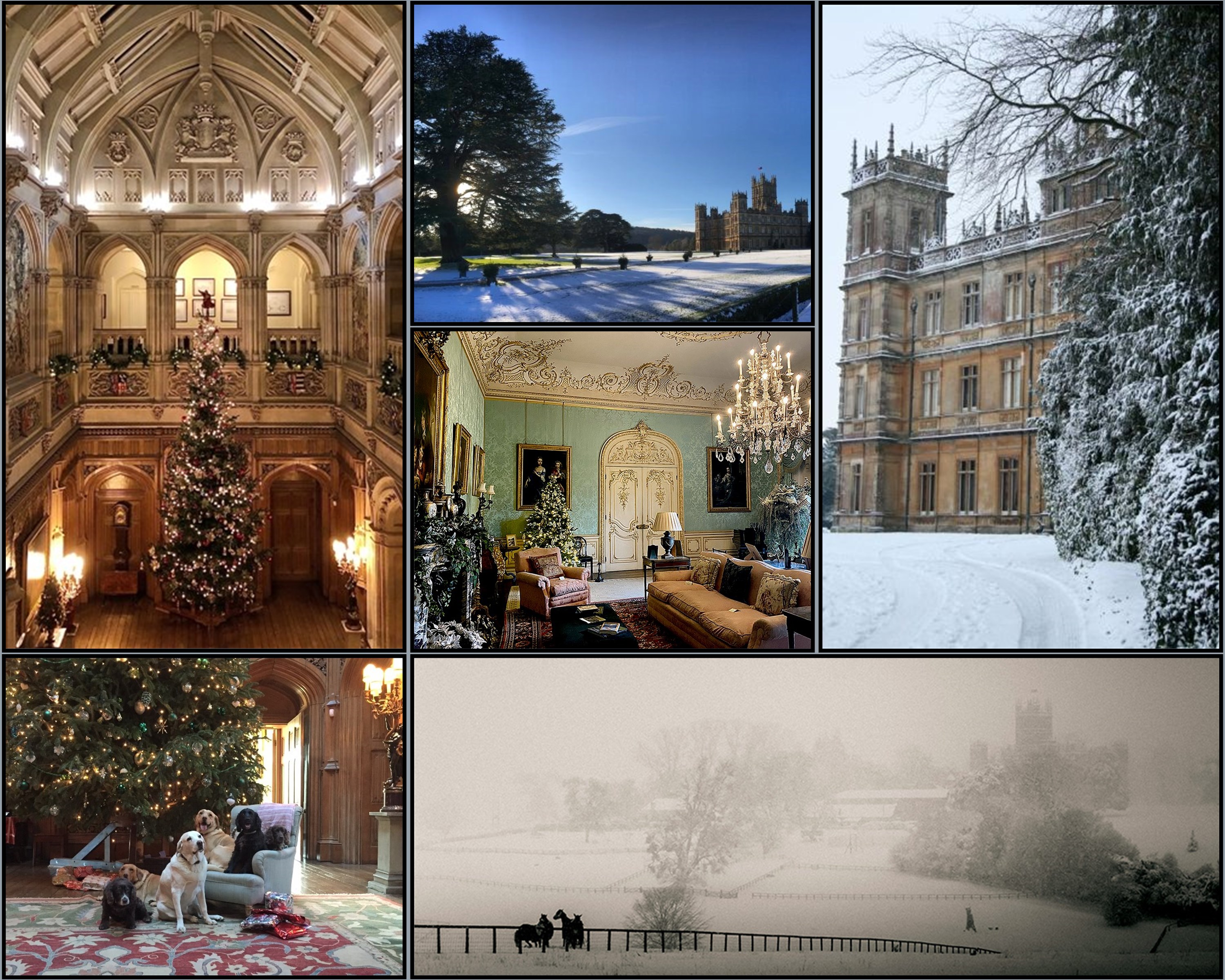
For those not familiar with the television series Downton Abbey, it is a period drama that was shown during six seasons. It represented an English aristocratic family, the Crawleys who lived at the Downton Abbey estate. We followed their lives from 1912 through the 1920s. The show depicted historical events as well as how life was for the nobility and their servants during this rapidly changing time. Downton Abbey is fictitious but the estate where the series was filmed is in Hampshire, England. The real Highclere Castle, set on 5,000 acres of land, was built in 1679 and is the country seat of the Eighth Earl of Carnarvon, his family, staff and seven dogs. There are 300 rooms in Highclere Castle, the real Downton Abbey, 40 to 50 of them are bedrooms but none have showers - only full baths. (Click on collage to enlarge.)
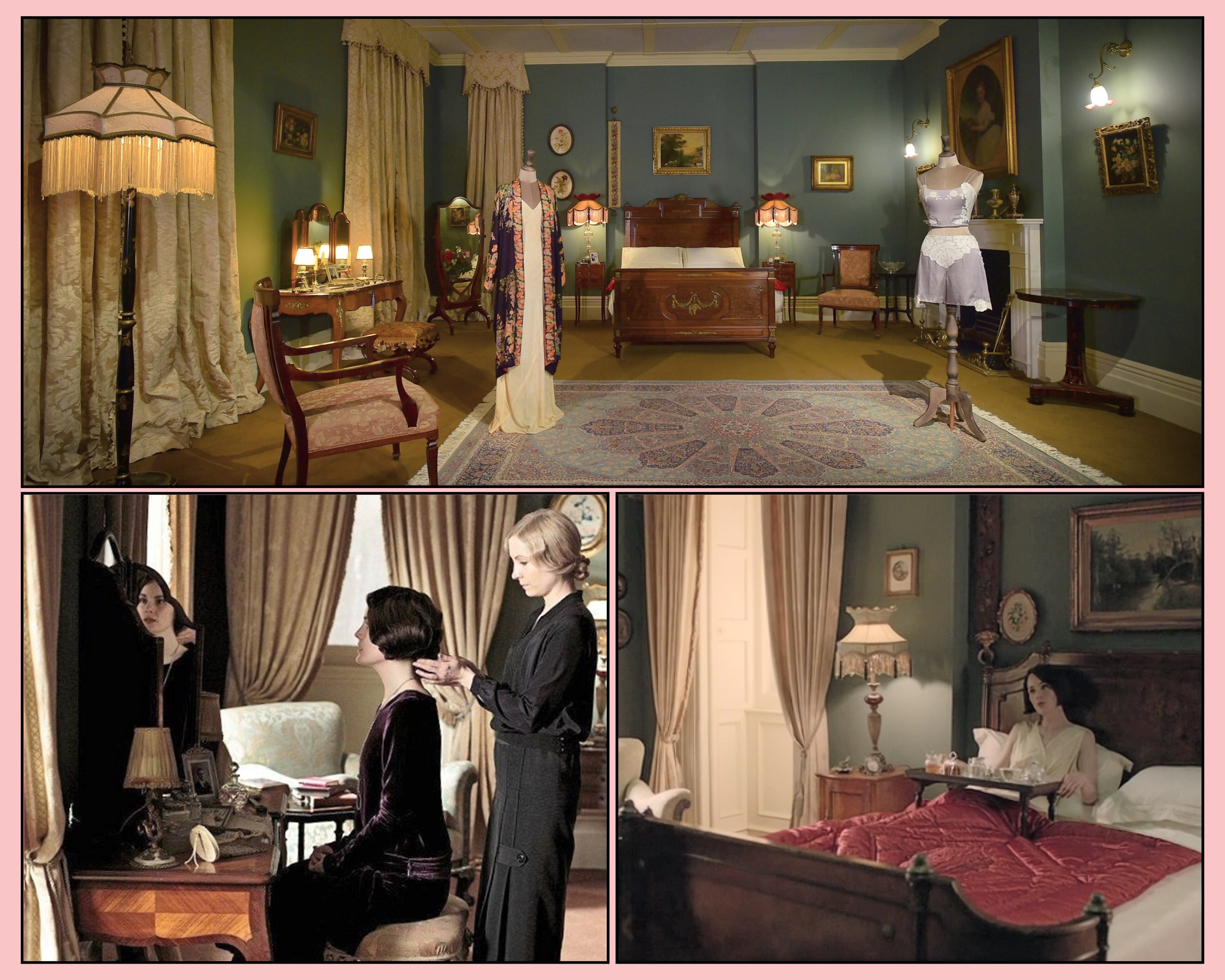
The estate is open to the public for self-guided tours during the summer months and at Easter and Christmas. I certainly would like to visit it, but this would be the estate as it is now in the 2020's, not as in the post-Edwardian times shown in the series. Exterior shots of the abbey, the main hall, dining room and drawing room use Highclere Castle in the TV series, but the servants' quarters, kitchen and family bedrooms were sets created at the Ealing Studios. The Atlanta Downton exhibit showed those sets, such as the dining room, Mrs. Patmore's kitchen, Lady Mary's bedroom, Carson's pantry plus many artifacts from the show. At this exhibition you really felt like you were in the kitchen and in the servants' quarters. Actually you were, because they do not exist in the real Highclere Castle. There is no downstairs kitchen area there, that area is now devoted to an Egyptian exposition.
I visited the Atlanta exhibition last year early one morning in mid-week. There were not many visitors and I found myself alone in the reconstructed servants' quarters. I took many pictures. It felt like the servants were just around the corner,
and the bell board was going to summon the staff any minute.
Then I entered the kitchen that was so very busy during the TV shows.
Walking by the pantry of Mr. Carson, the butler in the show, I could visualize him writing at his desk.
Back upstairs I entered a large room and sat in one of the chairs. The walls became alive with an immersive, multi-media image projection of several rooms of Downton. In this three-sided video you could see doors open with characters conversing. Then there were black and white scenes of World War 1 with explosions, soldiers running into tranches transporting you to the horrors of this war; more scenes followed and it ended with images of the staff of Downton Abbey.
Moving on in front of Lady Mary's bedroom I could almost see her sitting by her dressing mirror, or reading newspapers in bed.
I took several photos of the gorgeously appointed dining room, decorated for the Holidays.
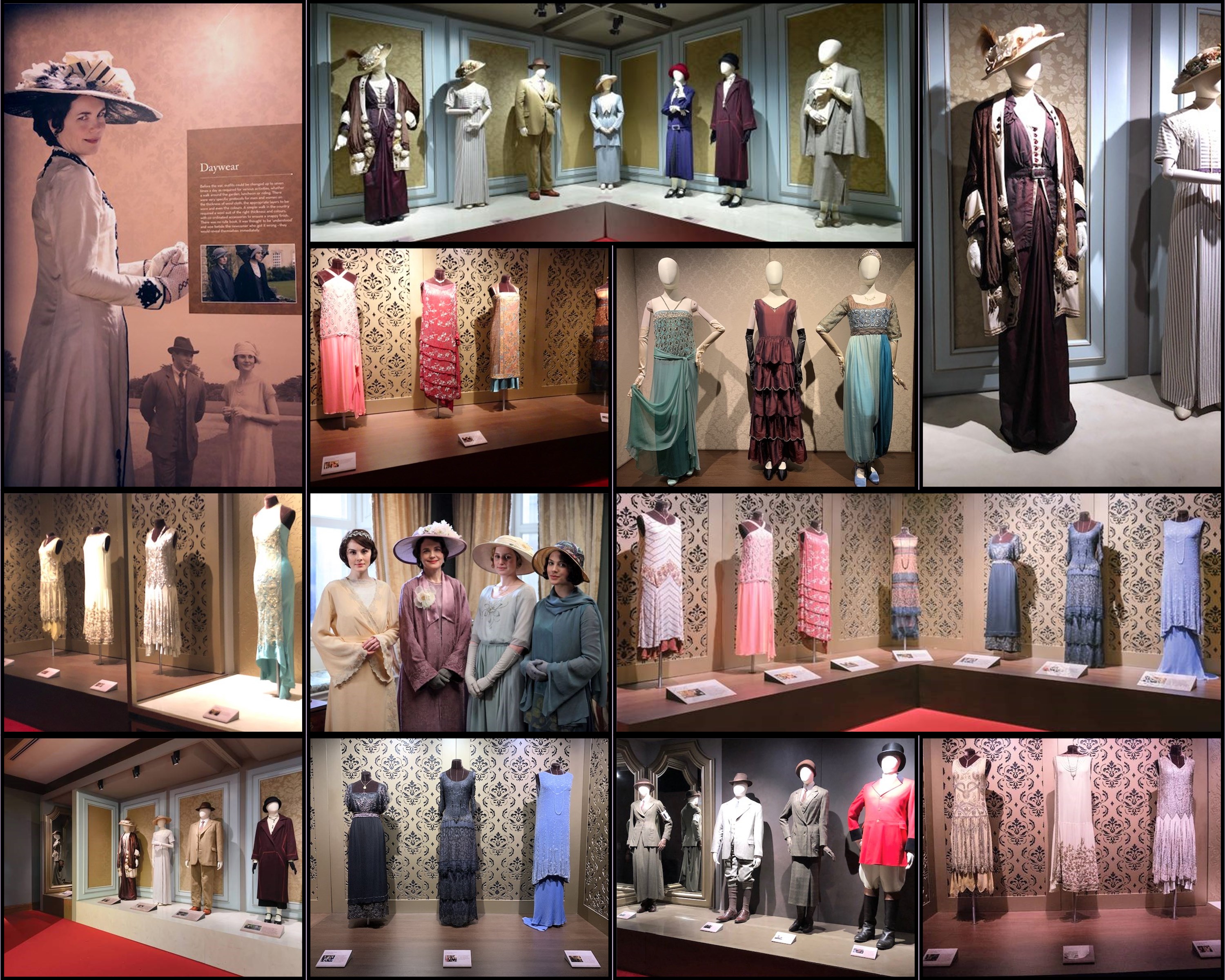
This was such an expansive exhibition with 50-plus costumes and a multitude of early 20th century artifacts. There were displays explaining the society, the culture and issues of those times; a great number of film clips and photos of the TV show were all around.
A beautiful hat display made me sigh. I own several lovely hats that I never wear. Apart from sun hats for gardening there are not many occasions to wear fancy hats nowadays, at least in the United States.
Several rooms contained actual outfits worn by the actors during the shows. They ranged from riding outfits to country tweeds and lavish evening gowns. There were faithful reproductions of the jewelry and garments aristocratic ladies and gentlemen might have worn in the 1910s through the 1920s in England, as well as their servants' outfits. Some of the dresses, or parts of the dresses, were authentic such as the extensive beadwork on some of the gowns. (Don't forget to click on the collage to enlarge and see better.)
Lady Edith's wedding short sleeve dress was a vintage original garment, I understand. The lace was exquisite. For a 100+ years old lace it looked stunningly fresh, see the first 3 top photos in the collage below.
Many of the gowns had intricate detail work, such as Lady Rose's presentation dress below. It is an adaptation of a vintage original, with a green applique ribbon. The costumes on the TV show were always elegant.
I had come to the end of the exhibit. Mr. Carson, the butler, gave some parting words through a hologram ending with: "Perhaps we'll meet again. You never know."
It had been an enjoyable exhibition - this fully immersive,multi-media extravaganza made me feel like I had visited the Crawleys at Downton Abbey during the yearend holidays.
The gift shop offered many souvenirs from the show, mugs, teas, books, etc.
I already own several books on Downton Abbey including the Countess of Carnarvon's "Christmas at Highclere." It includes a narrative of traditions at the castle, recipes and details on the elaborate Christmas parties there.
In her book, Lady Carnarvon gives a behind the scenes look at the rituals and routines of the castle throughout the Holidays. It tells of Highclere Christmases past and present including the raising of a 25-foot tree in the saloon, an opulent room designed for the 4th Earl in the 1860s. (This is one of 60 Christmas trees thoughout Highclere.) There are beautiful illustrations of the Castle grounds as well.
Cold Christmas 2022 is gone now. I watched King Charles' first Christmas speech on the BBC via youTube. I'll quote some of his ending words: "While Christmas is of course a Christian celebration, the power of light overcoming darkness is celebrated across the boundaries of faith and belief. So whatever faith you have, or whether you have none, it is in this life-giving light and with the true humility that lies in our service to others, that I believe we can find hope for the future. Let us therefore celebrate it together and cherish it always." These are noteworthy words, indeed.
My final words are not that eloquent. I only wish you a Happy New Year and hope that 2023 will bring you joy, happiness and good health; stay well and stay warm,
and ...

Tuesday, July 26, 2022

July 14 Paris celebration and some sights along the Tour de France 2022

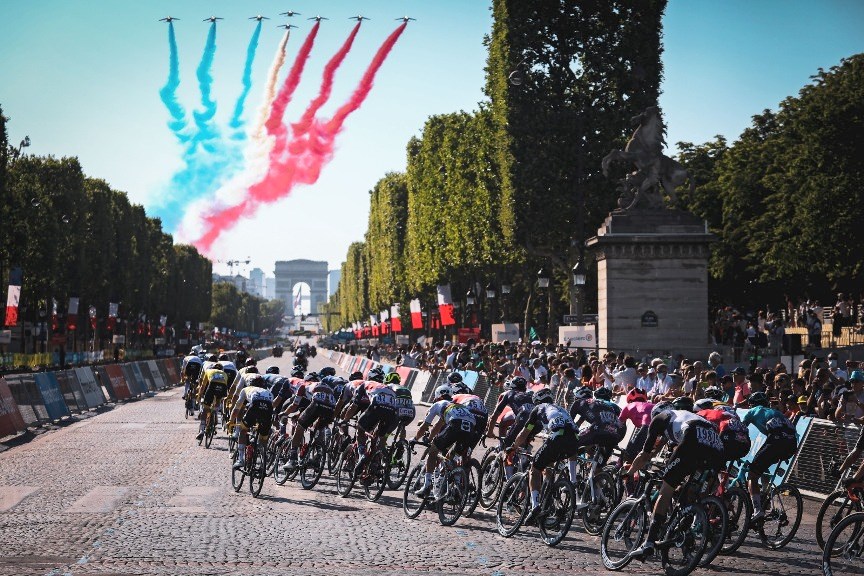
The Patrouille de France (French Acrobatic Patrol) of the French Air Force is shown above. It has been active since 1931 and is one of the oldest and considered one of the best in the world. It traditionally opens the military parade in Paris on the 14 of July /French National Holiday (also known as Bastille Day in anglophone areas.) Then about two weeks later, it flies over the Champs-Elysees Avenue at the close of the Tour de France. Nine pilots fly the Dassault/Dornier Alpha Jets with a team of 32 mechanics for support.
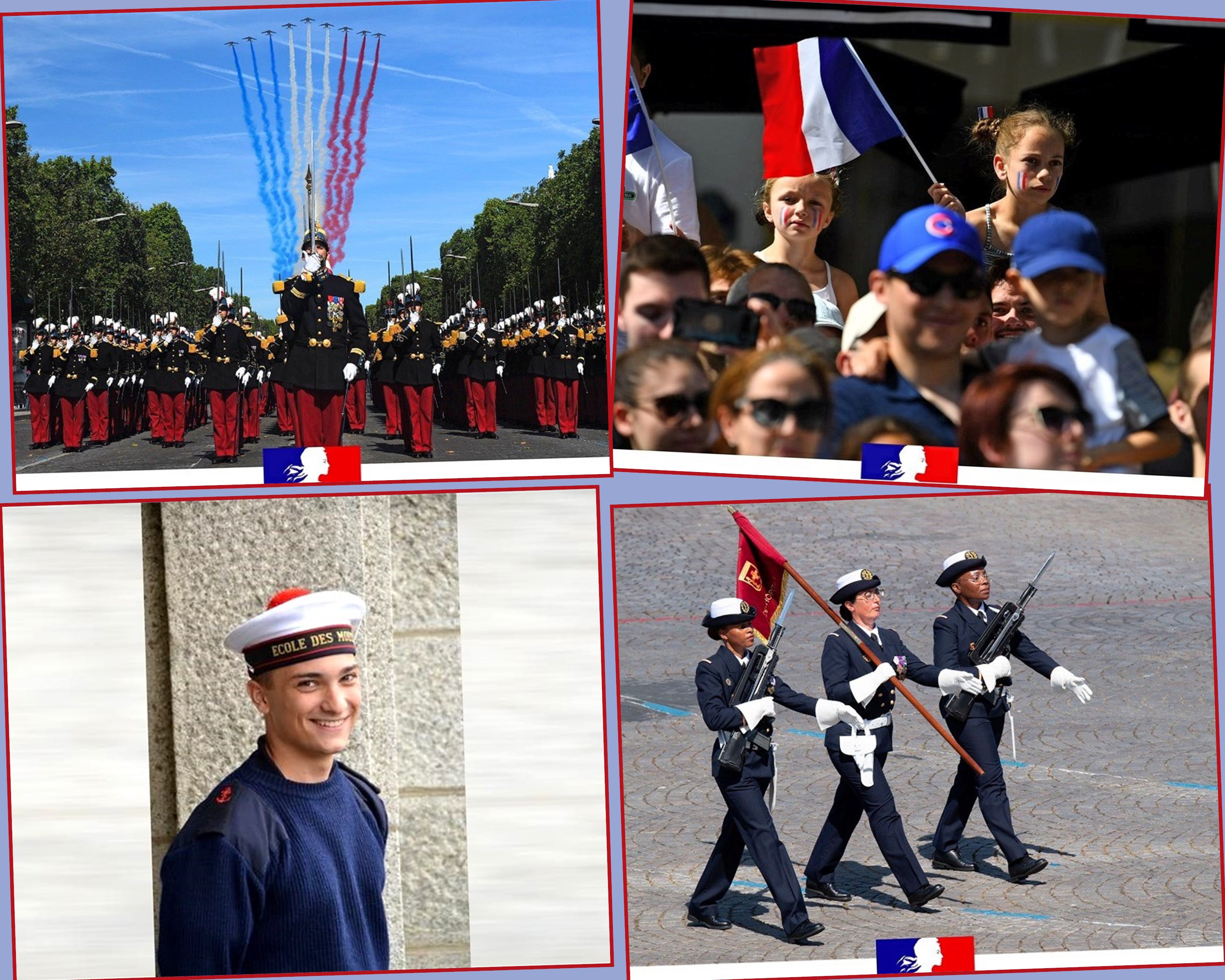
A 14 of July military parade down the Champs-Elysees Avenue in Paris has been a tradition since 1880. The parade starts at 10:00 am and lasts two hours. This year's theme was "Sharing the Flame" - a reference to the flame of the Resistance, and to the Olympic flame of which France is now the custodian until the Olympic Games in Paris in 2024. Olympic and Paralympics' medalists were part of the procession. This year French President Macron wished to honor Eastern European nations and invited their troops to open the parade (photo shown below courtesy Ministère des Armées.) The units and flags of the Baltic States, Poland, the Czech Republic, Slovakia, Romania, Bulgaria and Hungary opened the parade with troops on foot, followed by the soldiers of the French regiments engaged within the framework of NATO on the eastern flank of Europe, such as the alpine hunters deployed in Romania and Estonia. (France's Rafale fighter jets are also helping to protect the Polish sky.)
The parade included 6,300 soldiers on foot, 71 aircraft, 25 helicopers, 221 vehicles and 200 horses of the Republican Guard. Louis, a 17 years old ship's boy and future ship's mate, was the youngest soldier in the parade. He is pictured below, courtesy Le Ministère des Armées.
In the evening of July 14, Parisians, French people and foreign visitors were invited to gather near the Eiffel Tower to watch the fireworks at 11 pm, for about 30 minutes. The theme this year was "Carpe Diem" (seize the day - take advantage of life.) The fireworks paid tribute to Ukraine, projecting the Ukrainian flag on the Eiffel Tower, the blue and yellow rockets drawing hearts in the sky, on the song "Stefania" by the Ukrainian group Kalush Orchestra, winner of the Eurovision contest. (Photo of the Ukraine colors in the first left photo below, courtesy Le Parisien.) This was followed by a public concert then popular dancing in various streets.
Most large towns, small cities and villages in France display fireworks for the national holiday, the 14 of July. However, this year to minimize the risk of fire linked to the ambient dryness and extreme heat, some municipalities canceled their traditional fireworks. One of the cities still with great fireworks was Carcassonne, shown below, courtesy Aude Tourisme. The Tour de France stopped to rest in this town, but on July 18, 2022.
The Tour de France 2022 started on July 1st and ended on July 24, 2022, including two rest days. It covered a total distance of 3,328 kms/2081.4 miles, about the same distance as Helsinki, Finland to Lisbon, Portugal or Washington, D.C. to Las Vegas, Arizona. There were 176 international riders from twenty-two teams (8 riders in each team.) The 21 stages covered 6 flat stages, 7 hilly stages, 6 mountain stages and 2 individual time trial stages. Apart from France the Tour visited 3 foreign countries, Denmark, Belgium and Switzerland. The cyclists rode into 39 stage towns. The Tour attracted 12 million spectators and was broadcasted into 190 countries. Founded in 1903, the Tour de France is the most prestigious bike race on the planet. Below is the 2022 route.
If you click on the Tour de France link on the right side of my blog you will see 21 entries. Along the years I have given the Tour's history, explained the stages, the colors of the jerseys and more. Please check any of these posts. It is quite fitting that the Tour started in Copenhagen, Denmark. Copenhagen is the world's most bicycle friendly city where the number of bicycles outnumbers the number of cars. If the US is known for having more guns than people, Copenhagen is known for having more bikes than people - 745,000 bikes for 602,000 people, and just 120,000 cars; the number of SUV vehicles, unlike in the US, is at a minimum. The first time we were in Copenhagen we stayed in a central hotel. I was so surprised to see more bikes during rush hour than cars, with business people in suits and some women in dresses and heels.
Accordingly, the Climate Change Performance Index's for 2022 shows Denmark as the top-ranking country in the world for global climate policy. Out of rankings of 60 countries and the EU, the US trailed the pack in 55th place. It could be the US's obsession with SUV vehicles. On average, SUVs use about a quarter more energy to move than a standard-sized family car, because they are larger, heavier and create more drag. A quarter might not sound like much, but between 2010 and 2018, the proliferation of SUVs on the road resulted in an increase of 3.3 million barrels of gasoline used per day. This created an uptick of 0.55 gigatons of CO2 over one decade, to 544 million tons of CO2, making SUVs "the second-largest contributor to the increase in global CO2 emissions since 2010 after the power sector." To put it another way, it means SUVs are producing more emissions than the entire aviation industry. The IEA forecasts that if conventional SUV purchases continue at the same pace, by 2040 they will have offset the emissions savings of close to 150 million electric cars. But, in the US, SUV sales continue to grow regardless. In Denmark there are twelve freeways just for bicycles.
The Grand Depart started in Copenhagen and stayed three days in the country. Fans came out to cheer the Tour in incredible numbers - thousands in every town. The Tour is truly international. One of the reasons I really enjoy it is because fans cheer the racers regardless of their nationalities. Of course I am happy if a French or American racer wins a stage but I am as happy to see a deserving racer win from another country. It was so sad at the Atlanta Olympic Games when most of the public left the indoor bike racing event when there were no US bikers left but just racers from the UK, Australia and Italy. Only a handful of people watched the winners get their medals - truly a shame.
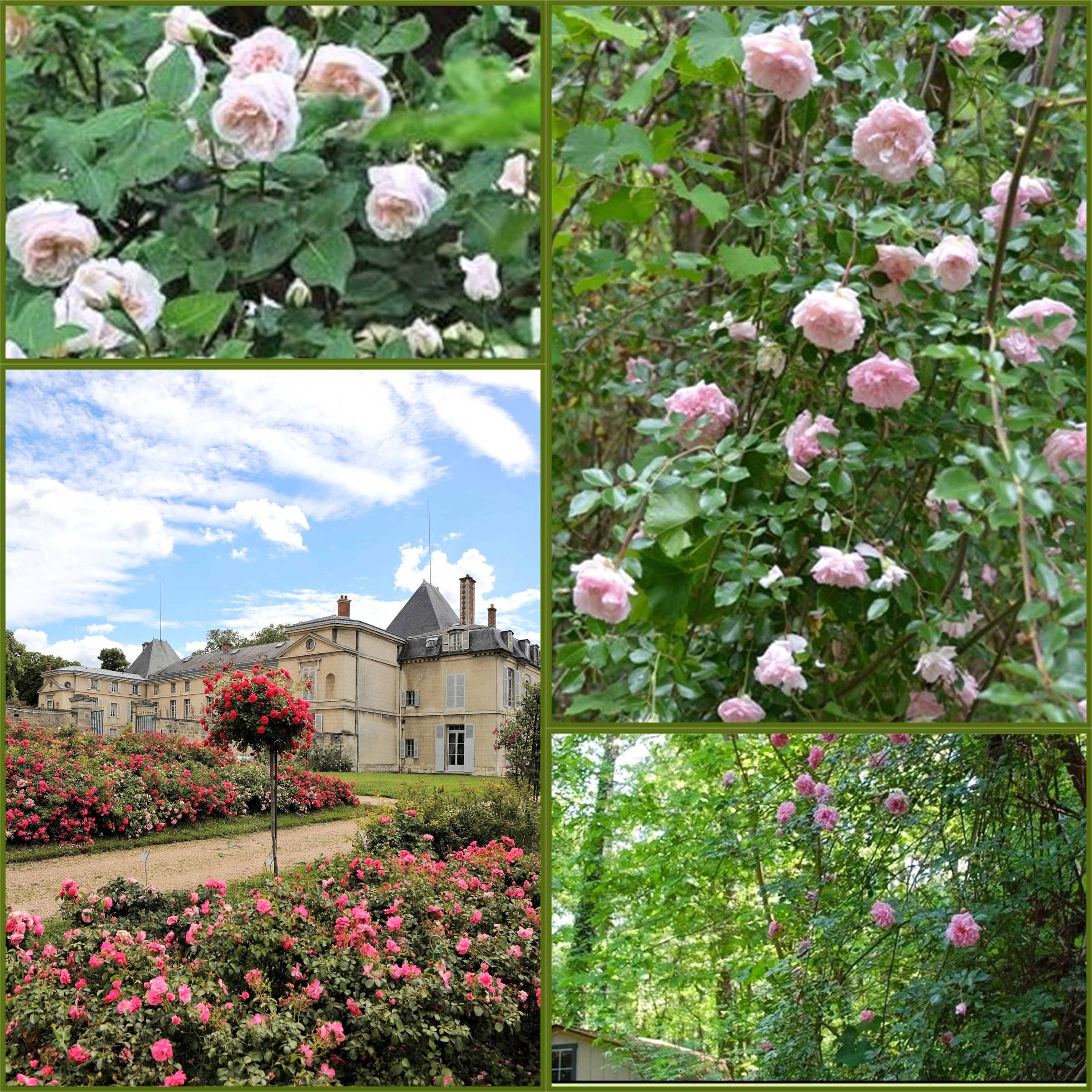
If I could, I'd fly back home to France every July to watch the Tour. But since I can't, watching this most famous race live on TV is a highlight of my summers here. I love the high drama of the race so physically challenging as well as the passion of the riders. Watching the hundreds of thousands of spectators from many countries is also fun. Of course, the scenery along the route or from the helicopters and drones over all the cities, towns, villages and hamlets is a joy; many castles are shown. I visited two of the castles below - the castle of Chillon in Switzerland (in center of collage) when I went twice to Lausanne and the castle of the Malmaison (bottom left) which is only 15 kms from Paris (about 9 miles) and visited it several times with my mother.
Since 1905 the Malmaison Castle has been a French National Napoleonic museum. Bonaparte had bought it for his wife, Josephine de Beauharnais (1763-1814) in April 1799. Napoleon lived in it several years and Josephine died there in 1814. The interior of the castle is one of the few places in France to exhibit a homogeneous set of furniture from the Napoleonic Consulate and First Empire. My mother and I loved to visit the rose garden there. One of their old antique Bourbon roses is called "Souvenir de la Malmaison." Originally it had been called "Queen of Beauty and Fragrance" but when one the Grand Dukes of Russia obtained a specimen from the Malmaison gardens for the Imperial Garden in St. Petersburg it was renamed "Souvenir de la Malmaison" as a remembrance for him. It produces light pink color blooms with a delightful fragrance; it is a climbing rose. I grew one in my garden in Georgia, shown below.
I even drew one of my Souvenir de la Malmaison roses.
The Tour racers drove by numerous lovely and historic towns. To mention and show even some of them would take pages and pages. Stage 13 ended on July 15 at Saint-Etienne. It is the only French city designated Creative City of Design by UNESCO. In 2020, Saint-Etienne also received its second UNESCO label as an "Inclusive City of Design." Saint-Etienne with all its museums and buildings is a permanent design experience, in architecture as well as in every day life. In 1915 the mayor of the city ordered a replica of the Statue of Liberty. Stage 19 ended in the town of Cahors. This city is famed for its wine and gastronomy and holds the label "French Town of Art and History." The famous medieval Valentre Bridge here is part of the pilgrimage path to Santiago de Campostela. The 14th century bridge took 70 years to complete, from 1308 to 1378 (in center of collage below.) Two new cities on the Tour were Lacapelle-Marival with its blue lake (bottom left) and Rocamadour (top left below.) From the Middle Ages on Rocamadour has been visited by pilgrims as it is also on the route of El Camino de Santiago. The population of 600 rises to 1.5 million tourists in summer.
The 21 stage ended in Paris as usual. The winner of the Tour this year was the Danish rider Jonas Vingegaard. He is the first Danish rider to win this race since 1996. At the start of the race in Copenhagen, 35,000 paying fans had packed into the Tivoli Gardens to greet the riders. They must have been deliriously happy to have one of their own win this grueling race. The 25-years old Vingegaard showed an impressive display of strength. He is below with his little daughter Frida.
Another thrilling Tour de France has ended. Now we have to wait for the 2023 rendez-vous in Bilbao, the Basque country of Spain, for the Grand Depart of the Tour de France 2023.

Tuesday, September 29, 2020

Postponed Tour de France 2020 ... and Slovenia


The month of July came and went and no Tour de France to watch.  For a while we were afraid it would be cancelled because of COVID-19, but it was postponed until September.  I watched it on television or by streaming on my iPad.  As you can see from the heading photo (courtesy Nice Matin) the 2020 Tour de France started on the French Riviera in Nice.  Below is the route.

The 107th Tour started in Nice on August 29, 2020 and concluded in Paris on September 20, 2020.  It ran for 23 days with two rest days.  The total distance was 3,484 km or 2,165 miles.  There were a total of 176 riders from 22 teams (8 riders per team.)  The 21 stages included 9 flat, 3 hilly, 8 mountain stages and 1 individual time trial.  For more information on the Tour de France in general, please go to Tour de France on the right of my blog under Categories.  It was odd to see the riders wearing masks.  Below in black is Colombian Egan Bernal who won the Tour in 2019 and in green my favourite rider from Slovakia Peter Sagan.

This year I did not watch the Tour as carefully as in previous years because there were many riders I did not know.  But as usual the landscape views along the route were outstanding.  I took more pictures of the sights than the riders and with 21 days of viewing I ended up with over 200 photos.  The commentators give facts on culture, castles, churches, villages, history and natural sights of each area of the stages.  Some of my friends watch the Tour just to see the landscape and listen to the cultural information.  Two helicopters follow the Tour and four motorbike photographers along the route capture all these lovely shots.  You can see the helicopter above the mountainous road below, at 12 o'clock, and the motorbike photographers.

Below views from stages 1, 2 and 3 - please click on collage to enlarge.
 

From stages 4 through 6 -

From stages 7, 8 and 9 -

From stages 11, 13 and 14 - 

As the helicopters were flying over the western central area of France the commentators mentioned that near the city of Vasles was a sheep reserve.  I was intrigued and looked for it.  It is called "Mouton Village" (mouton is sheep in French.)  It is a large protected park planted with more than 4,000 trees: araucaria, eucalyptus, etc. to house the sheep in their original habitat.  It is the first park in France to host twenty-two sheep breeds from around the world, such as the "rabbit-headed" sheep (Border Leicesters,) the Racka sheep from Hungary with their unusual spiral-shaped horns and the Romanov from the Upper Volga in Russia.  Below are some of their sheep (the park can be visited by the way) -

The small town of Vasles (population 1,100) also counts two castles: an old medieval one built between 1467 and 1471 and a private one, called Castle of the Sayette.  I checked this last one and found out that it has been the home of 26 generations or seven centuries of de la Sayette family.  They opened a small hiking trail on the castle ground last year and the sheep from Mouton Village used it to move to higher fields during the summer.  Below is the Chateau de la Sayette.

The helicopters often take close-ups of the castles below.  The commentators seem to be working for the French Tourist Office because they immediately enumerate all the pertinent historical details of the various landmarks - such a great variety of castles to stare at from my den sofa ...

Photos from stages 15, 16 and 17 - 

There were fewer spectators along the route this year but those present were following recommendations to wear masks and to keep safe distancing.  The riders themselves, when not in the race, were wearing masks.  The devil was also wearing a mask (this devil fan has been in the sidelines of the Tour since 1993.)

Ready for more castles?

The castle in the center of the collage above is the Castle of Virieu.  It was built in the 11th century by Wilfrid de Virieu.  In the 18th century it was remodeled and extended.  Some of the interior rooms can be visited as well as the main courtyard displaying cannons given by King Louis XIII in 1622.  The family also hosts fairs and festival on the castle grounds.  Since the 13th century the de Virieu family has also owned another castle nearby, the Castle of the Pupetieres, shown in the extreme bottom left of the collage below.

Below is a painting of the Castle of Virieu by British artist Richard Cole.

Photos from stages 18, 19 and 20 -

Toward the end of the Tour it was obvious it would be won by either of the two Slovenian riders.  Slovenia? It was not a country I studied when I was in school back in the days, so I checked.  A Balkan country, the Republic of Slovenia was the first republic that split from the former Yugoslavia and became independent.  Its population is only 2 million.  It is located in central Europe and bordered by Italy, Austria, Hungary and Croatia.  It is shown in red in the map below.

Slovenia is a stunning little country with glacial lakes, spectacular mountain peaks, clear blue rivers and extended forests.  Rick Steve, the American Travel Writer, says of Slovenia: "...It is an underrated gem in the heart of Europe ... Located where the Germanic, Mediterranean and Slavic worlds come together, Slovenia enjoys a happy hodgepodge of cultures while also presenting plenty of its own unique character.  And much like the country as a whole, its capital city of Ljubljana is a delight to explore, yet remains relatively undiscovered... Tiny, overlooked Slovenia is one of Europe's most unexpectedly charming destinations..."  Below are some photographs of Slovenia courtesy Rich Steve and the Slovenian Tourist Bureau.

On Sunday morning September 20, 2020, my cat Mitsouko and I watched TV for the conclusion of the Tour de France.  It is always a treat to see the riders arriving in Paris along all the favourite landmarks.  The City of Paris had only allowed 5,000 spectators; the streets were almost empty.

Then it was over.  This is the general ranking: overall first place winner - Tadej Pogacar of Slovenia for the team UAE.  He also won the polka dot jersey as best climber and white jersey as best young rider.  2nd overall place - Primoz Roglic of Slovenia, 3rd place Richie Porte of Australia.  The green jersey (fastest runner) went to Sam Bennett of Ireland.  The most combative went to Marc Hirschi of Switzerland.  The winner, Tadej (pronounced TaDay) born on September 21, 1998, was the youngest cyclist to win the 2019 Tour of California.  He also won 3 stages in this Tour de France.  He is the first Slovenian winner of the Tour de France and at 21 became the second youngest winner since 1904.


I took a last picture from my TV screen as the sun was setting over Paris.