Showing posts with label Forest. Show all posts

Saturday, November 12, 2022

Old Car City in White, Georgia

On Sunday 6 November, 2022 I drove the 4 1/2 hours from Nashville to Greater Atlanta so I could vote in the mid-term elections on Tuesday Nov. 8. Before, I usually voted during advance voting at the main Cobb County polling place, but this time I could not. At about 10 am I drove to where I used to vote in my area. There were just a couple of cars in the parking lot; I thought they had moved the voting location but a sign showing "vote here" was in front of the door so I went in. I was first in line and it took me only ten minutes to vote. Of course I live in the extreme northwest of Cobb County, in the rural area where houses are far in between (my neighbor has 40 acres between us behind the lake, and the next one is a farm.)
Thursday Nov. 10 was a bright and sunny fall day begging for me to stay oudoors, but where to go? In early 2020 I had planned to become a member of the Nashville Photo Club; then Covid happened and I did not. They met monthly and went on regular outings, near and far. They had been planning to drive to White in North Georgia to an old car junkyard-museum. I checked and realized it was only 26 miles from my Georgia house. If they were willing to drive 4+ hours to visit, I certainly could drive half an hour to take a look. So this is what I did that day. My house is not far from the Bartow county line. The red dot below, between Acworth and Kennesaw, is where my house is located.
Arriving around 10:30 am there was just another car in the parking lot (from Pennsyvania.) Old Car City is on highway US-411 with just a small southern restaurant across the road. I went in and paid the entrance fee (cash only.) There was an eclectic assortment of memorabilia, vintage collectible, antique toys, Americana, an old piano, etc. in the interior area.
I was shown a map then told the property had 6.5 miles of trails on the 34 acres (137,593.12 sq meters.) I walked by a sign with a short history of the business and a witch left over from Halloween when they offered a spooky "Haunted Trails." (Click on collage to enlarge and read better.)
The parents of Dean Lewis, the current owner, started a general store in 1931 that sold various items from tires, gasoline, clothing and car parts. Because of the Great Depression steel was scarce so they changed their line to scrapping cars; by the late 1940s it had become a salvage yard. When Dean acquired the business in 1970 there were 40 cars on the lot. He had a passion for old cars and spent decades acquiring wrecked and junked vehicles from recycling yards, auctions and private parties. But Dean did not like to sell the old vehicles' parts, he wanted to preserve them. He kept collecting them, had to buy more land; he stopped counting when he had collected over 4000 rusting metal carcasses. People were stopping by to take a look or take pictures, so about 15 years ago Dean realized that the business could be better sustained as a museum charging admittance. I started walking on the grounds, passing more unusual items, rusting bicycles and tricycles.
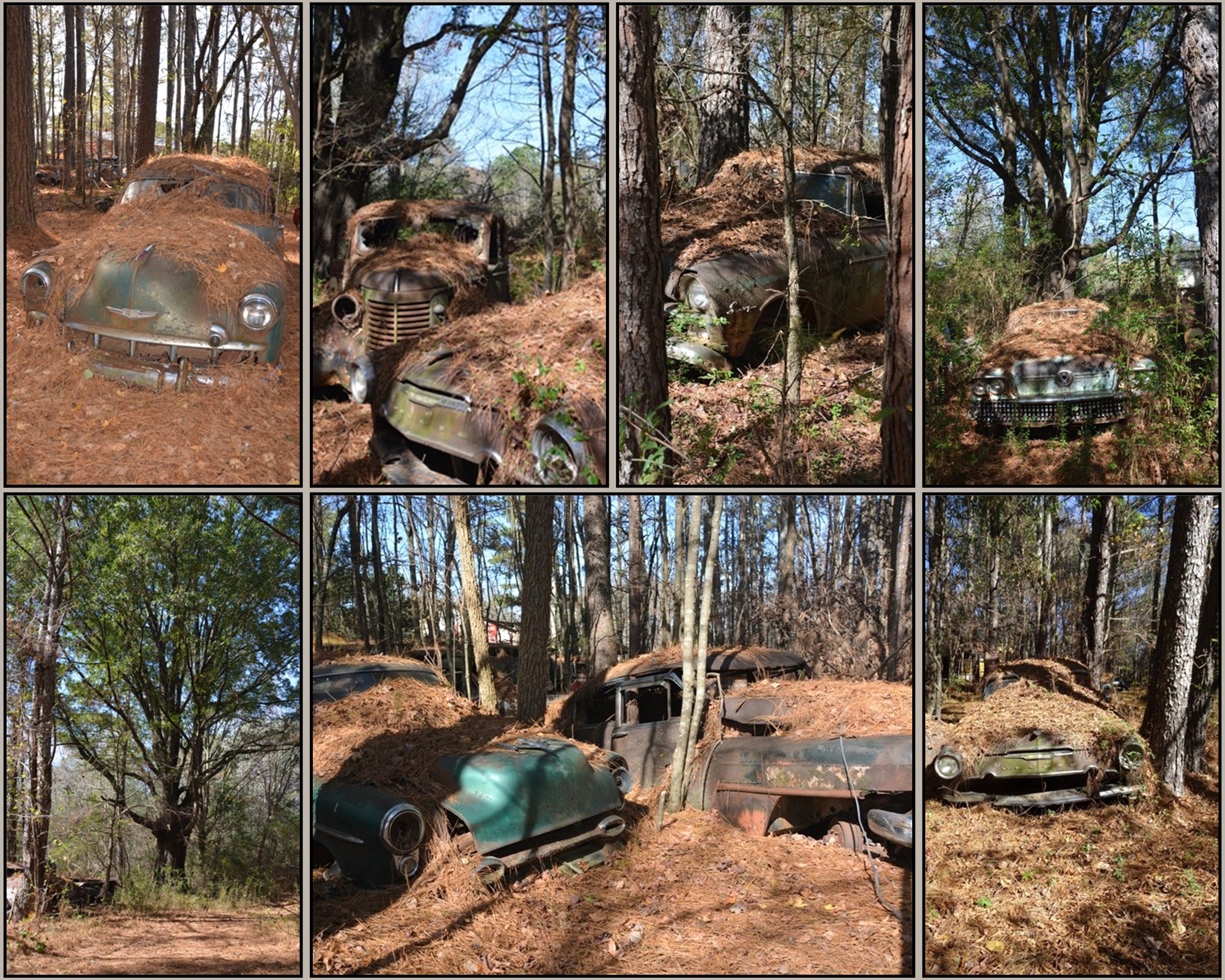
Then I entered the trail, looking in awe at all the decaying cars covered with pine needles and creeping vines. Some cars had trees growing through their bumpers or windshields and even lifted them. Some cars were on top of each other, maybe as they had been delivered. After more than 80 years the cars had been taken over by nature, they were part of it. This is why the slogan here is "Nature, Art, History and Cars." It was an amazing sight, but very quiet, with just the birds chirping, and no one else around.
Stopping to take photos, walking, turning, I knew I was getting lost, but so what.
Along the way there were random unique hand-painted signs, with optional spelling.
It was in the high 70s (26 c) but under the pine canopy it felt cool. It was a forest, really, with some very large trees and a heavy carpet of pine straw on the ground and covering the cars.
Actually with all the pine straw it was hard to read the make of the cars. I like vintage cars but I am not an enthusiast and unless I can read it I can't distinguish between all the different brands and certainly can't tell the models or years. Maybe after a good rain, if the straw moved it would be easier to read. I kept stopping and snapping - I had brought my Nikon D5200 and my small Sony DSC-HX90V plus took some with my Iphone. There was an embarrassment of choices - where to point?
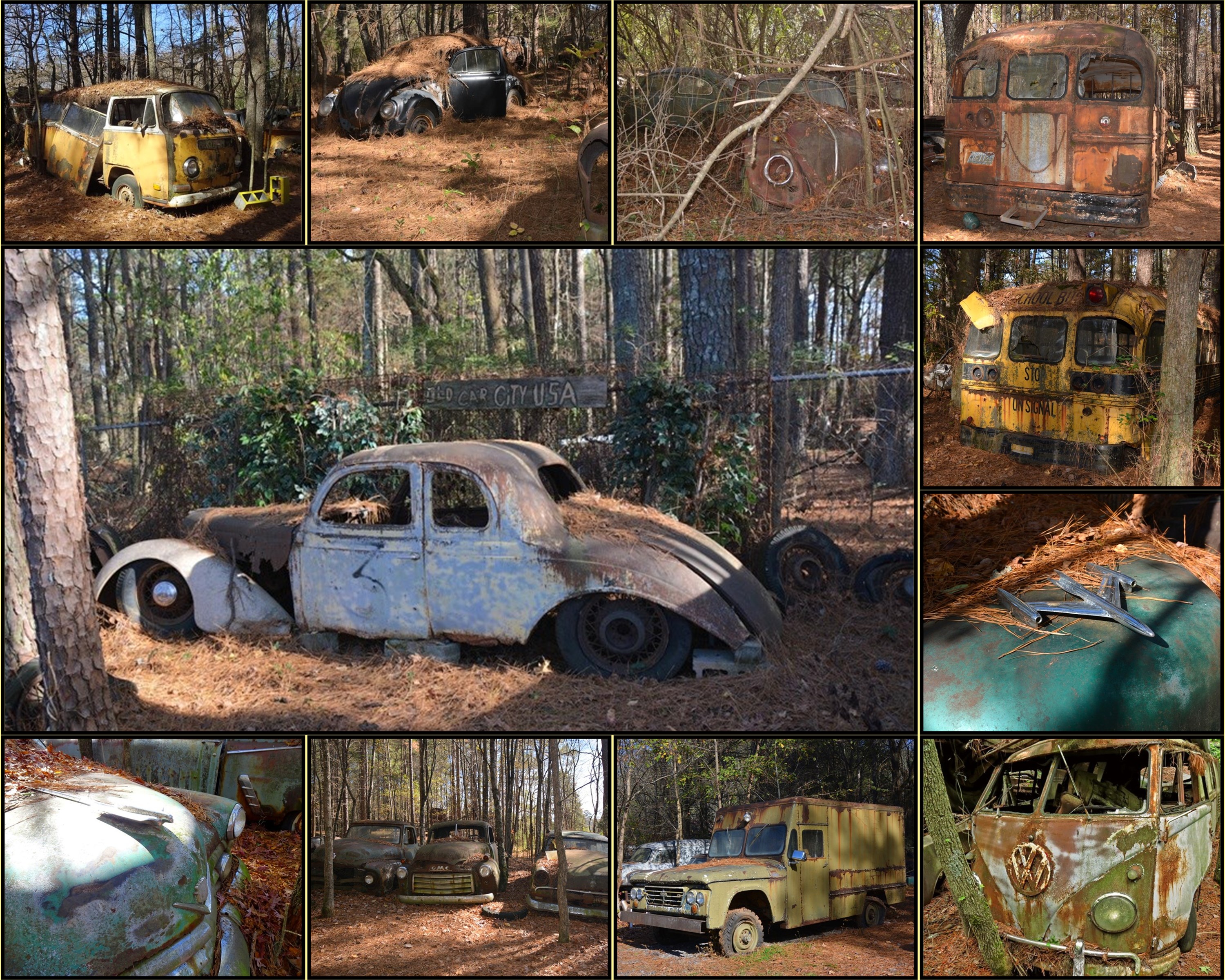
I read the oldest car there was a 1918 Buick, then a few from the 1920s, more from the 1930s and most vehicles from the 1940s to 1972. They included Packards, Desoto, Chevrolet, Studebakers, Hudsons, Fords, Edsels, Mercury, Buicks, Plymouths, Oldsmobiles, Dodges, Cadillacs, Chryslers, Pontiac, Lincoln, some buses, a 1941 Mack milk truck and a few foreign cars - I recognized some VWs. From a distance I thought I read "vagabond" on the back of a car. Getting closer, sure enough, it read "vagabond." I never knew such a model ever existed. Back at home I researched it. From 1946 to 1951 the Kaiser-Frazer Corporation made upper-medium price luxury automobiles; their Frazer Vagabond was a unique hatchback sedan. The Vagabond shown below (courtesy Wikipedia) has been restored to its prime glory. (I wish I could be restored...)
There certainly was a plethora of rustic relics from days gone by and I understood why another of the Old Car City's slogans was "Photographer's Paradise." How to select the best angle to snap these decomposing dream cars?
Some metal chairs were placed in some of the trails for a quick rest or meditation or reflection?
Then I saw it - a car I knew. Flying to France in 2008 I watched on the flight the movie "Gran Torino" starring Clint Eastwood with his prized muscle car, a 1972 Ford Torino. Here was a poor sweet green Torino resting under the Georgia pines.
It was already past 1:00 pm. I had been wandering in the forest among this chrome and rust cemetery for 2 1/2 hours. It was time to go back and cross the highway to the restaurant for lunch, but which way to get back? I kept going up and down trails, and they all looked alike. I did not reach the restaurant until close to 2:00 pm!
I understand that locals gather there for lunch and it gets quite busy, but by then there were just a couple of patrons. Wes-Man Restaurant is a typical rural southern restaurant. They open 6:00 am to 3:00 pm. Inside it looked cozy and tiny with license plates covering the wall along old newspapers, old high school annuals, etc. The lunch menu has a large selection of classic southern comfort food with burgers, salads, blue plates (meat and 3) and more.
There were bags of water hanging over the booths - to prevent flies they told me. I ordered the standard southern vegetable plate: fried okra, turnip greens, black eye peas, fried green tomatoes and corn bread. I'm pleased they served the vinegar pepper sauce for the greens, as they often don't in Tennessee. For dessert I had the blueberry cobbler. Everything was tasty especially the okra and fried green tomatoes.
Now that I had re-fueled my body I was ready to cross the road back to the forest of disintegrating relics. Close to the front of the lot the cars and trucks were parked on cement or gravel, not under pine trees. Many had moss and grime from all the decades they had been stationed there.
I wish I recognized some of those cars, like that long black one above. I did drive two vintage cars back in the days. My father, in the late 1940s, had bought a 1936 Simca-Fiat coupe, with stick shifts, for my mother so she would learn to drive. She always refused. The car spent years in storage in a French country warehouse until she gave it to me for my 18th birthday. I drove that old car all over Paris in the early 1960s and had so much fun. I also drove my boy-friend's 1939 Chevrolet coupe in Great Falls, Montana, a couple of times. The Chevrolet is in the bottom photo, below.
Walking back to the forest trails I passed some vehicles that were under shelter and some above the shelter's roof.
I kept on my little trek stopping here and there to snap hood ornaments, car remnants, ghosts of VW Beetles and vans, and crumbling school buses.
At 3:30 pm I was ready to head back as they close at 4:00 pm. Getting back to the main building I stopped by a collectible automobile in great shape. It was the maroon 1977 Lincoln Mark V Elvis Presley bought in 1977, just months before he died.
Later I read some negative comments about this unusual museum. Some said it was useless hoarding these pieces of junk. Other said the land would be better used in more money productive ways or that the owner Dean Lewis would profit more by selling the land than keeping that garbage around. I don't think Dean is interested in that. He says "I don't know what I would do if I couldn't get up every morning and look at old cars."
Since a little boy Dean had a passion for old cars. He was able to build a business around it and make a living. Eighty plus years later, Dean is still around his beloved old cars (he was born in 1937.) There is a lot to be said about this - life is not just measured in dollars. These vehicles had their day, their use and now can freeze in place and give pleasure to others. About 99% of them are unsalvageable. They have another use - a destination for families to walk in an uncommon forest. They are ideal as photo opportunities for professional photographers, ad agencies, media companies, videographers, photo clubs or just people like me who enjoy shooting unusual and unique pieces.
Another comment was: "A friend and I just traveled almost 1400 miles to photograph the incredible cars at Old Car City. We arrived at opening and stayed till closing for 3 days and didn't even come close to seeing/photographing it all!" There have been visitors from Sweden, Australia, New Zealand, China, Russia, Canada and the UK in addition to domestic visitors. I truly enjoyed getting lost in this one-of-a-kind forest and snapping these lovingly neglected car remains fading away under the Georgia sun.

Tuesday, November 26, 2019

In search of fall colors in Tennessee and Georgia

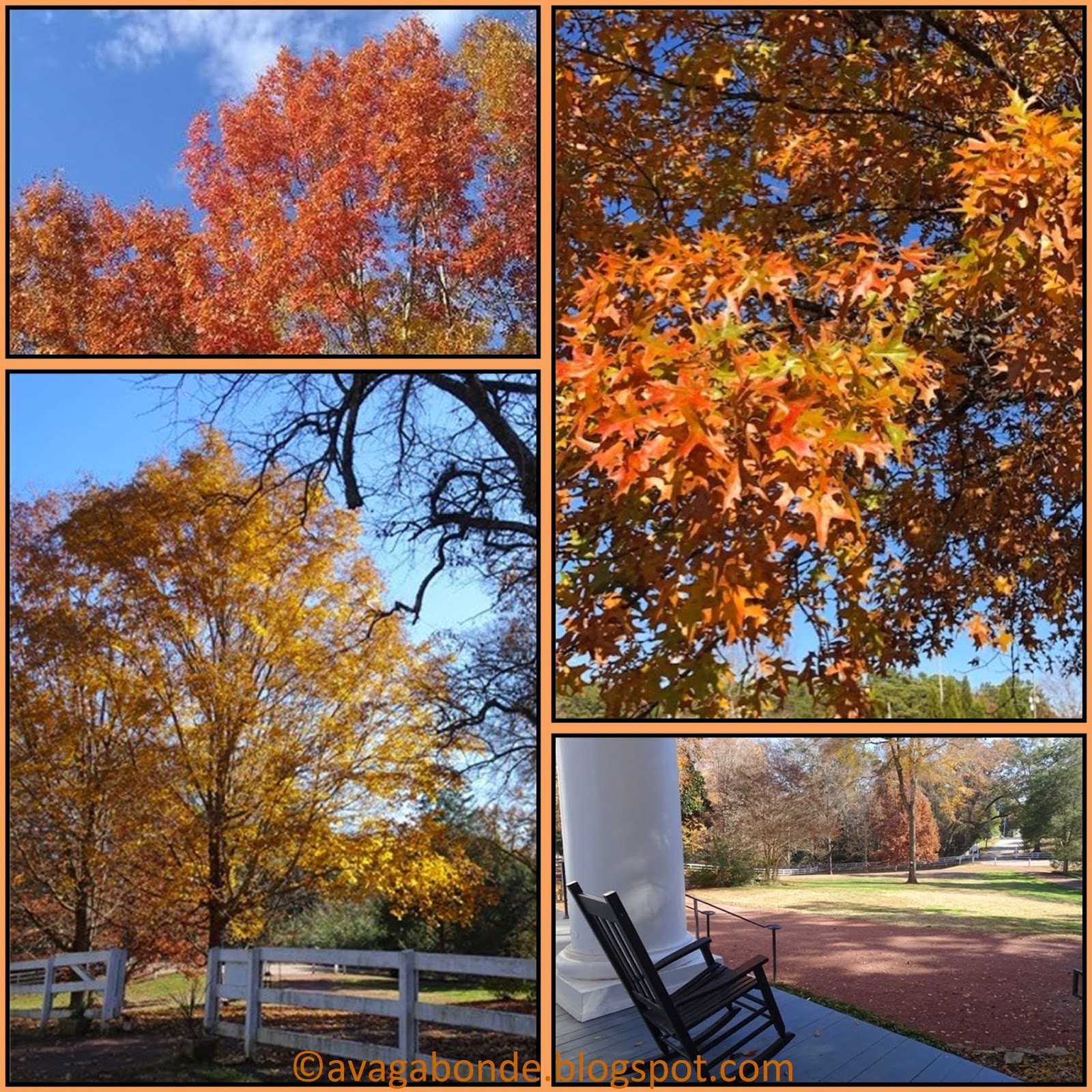
On the week-end of November 10, 2019, in search of fall colors, I drove to a small park called Beaman Park, about 15 miles northwest from downtown Nashville, Tennessee.  It covers 1,678 acres of natural areas, mostly ridges and hollows.

The Nature Center has a back patio (pictured in the heading) and a boardwalk.  Rocking chairs are provided so you can observe the steep wooded hills below.  It was a sunny Saturday afternoon, a bit cool - low 50s F (11 C.)  I encountered no one on the patio or on the boardwalk.

I sat in one of the rockers for a while.  The deck is perched high above the forest floor as Beaman Park is located on the edge of the Western Highland Rim.

I drove to another area of the park, to the trail heads.  There are three hiking trails, one of them following an old logging road with rugged hills and a shallow stream.  It was getting late afternoon - lots of shade.  The colors of the leaves were not very bright, though. (Please click on collage to enlarge.)

The following week, on Sunday 12 November, 2019, I drove south to Georgia.  I usually exit the freeway, I-75, at the Red Top Mountain Road exit.  Then it is about 8 miles to my house.  But if you turn left from the exit and cross a little bridge over Lake Allatoona, it is only a mile to the entrance of Red Top Mountain State Park.  Since it was warm and about 3:30 pm I decided to try my luck at fall foliage there.  My late husband and I often visited the park and I showed photos of it in several posts - here is a post from 2013: "Fall color at Lake Allatoona".  Then I drove up the hill to the park.

I parked by the Visitors' Center and petted a friendly dog near a bench.  Then I walked up a small trail.  Many dead leaves and branches.  As soon as there is a clearing though, pine trees grow like weeds in Georgia, and they are ever so green!  The fall colors were not as vivid as in prior years - could be because of the drought or the early frost, or a bit late in the season.

The sun was about gone and in this wooded area the colors were subdued.  I sat on a nice round rock and thought for a while.  Am not sure what about but I'll find some "thought" to write below.

"Everyone must take time to sit and watch the leaves turn."  - Elizabeth Lawrence,1904-1985, garden writer.

On Monday the weather was quite pleasant again, full sun and 66 F (18.8C.)  Driving to the grocery store I decided to drive the extra mile to one of the Cobb County Parks.  The entrance was promising with intense red trees along the road.

Unfortunately by the time I arrived at the lake it looked like the promise from the entrance had not been kept.  The lake was deserted, peaceful and placid but did not show much fall color.

Walking on the trail near the lake, I saw more pine trees and several little bushes with colored leaves.  The leaves from the couple of large trees there looked as though they had been burnt by the sun then frozen in place by the early frost.  The color palette was more in the shades of brown:  tawny, caramel, russet, cinnamon and gingerbread than gold.

I gave up looking for golden foliage and sat on the bench close to a small stream running into the lake, and recalled..."Those who contemplate the beauty of the earth find reserves of strength that will endure as long as life lasts."  Rachel Carson, 1904-1967, American conservationist.

That evening, I did find color; the colors of the sunset behind my neighbor's pine trees.

But I did not give up.  I had visited a state park, a county park and now with the sun still shining brightly I decided to drive to a city park.  The Roswell Old Mill Park is not far.  Vickery Creek waterfall, near the ruins of the mill, pours from a historic spillway dam and is gorgeous in any season.  The creek is a Chattahoochee River tributary.  The waterfall is not visible from the entrance to the park and is not advertized.  There are few visitors during mid-week.  I walked along the creek loving the rustling sounds of the water as it rushes over the rocks.

Once by the waterfall I sat on a huge rock and just listened to the appeasing sounds of the falling water.  It had not been an easy walk along the stony trail and I was pleased to sit for a while.  There was no one around - a good place for meditation.  I thought about a quotation from Jean-Jacques Rousseau, the francophone Swiss philosopher: Jamais je n'ai tant pensé, tant existé, tant vécu, tant été moi, si j'ose ainsi dire, que dans les voyages que j'ai fait seul et à pied.”  /Never did I think so much, existed so vividly, and experienced so much, never have I been so much myself, so to speak, as in the journeys I have taken alone and on foot."  Jean-Jacques Rousseau, 1712-1778, Philosopher.

The next few days I had to forget my search for fall foliage color and concentrate on keeping clearing out the house.  Although, the sun was still shining and I happened to look out through the screen of the kitchen window.  My backyard is on its way to becoming a true jungle forest now that my husband is not there to trim the English ivy vines.  Still, it looked like there was some rich fall color there.

The temptation to step outside was too strong - so I went out and took more photos...even walking closer to the lake in the back.

It was time now to get ready to drive back to Nashville where the fall foliage is not in its full glory any longer but where the temperature is cooler and more like fall.

"Life starts all over again when it gets crisp in the fall."  F. Scott Fitzgerald, 1896-1940, American writer


Now I'll end with my best and sincere greetings to each of you for a very Happy Thanksgiving!


Sunday, February 24, 2019

Destrehan Plantation's trees and more ... trees

Rain, more rain and fog - until next week maybe.  I thought I would write a post on one of the sunny days we had in New Orleans, Louisiana, last December.  We drove out of the city to visit Destrehan Plantation.  I started a post recounting the visit there but then noticed that I took many tree pictures.  After writing about the trees at the plantation and, as usual, being sidetracked and talking about other trees, the post became too long.  I re-started the post to focus on trees and shall write about our visit to the plantation later.  The trees at Destrehan are hard to miss as they are gigantic and numerous - they are the southern live oak trees (Quercus Virginiana) covered with Spanish moss.

 It seems that I always had a visceral attachment to trees.  As a wee child I loved to play under the plane trees in the square near our home in Paris.  We lived in a flat but mother would take me most afternoons two blocks up to the Square d'Anvers.  This square was opened in 1877 with a bandstand, a statue of Diderot (a French philosopher,) a column to Victory and many "platane" trees - plane-trees.  Parents would sit on benches and little children would play in sand boxes under the trees.  During WW2 the Germans melted the statues for metal.  Later in the 1970s an underground parking was built and the plane trees were cut down.  Other trees were planted but it does not look the same anymore.  Below are vintage postcards that show the square in the early 1900s.  When I used to play there in the mid to late 1940s the trees were even bigger than in the center postcard below.  I took pictures of the rebuilt square several years ago.  It is two blocks down from the Sacre-Coeur de Montmartre basilica.

Because of food rationing during and after WW2 (mother obtained one egg per week for me by doing some sewing for a farmer's wife) my health was not the best.  The doctor told my parents that we should move to a place with fresh air or I would have to be placed in a sanatorium for a while.  My parents bought a house in St Leu la Foret, a small town about 13 miles (20 km) from Paris at the foot of the large Montmorency Forest, but we still kept the Paris flat.  In St Leu I would take my dog (shown below) walking on the trails in the forest, or I would also ride my bike deeper in the forest.  I loved that forest.  I knew it so well - all the best high spots to see Paris in the background and the special areas where wild hyacinths would grow in spring.  This is a large forest of about 2200 hectares or 5440 acres.  At the end of the Middle Ages the Montmorency Forest was planted with chestnut trees for the manufacture of wine wood barrels and also for heating; some of these chesnut trees became very large.  I placed a red cross on the map below to show where our house in St Leu la Foret was located.  Click on collage to enlarge.

In Georgia my husband and I bought our house mostly because it was surrounded by trees.  The house stands only on one acre but there are many acres of trees around us, so it feels very secluded and we only see trees.  We never had a garden because the tall pines created too much shade, but we planted annuals in pots.  My dear blogging friends who have been reading my posts for a while have seen many pictures of the trees around the Georgia house.  Here are some views below showing the front, sides and backyard with the lake behind our house.

This house is located in West Cobb County, between 3 towns: Marietta, Kennesaw and Acworth (about 30 miles or 50 km northwest of Atlanta.)  There are more trees near our house because our road is very close to the Kennesaw Mountain National Battlefield Park.  This park is a 2,923-acre (11.8 km2) National Battlefield that preserves a Civil War battleground (the battle took place between June 18, 1864 and July 2, 1864) of the Atlanta Campaign.  Every day I drove through this park to go and come back from work, and there are many trees along the route.  My husband and I often walked on trails around the park.  We also walked to the top of Kennesaw Mountain.  You can see by the photo panorama below that the mountain is covered with trees.  At the very top of the mountain there are rocks as well; do click on collage to get a better view.

Neighboring houses also have pretty trees - our neighbors on the right have flowering trees in spring.  On the left is a farm with a large tree standing in the center of a meadow.  In winter you can easily see Lost Mountain behind the meadow.

Fortunately my late husband loved trees as much as I do.  I remember that for one of his father's big birthdays - either his 70th or 75th, my husband thought that the best gift would be to offer him a small tree.  We purchased a Ginkgo Biloba for him as it is a hardy tree - it stands strong against pollution, soil compaction, disease, wind, drought, fire, cold and pests.  The first winter in our house in Georgia we bought a living Christmas tree, a hemlock, which we planted near our mail box.  After 39 years it was very tall and lovely.  Unfortunately 3 years ago the Water Commission cut it down to install a water main pipe for a town near us.  In the early 1980s our friend gave my husband a black walnut tree and to me a fig tree.  Both were planted and grew well.  I made fig jam every year, but not long ago during a hard freeze my fig tree died.  Then last June 2018, during a strong wind storm, the black walnut tree fell down.  It was like losing friends.  Below is a Ginkgo Biloba with its fall foliage, top right is our hemlock tree, then a branch from my fig tree, and lastly the fallen black walnut tree.

When my husband's memory was fading I would remind him of places by mentioning trees.  For example I would not say "the restaurant facing the Shell gas station" but "the restaurant that has 3 maple trees up front" or "the garage that has the huge oak tree at the corner" or "the doctor's office where there are many redbud trees in the parking lot" and he would remember where they were located.  When we had to place him in an assisted living center I searched for one with free access to a garden with pretty trees.  We found one in Franklin, TN.  When I visited my husband he would be sitting there, or working on the plants.  Then when we had to move him to a Veteran approved nursing facility, it took me a while again to find one with a garden and trees, but I did.  It gives me comfort to know that 3 days before he died my husband was walking in the garden and sitting on a bench under a lovely tree.

Along the years I have taken a multitude of tree photographs.  Often while driving if we passed an interesting tree I would stop the car, turn around, and we would look at it and if I had my camera I would snap it.  Yesterday I gathered some of the tree photos I have here in Georgia, just a small sampling, because my old film photos and my newer photos are in Nashville.  I have taken photos of trees in all seasons, in all different locales, close to home, far away, in cities, woods, mountains, swamps and parking lots.  From top left below: Central Park, NY, Riverside Park, NY, Golden red tree Governor's Mansion Atlanta, North GA Fairgrounds parking lot, Fall color Ellijay, GA, tree in front of Marietta antebellum home, woods and stream in N GA Unicoi State Park, trees from Montmartre in Paris, Alcovy swamps east of Atlanta, fallen tree after storm and walking with my grandbaby in Columbus, OH, trees in Buttes Chaumont Park in Paris, pine trees viewed from train in the Yukon Territory, Canada.

I have taken photos of trees with full foliage or trees that have lost it, or just trunks.  Below tree in San Antonio garden, Texas, bare tree limbs in Marseille, France, tree trunk and bare branches on trees in a Kauai park, Hawaii.

I wished I could have picked up an orange from that bushy orange tree in San Juan Capistrano, California shown below the lanky palm trees on San Clemente Beach, California.

Tree branches over dramatic skies are always exciting.  Below are trees over a stormy sky from top of Kennesaw Mountain, GA, and a tree over sunset from Del Cerro Park in Rancho Palos Verdes, California.

So you can imagine what a delight it was for me to view the monumental live oak trees when we arrived at the Destrehan Plantation.  I hurried up taking photographs because the tour was 10 minutes away then after this last tour the plantation would close.  The brochure says: "Established in 1787 and listed on the National Register of Historic Places, Destrehan Plantation remains the oldest documented plantation home in the lower Mississippi Valley."  And "Located on the historic River Road, this antebellum home with its lush green grounds and moss draped Live Oaks watches over the banks of the Mississippi River just minutes away from New Orleans."  These live oaks trees are over 230 years old at least and have grown very large, not too tall but some of their limbs are enormous and their spread is wide around the trunks.  Some of their branches are so heavy that they have to be supported with metal holders.

Many trees have been named.  The Henderson Live Oak is 45 ft (14 m) in height and up to 111 ft (34 m) in width.  It is shown below in center top of collage.

Just to view these majestic, tortuous and extraordinary trees would have made me happy to have been on Destrehan Plantation, even if I had not been inside to tour the antebellum plantation house.  What an exceptional array of wonderful ancient trees there.  These trees have also inspired artists, such as the painting of a live oak by Louisiana painter George Rodrigue (American 1944-2013.)

I had fun drawing my own little live oak trees.  Which one do you prefer?  I think I like the colors in the bottom left one.


Arbres de la foret, vous connaissez mon âme! …
…Vous me connaissez, vous ! – vous m’avez vu souvent,
Seul dans vos profondeurs, regardant et rêvant...
- Victor Hugo, Aux Arbres 1856

Trees of the forest, you know my soul! ...
...You know me, you!- you have seen me often,
Alone in your depths, watching and dreaming...
- Victor Hugo, To the Trees 1856, French poet and novelist, 1802-1885