When my younger daughter and family moved from Columbus, Ohio to Brentwood, Tennessee in 2010, my late husband and I drove often from Georgia to visit them. An old barn was only two miles from their house. I always wished to take several photos of it, but it was facing a two-lane road with traffic and it was difficult to stop. I did take one picture from our car and even included it in a post about the huge pretentious houses being built in Brentwood; the barn was showed in the first collage of my post, look at the post
here (that older photo is also in the collage below.) Two years ago my daughter and family moved to another house and this time the barn is only 1/2 mile away. (Click on collage to enlarge.)
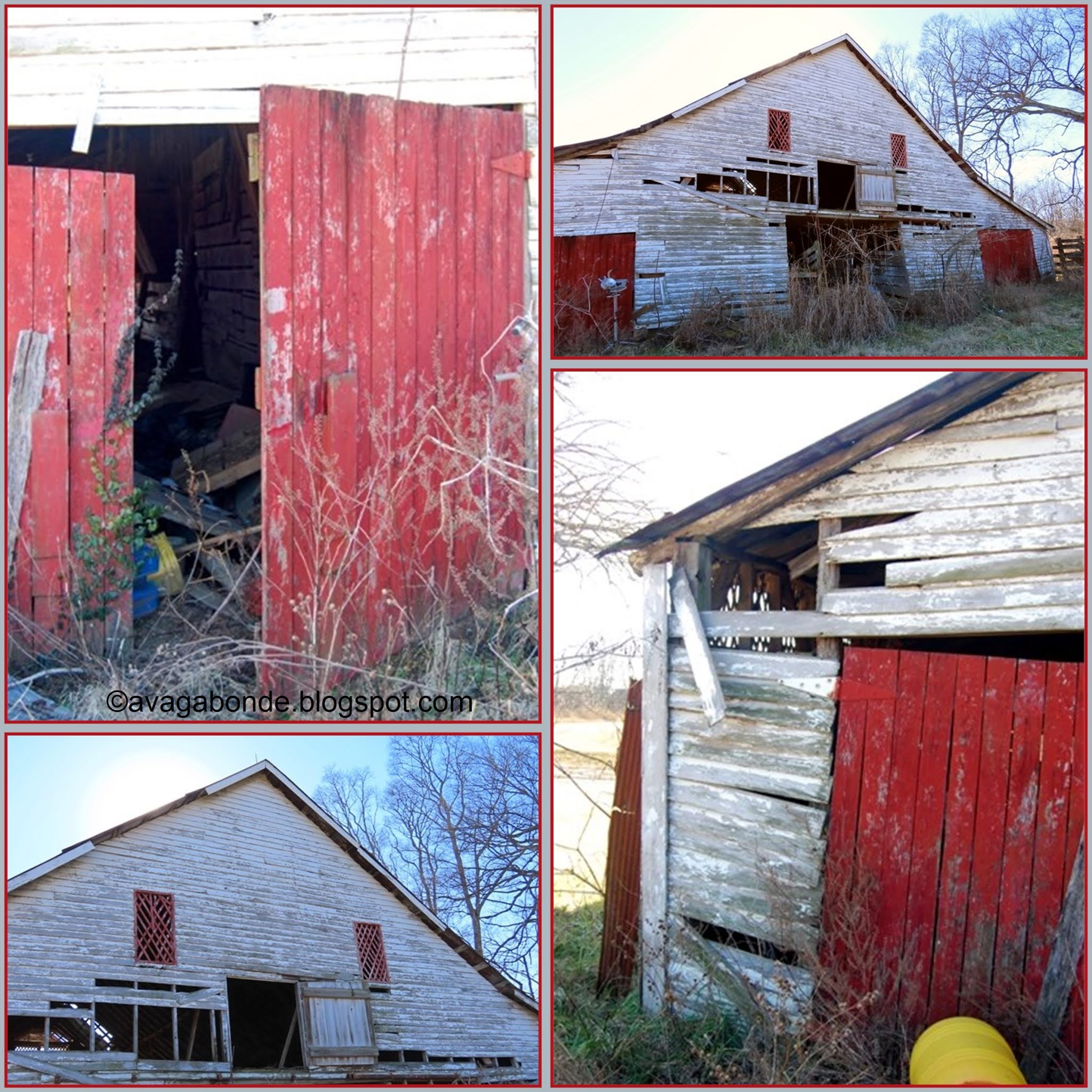
The barn has suffered damages from the heavy winds and tornadoes that came through in the last couple of years. When about a week ago my daughter told me that the property, barn and house, was going to be torn down and to come and take pictures. I decided to do just that. People had been taking photographs she said, but the day I went there, I was the only one. It was sunny with mild weather. I came close to the barn and could see the damages time had done.

The main house was easily seen when turning around the barn. I walked over the property and took numerous photos. Once back home I was curious about its history. I'll share what I found while I show you my pictures. Originally, around 1806 Jabez Owen built a log cabin on the site. Dr. Jabez Owen was one of the wealthiest men in Williamson County, a physician and planter; he owned hundreds of acres of land and 58 enslaved people. Some of their antebellum cabins are still standing on the property now (shown in collage below.) "Antebellum" means
before the war in Latin and usually refers to structures built in the American South during the 30 years before the Civil War (1861-1865.) Antebellum mansions and plantations homes don't have a specific style, they just date to a certain time and place in history that still triggers strong emotions today. (Below, front of slave cabins.)
In 1845 or so the house was expanded by Thomas Perkins Primm. It included a pair of log cabins for enslaved workers (shown above) with vertical board doors and a shared stone chimney. Later, in the 1920s and 1930s a stone springhouse, a frame barn with weatherboard siding, a frame garage and a frame shed were added. Those outbuildings are slowly collapsing now.
Then I could see the side of the house, which from a distance, still looked nice (maybe?).
Thomas Perkins Primm in 1845 expanded the original Owen log cabin into a two-story frame house in the Greek revival style, the classic Middle Tennessee style then, with four columns supporting the two-story porch. Nine years later there were considerable troop movement near this house when on December 1, 1864 an engagement took place between Confederate General Forest and USA General J. H. Wilson. As late as 2015 the house was still deeded to Charlie Primm, a descendant of Thomas Primm. Charlie McNairy Primm died in July 2011 at 88 years of age. He operated a very successful dairy farm in the area with his brothers (his 11 siblings died before he did.) As I came closer to the side of the house I could see how decrepit it now was.
I walked around to the front of the house. The green shudders were still attached, although one was weather beaten.
I was there after lunch in mid January 2021, and the place was very quiet and peaceful. This farm was located on a vast piece of land but in 2003 a great deal of the Primm Farm was sold to be turned into Montclair, an upscale house subdivision. More land had been donated to the city of Brentwood by the late Edgar Wilson Primm and turned into Primm Park, which encompasses an American Indian burial mounds and an early 2-story school,Boiling Springs Academy. Prehistoric Native Americans Mount Builders lived in the area between 900 and 1450 AD. Below is a photo of the early school with an Indian mound behind it, photo courtesy the City of Brentwood.

Boiling Springs Academy originally opened as a private school in 1833 for sons of wealthy plantation owners. Tuition was then $8 per semester ($10 if geography and English were added.) It has two rooms, one upstairs and one on the main floor. Now six schools in Brentwood have "A Day in 1845" for second and third graders. They sit in old-fashioned desks and use chalk, and McGuffey's readers for the day's lessons. They come dressed in period clothes loaned to them by the Historic Commission. They spend the day much like the children of the 1800s, now being taught by retired teachers. Their lessons include penmanship, arithmetic (using slate and slate pencils,) reciting of maxims, a spelling bee and more. Pictures below courtesy the City of Brentwood. (This school is just up the road from the barn and farm and I drive by them each time I visit my daughter.)

Coming closer to the front porch I could see a couple of old rocking chairs standing guard in the entryway surrounded by weeds growing through cracks in the floor. They stood close to the massive Doric columns with peeling paint. I could have sat in one of those, while gazing at the decaying porch ceiling, painted in light blue, as the old houses of Louisiana, to remind of the sky. But I did not, out of respect.

The house must have been deteriorating for a long time. The roof certainly needs replacement and I understand that there is termite damage as well as dry rot. But why was this historic house (with remains of the 1806 log cabin still there) left to crumble like this? If there were 12 siblings there should be plenty of heirs who could have obtained a grant from the Historic Preservation Fund to restore this property. The Owen-Primm house was listed on the National Register of Historic Places in 1988. To be placed on this Register is not that easy. You have to fill a nomination form with historical information on the site and why the property embodies distinctive characteristics of a type, period or method of construction, ect. Congress enacted the National Historic Preservation Act in 1966. Such buildings listed in the Register tend to not only include the building but the surrounding landscape. This act works to save historic buildings for future generations of Americans.

If structures are deemed important enough to qualify to be in the Register of Historic Places, then they should be followed up to ensure that they do not fall into disrepair. But no laws protect these historic buildings and they can be torn down without public notice. Unfortunately most of the financing come from the Historic Preservations Funds, and in this country, historic preservation is of little concern. The last time I checked, the USA is at the bottom of all western countries for the funding of the arts and humanities, which include historic preservation, libraries, museums, etc. In spring 2020, former president Trump unveiled the largest federal budget in history - $4.75 trillion. He wanted to eliminate the funding of the arts and humanities as non-important. The 2020 US budget still included $32.7 million for historic preservation (when the US tax payers paid, as of October 2020, $141 million for Trump's golf trips!) By comparison the 2020 French budget (a much smaller country the size of Texas) was 338 million Euros or $411,366,000 for their historic preservation alone.

In 2012 I started following more keenly the disinterest of most of the US public for historic preservation when I read that the owners of a historic mansion on Long Island, NY, that had inspired F. Scott Fitzgerald to write The Great Gatsby, had "allowed" it to fall into disrepair. This way it would be too far gone to rehabilitate and instead could be demolished so the land be sold instead to the highest bidder to build four McMansions (and getting more money for it, money being #1, of course.) You can read about it in my post "
Why Long Island, NY?" where I explained why my late husband and I made a trip to Long Island to visit more historic buildings before they would also be demolished. I could not believe that the federal government, the state, county or city would not help this historic mansion listed on the Register of Historic Places. (Interior of the Owen-Primm house below, courtesy The Tennessean, Williamson Herald and Williamson Source.)

My blogging friends know that I was born and raised in Paris, France, where we respect our "patrimoine" or National Heritage, and strongly support it. The French Revolution was 50% against Royalty and 50% against the overbearing Church. Castles and churches were burnt or used as warehouses, including Notre Dame de Paris. Victor Hugo in 1831 wrote his book "Notre Dame de Paris" (in English "The Hunchback of Notre Dame") to help save the decaying cathedral. Years later, on December 9, 1905, the French Government passed a law that made all churches built before 1905 the property of the state, not the church (I guess because the French being so secular, no one would pay...) This is why when the roof of Notre Dame de Paris burnt down, people of all religions, no religion, as well as churches of all denominations, synagogues, Buddhist temples and Muslim mosques donated to rebuild the cathedral, not the Vatican. In western countries with the strongest reputation for the funding of historic preservation and the arts, culture expression is considered a universal right, like other basic needs, and not a privilege for just the wealthy.

Would the wealthy US tourists keep flocking to Europe if their historic sites had been bulldozed to make place for more subdivisions? Will future generations of tourists, domestic and international, come to visit Brentwood subdivisions or would they instead be interested in an antebellum farm where a realistic African-American museum had been establishedf in the authentic quarters of their enslaved workers? By the way as far as I can tell there is only one US museum dedicated to slavery in this country, in Louisiana - why? The 1860 Census counted about 4 millions enslaved people in the US, working 10-16 hours a day, six-days a week, with children as young as 3 being put to work. It would help future Williamson County's children, one of the wealthiest county in the US, predominantly white, to find out how the life of southern planters was eased by their enslaved workers who planted and harvested their crops, cooked their food, washed their clothes, nursed their babies, under inhumane conditions. This should not be forgotten or denied and a property like the historic Owen-Primm Farm could teach the way it really was. Walking back to the barn I passed gnarly trees that must have stood there for ages.

I took pictures of the back of the slave cabins. Up to ten enslaved people may have occupied them at the time but later they were used as storage. Considering their age, their exterior walls seem solid.
The back of the barn looked more dilapidated thant the front.
Then I was back facing the front of the storm damaged barn again.
Next time I come by will everything be gone? Demolition is planned for March. Below is the planned house subdivision we'll see in its stead.
Poet Maya Angelou said: "
History, despite its wrenching pain, cannot be unlived, but if faced with courage, need not be lived again." It was lived in Brentwood, Tennessee, but will it become just forgotten history?
ADDENDUM: February 3, 2021 - My late husband talked about the barn every time we drove by it. I thought he would be sad if he knew it was going to be demolished. Then late last evening my daughter sent me a link to the local newpaper, The William Source. This was their breaking news: Historic Owen-Primm House Saved from Demolition - by Press Release - February 2, 2021 -
The threat of demolition of Brentwood's historic Owen-Primm is over. After developers worked with the Heritage Foundation of Williamson County, TN, the home is under contract to a preservation-minded buyer as of Feb. 1. The buyer has yet to be publicly announced but has committed to saving the house, five acres of the property and its barn. A demolition permit filed in mid-December endangered the existence of the historic house on Moores Lane near Wilson Pike, but a 90-day wait period, per Brentwood city code, provided time for the Heritage Foundation and the City of Brenwood to seek other options ..."
Yesterday would have been my husband's birthday, since he was born on a February 2nd. He must be happy about this outcome, wherever he is.