This week's post was going to be on a day trip to San Francisco using the Alameda-San Francisco ferry. Alas, my desktop computer, a 4-year old Gateway 'all-in-one' - the computer with all my recent pictures - kept crashing and then stopped altogether. I took it for repair and was just told that I need to purchase a new computer (they said it was too old to be worth a repair...) I checked the pictures I have on my old laptop computer and could not decide which photos to use. My New York friend Frances, from the blog
City Views Country Dreams had a post last week showing beautiful dahlias; so I decided to use the dahlia pictures from a trip we made to each of the Canadian Maritime Provinces some years ago.
When we visited Halifax, Nova Scotia, we spent several hours in the Victorian Public Gardens. Below are some vintage postcards of the gardens - they have not changed much. (Click on collage to enlarge.)
We visited the gardens in mid-September when the dahlias were in full bloom.
My love of dahlias goes back many years, almost a life time. Let me explain. My parents were married in 1936 and lived in an apartment in Paris, near Montmartre. They had bought a small week-end country house in a little village about 2 hours north of Paris. I looked in the box of photos my late mother gave me and found photos of this house. On the back of one of the photos, my mother had written that the house had been bought in 1936, in Silly-Tillard, in the Department of Oise (I just found this out when I saw the photo today.) Below are old photos of my parents and the house, circa late 1930s.

The small village of Silly-Tillard is about 66 kms (41 miles) from Paris - the closest large town is Beauvais, 17 kms away (10 miles.) In 1936 there were 295 people living in the village and in 2012 the number went up to 487 - so it is still quite small. The village is located on the old road to Paris. It is a picturesque place with houses from the fifteenth to the eighteenth centuries, some of them half-timbered. There is also an old "lavoir" - outdoor public wash-house. Trout fishing is famous there. Here are some pictures of Silly-Tillard, courtesy Villages de France.

After World War II my parents drove during the week-ends to Silly-Tillard in their Renault Celtaquatre automobile. They usually went with friends and I stayed in Paris with my grand-parents. I still went to Silly-Tillard with my parents a dozen times. With no friends to play with, I would walk to the neighbors' garden. There, hundreds of dahlias were awaiting - it was a gem of a garden. I remember this garden as one remembers a dream - flowers everywhere, of different shapes, and glorious colors. I spent happy hours there. Many dahlia plants were higher than me - at the time I must have been 5 years old or so. I don't have pictures of the garden but I found on the Daily Mail, UK, pictures of Amy Chesterman, 6 years old, in her father's dahlia garden in Bournemouth, England. I did not look like her but the dahlias would have been similar around me.
Below is a picture of our country house and my parents Renault Celtaquatre (these cars were manufactured between 1934 and 1938.)
During the war my parents' little house had been requisitioned and occupied by a German officer. When my mother found out (my father was in hospital because of war injuries) she walked ten miles to the kommandantur (German military headquarters) in Beauvais, near the village, and requested that rent be paid for the house. Everyone told my mom that she would place herself in danger, but she persisted and they did pay her rent in the end. But they also made some alterations to the house and my parents sold the house in 1947 or 1948 or so. I don't remember the house well, but I still remember the serene garden next door with all the dahlias ... most of all the variegated with white and the purples the best.
I am not sure how many dahlias were in our neighbors' garden, but to me it seemed like a field of flowers just as in the vintage postcards below.

When I heard that the Public Gardens in Halifax had a dahlia garden I knew that I had to go there. The original gardens were created in 1836, then established as a civic garden in 1867, and finally the City of Halifax took responsibility for the gardens in 1874. Nowadays the Public Gardens still look as they were originally planned in 1875 by the Gardens' Superintendent - as formal High Victorian Pleasure Gardens. At the entrance, we are greeted by a set of elegant wrought-iron ornamental gates, installed in 1890 and bearing the original Halifax coat of arms. The gardens include a bandstand, statues, fountains, ornate bridges, floral displays, 80 species of trees and 200 of shrubes - some exotic and semi-tropical. One of the trees was planted by King George VI in the 1930s. In 1984 the Halifax Public Gardens were recognized as a National Historic Site.

We entered the gardens through the elegant gates, built in Glasgow, Scotland and standing in the gardens since 1890. We walked on the alley bordered by large trees and then followed a body of water to Griffin's Pond.
We stopped to look at the ducks.
A replica of the RMS Titanic floats on the pond. It is a reminder that 121 victims of the Titanic were interred at Halifax Fairview Cemetery after the ship sank on 14 April 1912.
We kept walking on the winding paths, stopping to admire the flower displays.
Several historic statues were near traditional Victorian carpet beds:
Flora, the goddess of flowers and spring and
Diana, the goddess of woodland and wild animals.
As in all fine Victorian Gardens, the Halifax Public Gardens have fountains in addition to the historic statues. In 1897 the classical sculpted Victoria Jubilee Fountain was erected to commemorate Queen Victoria's Diamond Jubilee. This fountain sits in the center of the gardens. In 2012 the fountain was restored in celebration of Queen Elizabeth II's Diamond Jubilee. The Boer War Memorial Fountain was built in 1903 to honor the memory of the soldiers from Canada who took part in the war in South Africa.
Next we came by the colorful gingerbread style bandstand. It was built in 1887 to also commemorate Queen Victoria's Golden Jubilee. It is an ornate wooden bandstand with a copper roof. It has been used for concerts and social events for 128 years and was restored in 2011. Walking around the bandstand I could see the dahlia beds, at last.
The dahlias are tuberous flowers originally from Mexico, Central America and Columbia. The director of the Madrid Botanical Gardens, Antonio Jose Cavanilles, named this plant in honor of Anders Dahl, a Swedish botanist, who died in 1789 - the same year Spain was to receive the dahlia plants from Mexico. There are more than 57,000 registered cultivars of dahlias. They come in a great variety of colors, sizes and shapes - anemones, collarette, balls, etc. Dahlias bloom from late summer until first frost. It is difficult to choose a favorite. Below are two anemore forms with yellow centers, and two ball forms - a fuchsia pink and a dark red.
The two cultivars below were new to me - but they have a certain charm.
There were so many exquisite blooms and amazing colors - I kept moving from one to the next in awe.
Aren't these lovely?
How about these, from pale yellow to golden apricot colors?
This big fluffly dahlia below is called a "Big Head" in France and a "Dinner Plate" here.
The collarette dahlia type was first introduced at the 1900 Universal Exhibition in Paris. The American Dahlia Society listed the collarette as a form in 1905. The red collarette dahlia below looks almost artificial. It is a stunning flower, indeed.
The American Dahlia Society was founded in 1915. This coming week-end (Sept. 19-20, 2015) they will celebrate their 100th anniversary with a show at the Hofstra University, in the village of Hempstead, Long Island, New York. If I had known about this earlier I, perhaps, could have gone there for a quick trip. Dahlia photos below courtesy ADS library.
These are gorgeous flowers -
la crème de la crème.
Here are some more
Walking in these mid-19th century idyllic gardens, just half a mile from downtown the modern city of Halifax, was like entering a time capsule - being back in Victorian times. It was the fashion then to walk in gardens, wearing a lovely outfit, while listening to the military bands in the bandstand gazebos. I think that these unspoiled gardens, with their rainbow of floral delights, would have enchanted the French ladies Monet painted below - on top "Woman in a Garden" then "Woman with a parasol in a Garden" by Claude Monet, French 1840-1926.
Don't you love these amazing, dramatic flowers?


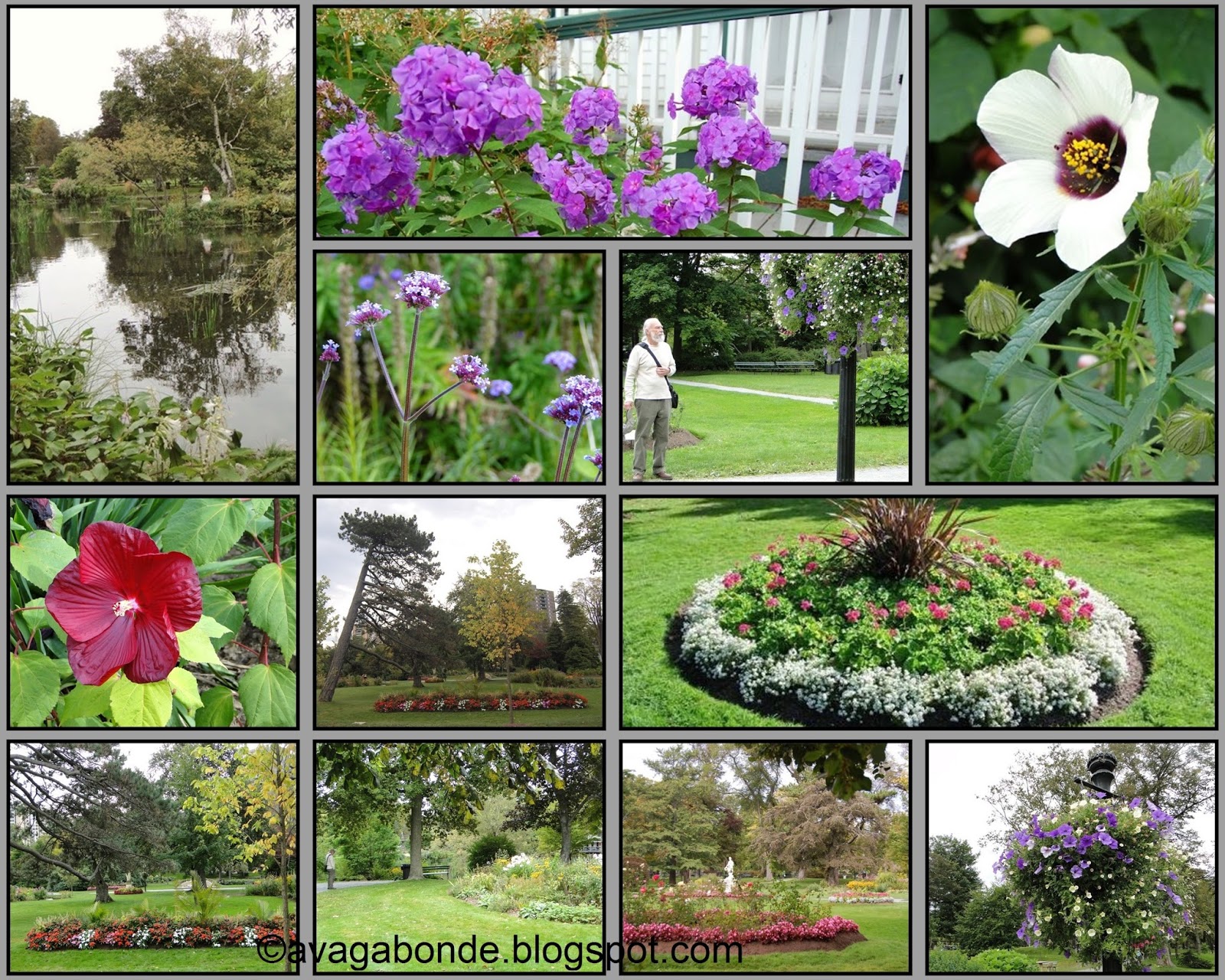


 Click collage to enlarge then click on each pictures to see better

 Martinecock Native Americans (courtesy the Garvies Point Museum)


