Showing posts with label trees. Show all posts
Wednesday, January 18, 2023
Some French customs ... Noël and New Year
Already half of January is gone. I have to hurry up and send my good year wishes to my French family and friends before the end of the month. In France it is the custom to send cards of Bonne Année (New Year) meilleurs voeux (best wishes) during the month of January (not in December because that is considered bad luck.) The wishes have to be sent or given between the start of the New Year and January 31st. Along the years I have received many cards. I'll show some of them below. (Click on collage to enlarge.)
Very few Christmas cards are sent in France, it is not the tradition. They are very hard to find anyhow. Also I have never received cards from France with photographs of the senders like it is done here, more and more. Here I even received some from US businesses, such as from the man trimming my front yard grass (see below.)
My Muslim friends have sent me New Year greeting cards, too.
Usually most holiday stamps in France are just for a happy New Year and best wishes. Those stamps are not religious.
The French post office also issues Chinese lunar New Year stamps.
Another custom from the US which is not followed in France is the outdoor lightning and decorations on people's houses; however, most cities in France are decorarted during the holidays. (Photos below of Paris, Rennes, Strasbourg, Nimes and a town in Brittany.) Also in France you don't usually hear Christmas carols in the shops as you do here.
As you can see in the photos above there are many Christmas trees. Actually in France there are Christmas trees everywhere - from the largest cities to the smalles villages, and in city halls, church steps, public spaces, train stations, and of course shops. Below are some large Paris department stores during the holidays. Top left is Le Printemps, next to La Samaritaine, below left is the Galeries Lafayette next to the Bon Marché. (France is one of the least religious countries in Europe, with only 6% attending church, at least once a month.)
The reason is that Christmas trees are not considered religious in France. They are not called Christmas trees in French but arbres or sapins de Noël (trees or pine trees of Noël.) Noël is not a Christian word, but its origin is from the Gaulish language, even though the Catholic church tried hard to say it is from the Latin (!) You may not know too much about the Gaul Empire. In France, in my first grade elementary class, I learned that it was the origins of France.
We were always taught about "nos ancêtres les Gaulois" (our ancestors, the Gauls.) That saying is quite popular in France. Below is a map of the ancient Gaul Empire and a Paris restaurant named after it.
There are many books on that subject as well.
The Gauls became so popular in France that a brand of cigarettes is called "Gauloises." They came in different flavor, dark, blonde, light and menthol. I knew them well because my father was a chain smoker of the strong dark ones (he died of lung cancer at 65 years old.) Now it is written on the pack: "Nuit gravement à la santé" /seriously damages health. They were manufactured in France but young people don't smoke as much now or prefer American tasting, sweeter cigarettes. Since 2017 they have been made in Poland; however, the "menthol" flavor has been banned since 2020. Cigarettes are only sold in tobacco stores in France. Malboro are the most popular and cost 10 Euros a pack of 20 cigarettes ($11.)
The Gaulish warriors were fierce, tall and muscled. They excelled on the battlefield, terrifying their enemies with their famous "sacred fury." The Greek historian Diodorus Siculus (between 30 and 60 BC) described the Gaul warriors thus: "The Gauls are tall of body, with skin moist and white. Their hair is blond not only by nature but also because they practice to increase artificially the peculiar nature of their coloring. Some of them shave off their beards, but others let them grow moderately. The nobles shave their cheeks, but let their mustaches grow freely so as to cover their mouths. They dress in astonishing clothes, tunics dyed in all colors ..." (Interesting to note that the Gauls/French already bleached their hair 600 years BC!.)
Vercingetorix was the Gaulish chieftain that we knew so well when were were children. He is considered the first national hero of France for his defense of our land. It is said even his enemies greatly admired him and feared him. He was tall, handsome, a charismatic leader and an inspiring public speaker. Below are two paintings about Vercingetorix and two French stamps commemorating him.
Napoleon III (1808-1873) a nephew of Napoleon I, greatly admired Vercingetorix. He paid with his own funds to have a statue of the warrior erected in central France, in Alesia, Burgundy (a site of a Gaulish battle.) The monument sculpted by Aimé Millet, erected in 1865, is in bronze and 22 feet tall. At its base is written: "La Gaulle unie, formant une seule nation, animée d’un même esprit, peut défier l’univers." (Gaul united, forming a single nation, animated by a common spirit, can defy the universe.") There are other statues of Vercingetorix, one of him riding a horse and made by Frédéric Bartholdi (1834-1904) the French sculptor who designed the Statue of Liberty, now in the USA.
Napoleon III insisted that all schools curriculum should start with the history of Gaul. He was the first President of France from 1848 to 1852 and the last monarch of France as Emperor of the French from 1852 to 1870, also the last monarch to rule over France. The Gauls spoke the Gaulish language which became extinct by 1000 AD. Quite a large number of French words came from Gaulish, such as brave/bragos, brosse (brush)/bruskia, cheval (horse)/caballos, manteau (coat)/mantion, sapin (pine tree)/sappos. And we are back to our fir tree with Noël coming from the Gaulish "noio" (nouveau-new) and "hel" (soleil-sun.) More than a thousand years before the Christian era the Gauls had a pagan festival around our December 24, at the time of the winter solstice. It lasted for a week or so. The spruce, tree of birth and symbol of life, was linked to this festival to celebrate the rebirth of the Sun. It was then decorated with fruits, fllowers and wheat. This evergreen tree was a picea abies, or European spruce, shown below around a lake in France and on a botanical plate of 1885.
In 336, under Emperor Constantine, the Church in Rome chose December 25 to celebrate the birth of Christ. It may have been a PR gesture for dethroning the centuries old solstice pagan festival which took place on Dec. 24/25 and replacing it with a Christian referent. It was also to take advantage of this well established pagan festival; people were given a Christian alternative to the pagan festivities. Eventually many of the pagan symbols and actions were re-interpreted in ways acceptable to Christian faith and practice, including the date and name of the festival. All countries switched to these Christian names but not Gaul/France. France kept the name of Noël from the ancient pagan festival and the name of its tree, the only country to do so. Till now they refer to it as Noël and le sapin de Noël (the pine tree of Noël.)
Some old French tree of Noël traditions: in 1521, in Sélestat in Alsace (the town where my grandfather was born and raised and under the German Empire at that time,) a fir tree in the city square was decorated with paper flowers and sweets. Later they added candles (walnut shells filled with oil) chocolate and garlands. The city of Sélestat is celebrated as the capital of the arbre de Noël in France, tradition born there is 1521. In 1738, Marie Leszczynska (daughter of the King of Poland,) wife of Louis XV, King of France, had a Christmas tree installed in the Palace of Versailles, helping to spread the fashion for the decorated tree throughout France. (Photos below: Sélestat cradle of Noël, a stamp, Marie Queen of France, and Sélestat in summer.)
But another country has a secular holiday fir tree - they call it Yolka. After the Russian Revolution, Christmas celebrations were banished in the Soviet Union. In 1935 they replaced it with a secular New Year holiday with a New Year fir tree called "yolka." There were celebrations and gift giving. The Kremlin gave a special New Year party for children with clowns, gifts, dances, songs and more (and I think they still do.)
New Year with decorated yolka tree, gift exchanging, celebrations and singing have survived till now in Russia and former Soviet Union states. Large yolka fir trees can be found in many cities, such as Grozny the capital of Chechnya (mostly Muslim,) Kazan, Ulan-Ude in East Siberia and many more.
So it is now that everyone in Russia and former USSR states celebrate New Year with a decorated fir tree, Christians, Muslims, Jews, Buddhists, Atheists, Agnostics, Sikhs, Hindus, etc. It is not considered a Christmas tree, just like in France, it is a universal tree of light, fun, goodwill and hope. During the Soviet years the Jews were not allowed to celebrate Passover, Hanukkah or any other religous holidays, but they could celebrate Novy God (New Year) with a decorated yulka tree - and they all did. After millions of Jews emigrated from the Soviet Union they continued their yolka tradition and passed it to their children. However, many Jews in Israel cannot accept the concept of a secular decorated fir tree and have been trying to stop that tradition. I even read in international newspapers that some towns in Israel a couple of weeks ago vandalized and or burnt yolka trees. It is quite sad to me that some people leaving their country to escape persecution are not fully accepted in their new country either. At least they can come to France and have a yolka tree (but as in the US, there is anti-Semitism in France, too, alas.)
As I said above the concept of sending Christmas cards is not followed in France. Since living in the US I have changed my customs/traditions and I do send Christmas cards. I also send New Year cards to France (I feel one should not be rigid but flexible with traditions.) In France you should not say "Happy New Year" before the 1st of January - it is considered back luck. But after the first you may wish it to everyone you meet, write it on every email or text! Another French tradition started by General de Gaulle in 1960 is the New Year's Eve presidential message (like the Christmas message of the late UK Queen and new King.) On television, at 8 pm the President of the French Republic speaks to the nation from the official Elysée Palace and gives his "Presidential Greetings." This year President Macron in a 20-minute statement addressed the French people with "wishes for unity, boldness and collective ambition."
My wish for you is to have a great year. May the next 12 months be synonymous with joy, laughter and good health.
Saturday, November 12, 2022
Old Car City in White, Georgia
On Sunday 6 November, 2022 I drove the 4 1/2 hours from Nashville to Greater Atlanta so I could vote in the mid-term elections on Tuesday Nov. 8. Before, I usually voted during advance voting at the main Cobb County polling place, but this time I could not. At about 10 am I drove to where I used to vote in my area. There were just a couple of cars in the parking lot; I thought they had moved the voting location but a sign showing "vote here" was in front of the door so I went in. I was first in line and it took me only ten minutes to vote. Of course I live in the extreme northwest of Cobb County, in the rural area where houses are far in between (my neighbor has 40 acres between us behind the lake, and the next one is a farm.)
Thursday Nov. 10 was a bright and sunny fall day begging for me to stay oudoors, but where to go? In early 2020 I had planned to become a member of the Nashville Photo Club; then Covid happened and I did not. They met monthly and went on regular outings, near and far. They had been planning to drive to White in North Georgia to an old car junkyard-museum. I checked and realized it was only 26 miles from my Georgia house. If they were willing to drive 4+ hours to visit, I certainly could drive half an hour to take a look. So this is what I did that day. My house is not far from the Bartow county line. The red dot below, between Acworth and Kennesaw, is where my house is located.
Arriving around 10:30 am there was just another car in the parking lot (from Pennsyvania.) Old Car City is on highway US-411 with just a small southern restaurant across the road. I went in and paid the entrance fee (cash only.) There was an eclectic assortment of memorabilia, vintage collectible, antique toys, Americana, an old piano, etc. in the interior area.
I was shown a map then told the property had 6.5 miles of trails on the 34 acres (137,593.12 sq meters.) I walked by a sign with a short history of the business and a witch left over from Halloween when they offered a spooky "Haunted Trails." (Click on collage to enlarge and read better.)
The parents of Dean Lewis, the current owner, started a general store in 1931 that sold various items from tires, gasoline, clothing and car parts. Because of the Great Depression steel was scarce so they changed their line to scrapping cars; by the late 1940s it had become a salvage yard. When Dean acquired the business in 1970 there were 40 cars on the lot. He had a passion for old cars and spent decades acquiring wrecked and junked vehicles from recycling yards, auctions and private parties. But Dean did not like to sell the old vehicles' parts, he wanted to preserve them. He kept collecting them, had to buy more land; he stopped counting when he had collected over 4000 rusting metal carcasses. People were stopping by to take a look or take pictures, so about 15 years ago Dean realized that the business could be better sustained as a museum charging admittance. I started walking on the grounds, passing more unusual items, rusting bicycles and tricycles.
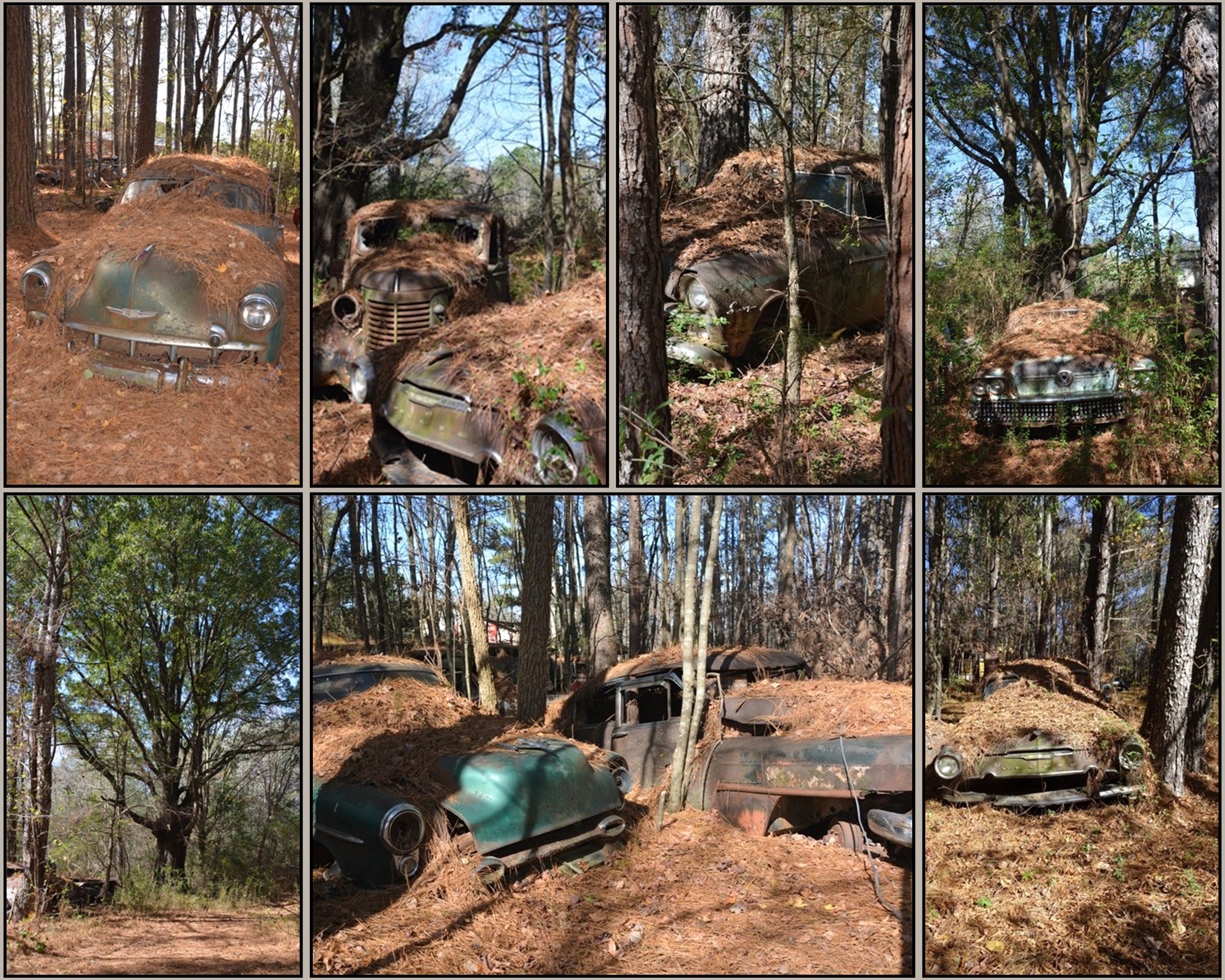
Then I entered the trail, looking in awe at all the decaying cars covered with pine needles and creeping vines. Some cars had trees growing through their bumpers or windshields and even lifted them. Some cars were on top of each other, maybe as they had been delivered. After more than 80 years the cars had been taken over by nature, they were part of it. This is why the slogan here is "Nature, Art, History and Cars." It was an amazing sight, but very quiet, with just the birds chirping, and no one else around.
Stopping to take photos, walking, turning, I knew I was getting lost, but so what.
Along the way there were random unique hand-painted signs, with optional spelling.
It was in the high 70s (26 c) but under the pine canopy it felt cool. It was a forest, really, with some very large trees and a heavy carpet of pine straw on the ground and covering the cars.
Actually with all the pine straw it was hard to read the make of the cars. I like vintage cars but I am not an enthusiast and unless I can read it I can't distinguish between all the different brands and certainly can't tell the models or years. Maybe after a good rain, if the straw moved it would be easier to read. I kept stopping and snapping - I had brought my Nikon D5200 and my small Sony DSC-HX90V plus took some with my Iphone. There was an embarrassment of choices - where to point?
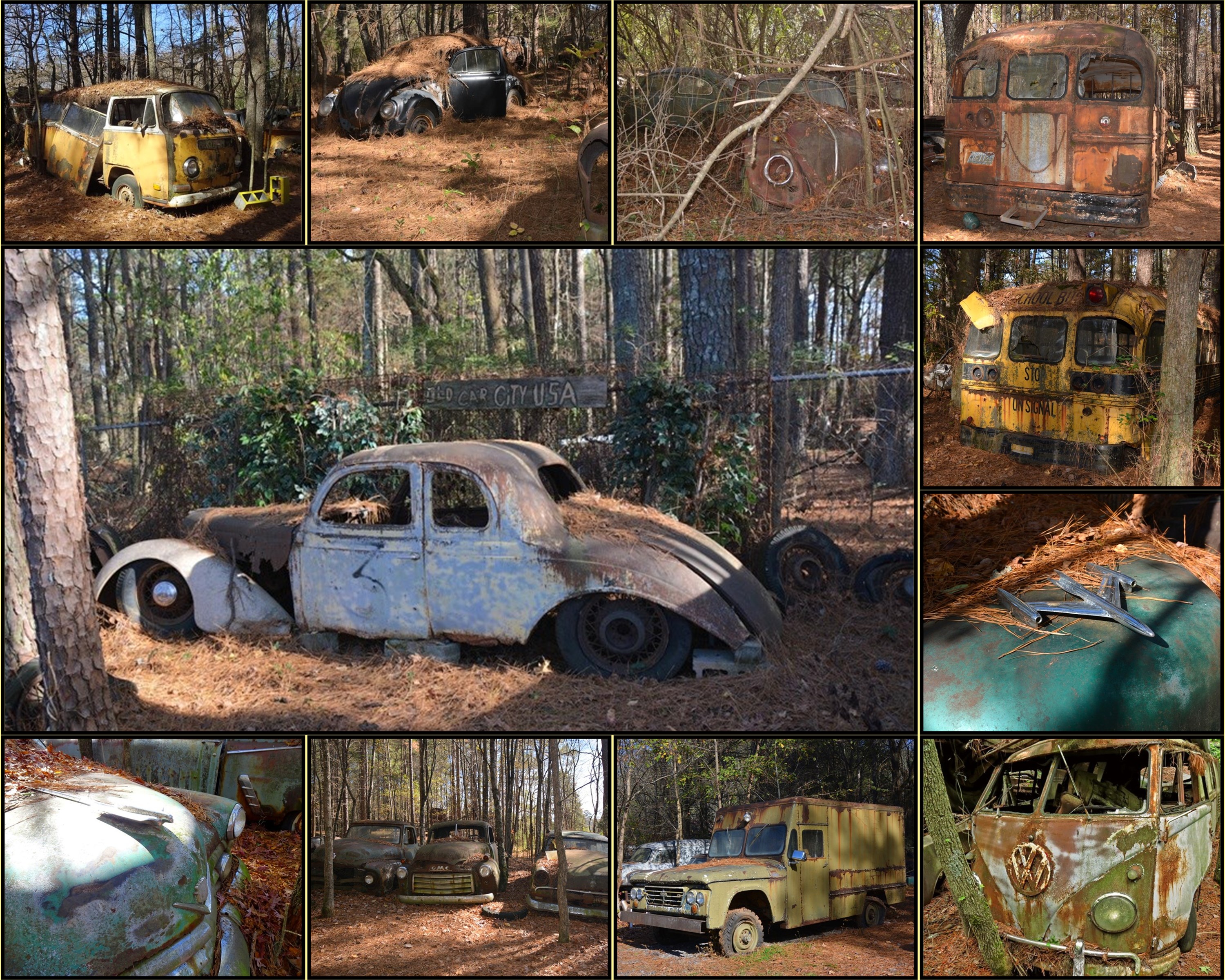
I read the oldest car there was a 1918 Buick, then a few from the 1920s, more from the 1930s and most vehicles from the 1940s to 1972. They included Packards, Desoto, Chevrolet, Studebakers, Hudsons, Fords, Edsels, Mercury, Buicks, Plymouths, Oldsmobiles, Dodges, Cadillacs, Chryslers, Pontiac, Lincoln, some buses, a 1941 Mack milk truck and a few foreign cars - I recognized some VWs. From a distance I thought I read "vagabond" on the back of a car. Getting closer, sure enough, it read "vagabond." I never knew such a model ever existed. Back at home I researched it. From 1946 to 1951 the Kaiser-Frazer Corporation made upper-medium price luxury automobiles; their Frazer Vagabond was a unique hatchback sedan. The Vagabond shown below (courtesy Wikipedia) has been restored to its prime glory. (I wish I could be restored...)
There certainly was a plethora of rustic relics from days gone by and I understood why another of the Old Car City's slogans was "Photographer's Paradise." How to select the best angle to snap these decomposing dream cars?
Some metal chairs were placed in some of the trails for a quick rest or meditation or reflection?
Then I saw it - a car I knew. Flying to France in 2008 I watched on the flight the movie "Gran Torino" starring Clint Eastwood with his prized muscle car, a 1972 Ford Torino. Here was a poor sweet green Torino resting under the Georgia pines.
It was already past 1:00 pm. I had been wandering in the forest among this chrome and rust cemetery for 2 1/2 hours. It was time to go back and cross the highway to the restaurant for lunch, but which way to get back? I kept going up and down trails, and they all looked alike. I did not reach the restaurant until close to 2:00 pm!
I understand that locals gather there for lunch and it gets quite busy, but by then there were just a couple of patrons. Wes-Man Restaurant is a typical rural southern restaurant. They open 6:00 am to 3:00 pm. Inside it looked cozy and tiny with license plates covering the wall along old newspapers, old high school annuals, etc. The lunch menu has a large selection of classic southern comfort food with burgers, salads, blue plates (meat and 3) and more.
There were bags of water hanging over the booths - to prevent flies they told me. I ordered the standard southern vegetable plate: fried okra, turnip greens, black eye peas, fried green tomatoes and corn bread. I'm pleased they served the vinegar pepper sauce for the greens, as they often don't in Tennessee. For dessert I had the blueberry cobbler. Everything was tasty especially the okra and fried green tomatoes.
Now that I had re-fueled my body I was ready to cross the road back to the forest of disintegrating relics. Close to the front of the lot the cars and trucks were parked on cement or gravel, not under pine trees. Many had moss and grime from all the decades they had been stationed there.
I wish I recognized some of those cars, like that long black one above. I did drive two vintage cars back in the days. My father, in the late 1940s, had bought a 1936 Simca-Fiat coupe, with stick shifts, for my mother so she would learn to drive. She always refused. The car spent years in storage in a French country warehouse until she gave it to me for my 18th birthday. I drove that old car all over Paris in the early 1960s and had so much fun. I also drove my boy-friend's 1939 Chevrolet coupe in Great Falls, Montana, a couple of times. The Chevrolet is in the bottom photo, below.
Walking back to the forest trails I passed some vehicles that were under shelter and some above the shelter's roof.
I kept on my little trek stopping here and there to snap hood ornaments, car remnants, ghosts of VW Beetles and vans, and crumbling school buses.
At 3:30 pm I was ready to head back as they close at 4:00 pm. Getting back to the main building I stopped by a collectible automobile in great shape. It was the maroon 1977 Lincoln Mark V Elvis Presley bought in 1977, just months before he died.
Later I read some negative comments about this unusual museum. Some said it was useless hoarding these pieces of junk. Other said the land would be better used in more money productive ways or that the owner Dean Lewis would profit more by selling the land than keeping that garbage around. I don't think Dean is interested in that. He says "I don't know what I would do if I couldn't get up every morning and look at old cars."
Since a little boy Dean had a passion for old cars. He was able to build a business around it and make a living. Eighty plus years later, Dean is still around his beloved old cars (he was born in 1937.) There is a lot to be said about this - life is not just measured in dollars. These vehicles had their day, their use and now can freeze in place and give pleasure to others. About 99% of them are unsalvageable. They have another use - a destination for families to walk in an uncommon forest. They are ideal as photo opportunities for professional photographers, ad agencies, media companies, videographers, photo clubs or just people like me who enjoy shooting unusual and unique pieces.
Another comment was: "A friend and I just traveled almost 1400 miles to photograph the incredible cars at Old Car City. We arrived at opening and stayed till closing for 3 days and didn't even come close to seeing/photographing it all!" There have been visitors from Sweden, Australia, New Zealand, China, Russia, Canada and the UK in addition to domestic visitors. I truly enjoyed getting lost in this one-of-a-kind forest and snapping these lovingly neglected car remains fading away under the Georgia sun.
Subscribe to:
Posts (Atom)