Showing posts with label Flood. Show all posts
Monday, April 12, 2021
Picasso in Nashville, the weather and Paducah, KY
Let's start with the weather. My return trip to Nashville from Atlanta was planned for March 25, 2021, but storms started accumulating that day followed by tornadoes. One touched down in a small town west of us. I stayed up till 2:00 am on the 26th under tornado watch. On the morning of the 26th a violent tornado devastated the city of Newnan, GA, south of Atlanta, destroying several historic homes. I still left my house in Atlanta for Nashville on the 26th of March as it was my birthday and I had bought a cake at the French bakery. Because of all this I did not realize that it had rained so heavily in Nashville that part of the town had been flooded, including the basement in my Nashville house. When I looked a couple of days later, I saw water one foot high on the basement ground (as the sump pump lever had malfunctioned.) The water had entered my new water heater. It had to be replaced with a tank-less water heater (cost $3,500 - so was not very happy about that!) Below photos of the Georgia tornadoes and Nashville flood.
On the 27th we did celebrate my birthday at my daughter's, ending with the French chocolate birthday cake. She gave me a pretty hyacinth planter that has a lovely fragrance.
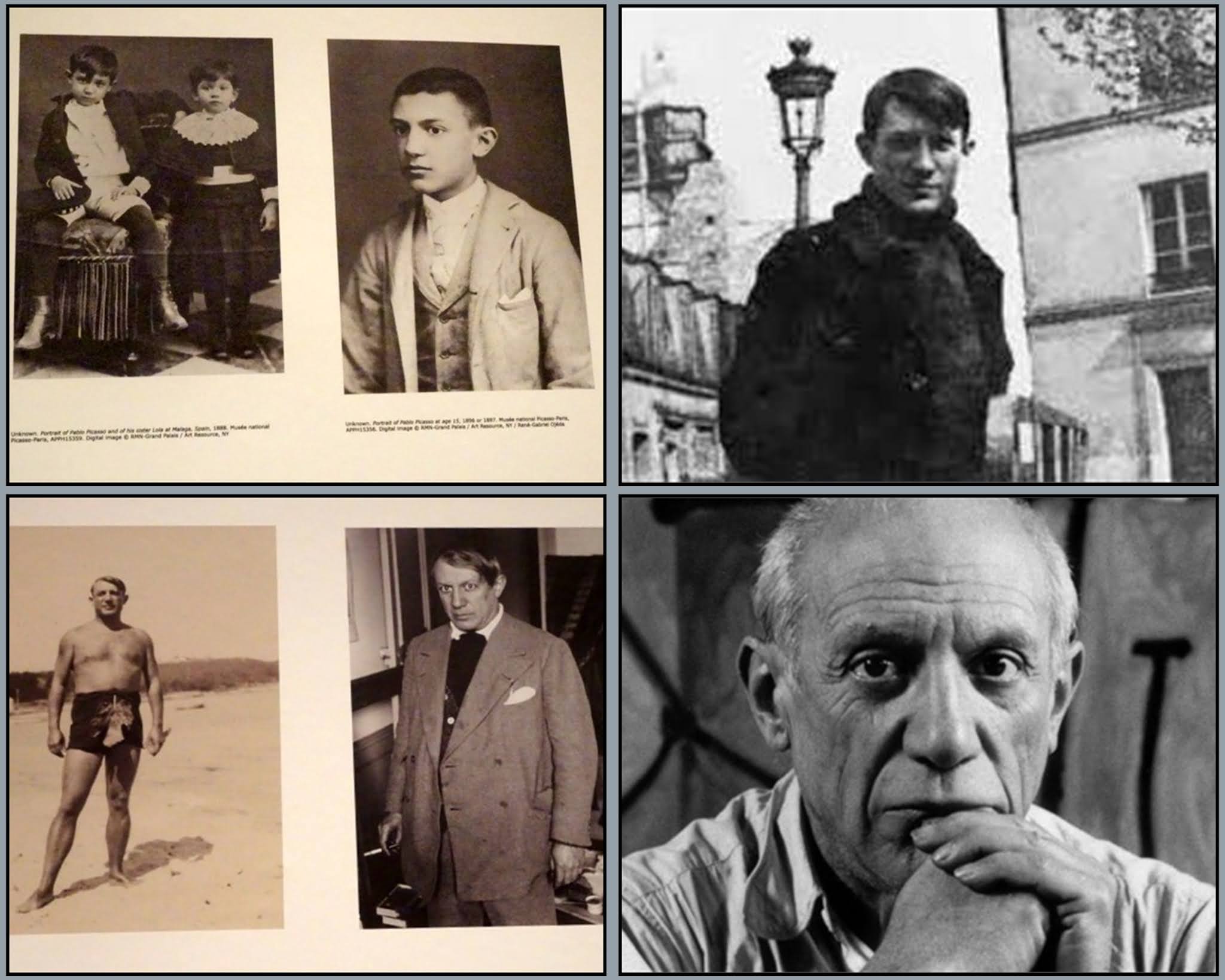
The Frist Art Museum in Nashville celebrated its 20th anniversary with a unique exhibition from France called "Picasso - Figures" on loan from the Musée national Picasso-Paris. The Nashville Picasso exhibit is the one and only appearing in the U.S. in 2021. It will end here on May 9th. Advance timed tickets are required as well as social distancing in the museum. When I attended the show few people were there. The exhibition features 75 paintings, sculptures and works on paper that are exploring the artist's lifelong fascination with the body as a means of conveying his deep feelings. Famous and lesser-known works ranging from his early years to his late period are shown with accompanying explanation. There were informative panels on the wall and a short history of Picasso's life. If you click on the photos below it will enlarge and be easier to read his biography.
Pablo Ruiz Picasso was born in Malaga, Spain, on 25 April 1881. As early as seven years old, he was trained by his father, a professor of art at a local university. At 13 years of age Picasso took lessons with his father who was then working at the School of Fine Arts in Barcelona. Picasso studied also in Madrid and took frequent trips to Paris where he moved in 1904. In 1940 Picasso applied for French citizenship but was refused. With General Franco in power in Spain, the French government could not decide whether Picasso was a communist or anarchist, so they ruled out his request. But after he died, France honored him and his work with a museum in a historic Paris building. There were photos of Picasso in the exhibit.
It felt strange in a way to see these famous paintings here in Nashville. I knew so many of them from having seen them in magazines, newspapers, postcards and so on, but here were the authentic paintings, the real thing. I guess it felt as someone who might have seen many renderings of the Eiffel Tower or the San Francisco Golden Gate Bridge, then see them "in the flesh" if you will. Awe inspiring. The exhibition started with a painting Pablo executed when he was not 14 years old "La Fillette aux Pieds Nus" (The Barefoot Girl.)
Picasso had numerous romantic relationships - he loved women and they fueled his art. Picasso was married twice, from 1918 to 1955 (although they lived separately from 1938 on) with Olga Khokhlova, a Ukraining ballet dancer of noble descent and the mother of his son, Paulo (Olga slowly drank herself to death after he left her for another woman, Marie-Therese Walker.) From 1961 to his death in 1973 he was married to Jacqueline Roque who he had met when he was 72 and she 26. Pablo had hundreds of affairs, and six significant mistresses, such as Marie-Therese Walker, who gave him a child, Maya (Marie-Therese hang herself later.) Then Francoise Gilot (between 1943 and 1953) with whom he had two children, Claude and Paloma. Francoise is the only woman who left him, and Picasso resented this tremendously. He disinherited their two children. Francoise subsequently married the American physician and researcher, Jonas Salk, who created the first vaccine against polio. Jacqueline Roque, his second wife, was the most featured woman across his artwork - he painted 400 portraits of her. (Jacqueline could not live without Picasso and in 1986 she committed suicide.) I took a side view of many of the paintings to avoid the glare from the lights above.
On June 3, 1964, Picasso painted Jacqueline Roque, his future second wife, and titled it "Jacqueline aux mains croisées" (Jacqueline with crossed hands.) She looks like a 20th century long-necked sphinx with the vacant gaze of a Mona Lisa. It is quite a famous work of art. I was surprised to see it in Nashville.
I took several views of it.
There was a short video showing Picasso painting a flower. Below is the sculpture "La femme à la poussette" (Woman with a baby carriage.) In 1950, while walking around in Vallauris (southeast France) Picasso would pick up random thrown away pieces and gather them for his work. For the bronze sculpture below Picasso combined pieces from a real baby buggy with the base of a frying pan and a handful of tart molds, then completed the sculpture with plaster such as the woman's head and arms.
Interspersed on the walls were some of Picasso's quotations.
There were also descriptions of Picasso's creative phases, labeled "periods." The "Blue Period" started in 1901 until 1904. The "Rose Period" lasted until 1906. Then from 1906 to 1909 Picasso was inspired by African art knwon as the "African Period" to be followed by his "Cubism Period" that was at first influenced by Cezanne. Picasso is known for breaking down basic forms then reconstructing them in an abstract way. Picasso took inspiration from everything in his life, his emotions, events, women, and work from his fellow artists. And in turn he has inspired millions of people.
From his academic years in Barcelona until his death, Picasso was inspired by paintings from Masters of the past. He redid them in his revolutionary style. He produced series from Delacroix, Velasquez, Manet, and more. Picasso was very stimulated by Edouard Manet's (French, 1832-1883)"Le déjeuner sur l'herbe" (Luncheon on the Grass.) Picasso recreated this painting his own way in 40 works of various disciplines such as paintings, printing, drawings and ceramics. Below is Manet's original 1863 oil painting (at the Musee d'Orsay in Paris) and Picasso's 1960 interpretation.
Below is one of the last paintings of Picasso one year from his death. The Musician was painted in 1972 in his house in Mougins, in the south of France.
Picasso is a pillar of modern art and one of the most influential artists of his generation. He is one of the most prolific in history with close to 50,000 known works. To be able to see some of his works in Nashville was a real treat. It was like a little piece of Paris. My mother lived for many years in the Marais district of Paris where the Musée national Picasso is now located. But in those years (the 1970s) the museum was just another dark historic building that was less than half a mile (750 meters) from her flat. The Hôtel Salé ( “salé” meaning “salty” in French) where is the Picasso museum now, was built in 1659 for Pierre Aubert de Fontenay, a collector of the salt tax. Along the years it saw many owners, including the Embassy of the Republic of Venice (before 1728) then more prestigious owners, a school, etc. Below an old photo of the building (pretty much as I used to see it) and now as a museum for over 5,000 works of Picasso and tens of thousands of archived pieces. (The museum is temporarily closed due to the Covid virus.)
After my father died my mother sold the big house and moved to the Marais district of Paris. Then, it was not touristy or even prestigious - it was just another old quartier of Paris, which is why she was able to purchase two flats there (to connect into one larger flat.) Although when she moved years later, the area was starting to be gentrified. Now of course Paris has changed a lot. The last time I visited the area wishing to go the the neighborhood restaurant we used to visit, it is now a Starbucks coffee shop, really. Of course I love my home town of Paris but at the same time when I go back I'm always afraid to be unable to find the places I knew. About two million people live in Paris now - 50 million tourists went there in 2019. Actually it is not easy to have your home town be Paris, who everyone else loves, too. I was thinking it might be nice to be from a small town, where things do not change much and local people are there, not herds of tourists. So I placed my finger on the U.S. map to see where I could be from,and what it would be like to be from there. My finger landed on Paducah, Kentucky.
Paducah? I had not heard of it, but it looks close to Nashville. Then it starts with the letters Pa - like Paris; Pa - Paducah. It is also a river town, since it is located at the confluence of the Ohio and Tennessee rivers. I found out that it is one of the world's UNESCO Creative Cities. This year is the 30th anniversary of the National Quilt Museum that was established in Paducah in 1991 (a must see for me.) There is also a famous African American museum located in the former 1908 Hotel Metropolitan where guests included Louis Armstrong, Duke Ellington, Tina Turner and more. I read that restaurants are also abundant there, with Tasting Table naming Paducah among the best small town for food in the U.S. River boat cruises stop in the Paducah port. (Photos courtesy the Paducah Tourist Bureau.)
On the Paducah travel site I also read: "Historic Downtown Paducah, Kentucky, has been consistently recognized as one of America's best and most beautiful Main Streets by Architectural Digest, the National Trust for Historic Preservation and many others. Preserved 19th century architecture frames contemporary cultural experiences. A certified Kentucky Cultural District with twenty square blocks listed on the National Register of Historic Places, Historic Downtown is incredibly walkable with creativity at every turn." Well, I might not be able to fly back to Paris because of the virus, but there is a good chance I can manage the two or three hour drive north from Nashville to Paducah, Kentucky, this summer. I'm pleased my finger fell on Paducah on the U.S. map - must be a nice home town, too.
Friday, December 8, 2017
Another season another state ... and more
In the last 4 months I tried several times to start writing a post, but there were too many interruptions. My choice for a heading photo kept changing. I had decided on a photo of the solar eclipse in Tennessee, then fall foliage on our street in Nashville, then finally decided to post a snow scene I took today in Georgia - anothere state, and another season for sure. My good camera is in Nashville, but luckily my Nikon D40 is still here so I could take the photos below.
I also looked out from each window: from the windows in the backyard where a little bird was taking shelter on the window screen, from the front yard waching the vehicles moving slowly along, and from the window I can see behind my computer. (Click on collage to enlarge.)
In July I had been staying in Brentwood, TN, at our daughter's house, during my post knee operation therapy. My last therapy session was on Sepember 7, 2017. I needed to have these sessions finished so I could drive back to Georgia to keep clearing our house there. I had not driven anywhere since early July. I read that Brentwood, TN, had been ranked the 5th best small city in the US out of 1,200 cities with a population between 25,000 and 10,000 people, but I saw little of it (Nashville ranks no. 13 out of the country's 100 largest metropolitan areas.) Lots of people converged to Nashville from many states and from out of the country to see the solar eclipse on August 21, 2017. Our eldest daughter, who lives in Pittsburgh, PA, came down with her husband to view the eclipse. This was a Total Solar Eclipse - see its path in the pics below.
A total eclipse is quite rare. This was the first total solar eclipse to sweep across the United States in 99 years. Most cities on the path of this eclipse organized activities around this unique event - Nashville, being the largest city on its path, assembled creative ways to entice people to come to the city, to the museums, parks, restaurants, cafes and more. Almost 500,000 visitors came to Nashville and hundreds of millions of people watched from other places.
Armed with our special eclipse glasses we drove the 11 miles from Brentwood to Nashville shortly before the eclipse. We thought the freeway would be jammed but it was almost empty, the streets too. The sun was bright with few clouds around. No other people were on our street - they had gathered at the park nearby. Our group kept looking up, but I could not stand too long and sat on a rock by the front of the house. There was a pretty Rose of Sharon shrub near me I had not seen before.
We stayed in our house driveway and waited. First I saw what is called "shadow bands." Seconds before the eclipse totality thin wavy lines appeared on the ground - ephemeral and rapidly moving as you can see from my pictures below.
Then it started to get darker. The birds stopped singing, the street lights came on, and it became cooler and very quiet - a bit eerie. It was not pitch dark, just a strange weird darkness. I tried to take pictures with a couple of cameras, through my cell phone, my iPad and my eclipse glasses but they did not come out too sharp. It was a very special moment, and then it was over.
Just a few days later, on August 25, 2017, Major Hurricane Harvey made landfall on the Texas coast and the city of Houston. It stalled over the area for several days producing devastating and catastrophic flooding. Some areas received more than 40 inches of rain in less than 48 hours, some up to 51 inches (1m30.) Houston is a boom town of approximately 2 million people and spreading over 600 square miles (1,600 sq km.) Over 40 people were killed, 100,000 homes were damaged and 500,000 vehicles waterlogged by flood waters - resulting in $190 billion in damages. (Pictures courtesy CNBC.)
The images on television were terrible but my husband did not understand them, because of his progessing Alzheimer's disease. By profession he had been an environmental planner and river planner. I remember well how, years ago, maybe in the 1980s, he had told me that Houston was the example given as a city waiting for a major flooding catastrophe. He told me it was not "if it happens" but "when" because he said that the city of Houston let developers build on massive flood plains and wetlands. They refuse to institute any type of land use plan. I wanted to tell him - "look, you were right, see what happened to Houston" but his eyes were vacant. More deaths and property damages are caused by flooding than by tornadoes or hurricanes. Lack of development control and sprawl contribute to flooding, but Houston is happy to proclaim that it is free of any control. However, when a major disaster hits, they expect Federal Aid (meaning US tax payers) to come and pay for the damages (and they do...) This will not change then. In 1845 the Berlin Academy of Sciences sent geologist Carl Ferdinand von Roemer (1818-1891) to evaluate the mineral assets of Texas. Roemer, called now the Father of Texas, said at the time that the Brazos River prairie close to the Houston area was an "endless swamp." He did not feel it would be a good place to build a city... (below map from NYT and photo of Ferdinan von Roemer.)
I had planned to write extensively about Houston explosive population and lack of local control, but before I could there was another major disaster called Hurricane Irma. Starting on August 30, 2017, Irma hit the Caribbean, producing winds up to 185 mph. Ten trillion gallon of water of rain fell on Florida. Irma was expecting to hit the state of Georgia by Septembert 10, and metro Atlanta by Monday 11. I had finished my knee therapy the previous Friday and decided to drive from Tennessee to Georgia that Sunday, against the opinion of my family who thought it was dangerous - I just wanted to be home in case a tree fell on the house. I thought there would be a lot of traffic on the freeway going south, but it was very light - the freeway going north was jammed. It felt strange driving down the highway with hardly any cars but many first responder trucks. There were convoys of ambulances, energy crew trucks, some coming as far as Michigan and Indiana - all driving south to offer help.
I had brought flash lights, batteries, water and some food with me, but in West Cobb County where our house is located it just rained. Other towns of Georgia, including the Atlanta area, suffered damages. (Pictures courtesy the Atlanta Journal Constitution.)
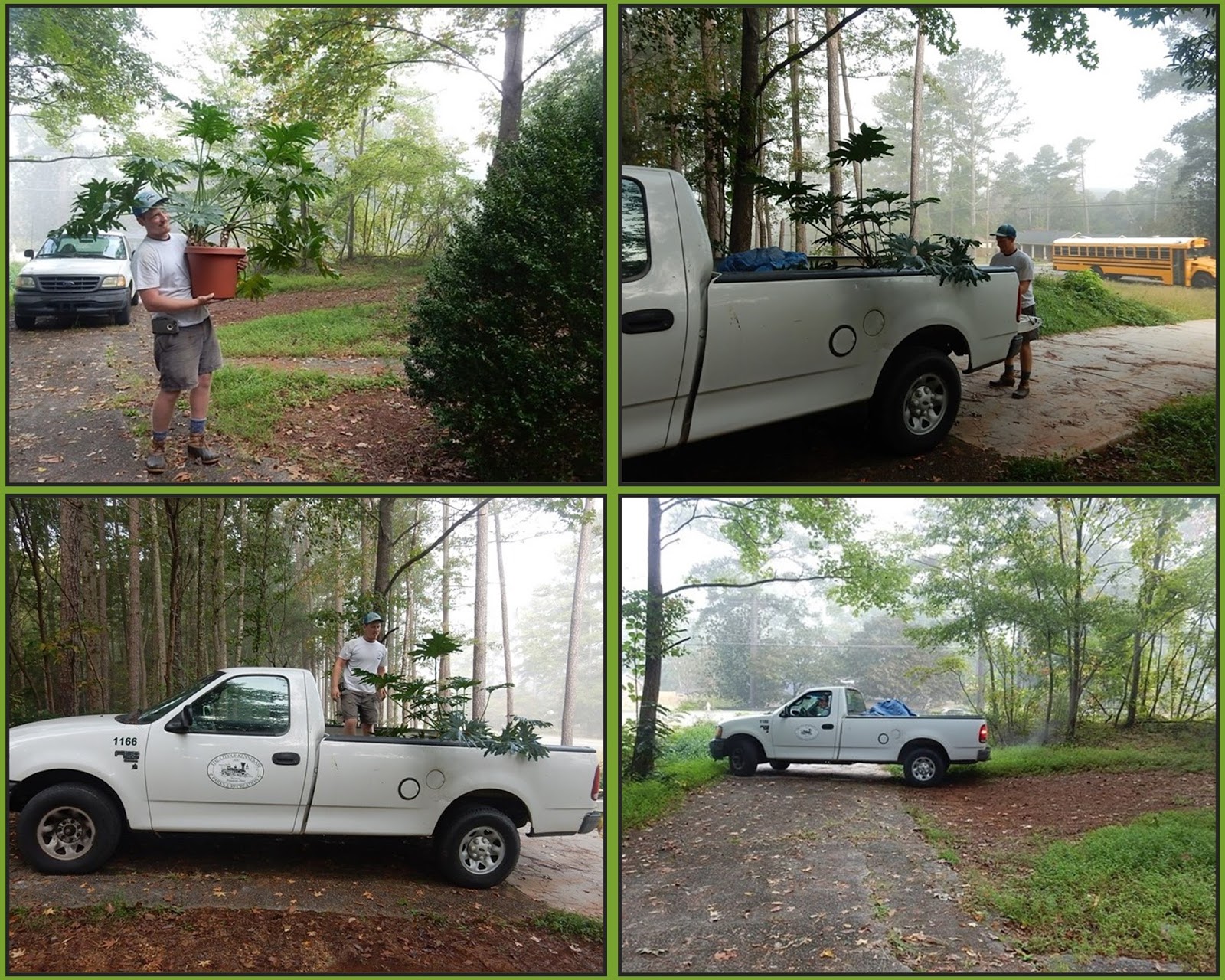
Before returning to Nashville in September, I called the Smith Gilbert Gardens (I have written posts on it several times, look under "gardens" on the side of my blog) to offer them my beautiful philodendron. It is about 20 years old and too large for me to move to Nashville. I knew it would die in our backyard during the winter and was not sure what to do with it. I was so pleased when a young man from the gardens came to pick it up.
Looking through my pictures since July and giving information about them would make this post much too long. I tried to drive back to Georgia from Tennessee at least once a month and stay ten days to keep sorting, giving away and moving items, but it is going very slowly. In October, by coincidence, I came back on the Sunday of the Chalkfest festival on the Marietta Square. I went and took many pictures of the artwork on the asphalt and I'll show them in a future post. In November when I came back to Georgia I found a bag with color prints I had taken in 1993 on a trip to Morocco, Paris and London. I had not seen these photos since then (I'll show some of them in a future post, too.) Then I drove from Nashville to Georgia again this past Monday, December 4th. That day was very sunny and warm - 70 degrees F (21C.) The weather changed quickly since today, three days later, we are having a snow storm. I don't remember seeing snow here so early in the season. It is very pretty.
As I write this, at 4:30 pm on Friday 8 December, it is still snowing. It started this morning before 7:30 am and it has not stopped. You can see from the bird feeder that there must be 3 inches of snow, at least. The shrubbery is bent under the weight.
The electricity has been erratic, coming on and off all afternoon. While the electricity was out I went back outside to take more pictures. It is not often that we have that much snow here; we had none in early 2017 and just one day in early 2016, a very light snow. I like the look of the brown pine tree trunks against the white snow.
Addendum Saturday morning December 9, 2017 - It must have snowed all night because at 8:30 am when I went out the accumulation on the bird bath looked like 10 to 12 inches high.
I took some pictures, then as I was donwloading them I saw that the sun had come out; everything looked so bright through my window behind the computer.
I bundled up again and went out to take more pictures. The snow is melting now but it is quite beautiful indeed and I can't stopped looking at this winter wonderland, so unusual here in Georgia.
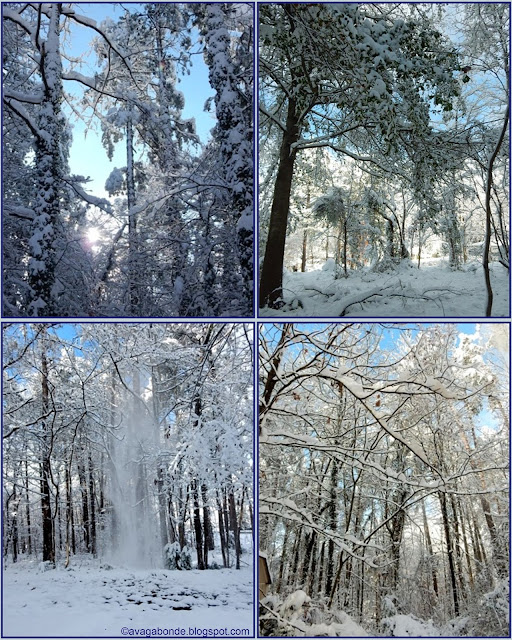
Second Addendum: Saturday afternoon. I just could not stay in the house and clean up when the sun and snow looked so tempting outdoors. I fetched my Canadian fur hat and my down coat, which I had not moved to Nashville yet, took my cane and went for a walk with my old camera. I'll place the photos in order in the collage below so you can go on the walk with me. Please click on the collage twice to see well. First, I took the path behind our house (you can see the back of our outbuilding on the right) and walked to the lake; a tree had fallen in the lake. Then I came back to the road and walked carefully because packs of snow were falling down from the wind and branches were on the pavement. I passed our neighbor's house that is for sale at $1.2 million. Then went by the little white house across the street that has a red barn and finally went up the path leading to the Kemp Farm. (It is a road with eclectic houses, McMansions near tiny houses then a farm.) I saw no one else on the road but cars passed me; two even stopped asking if I needed a ride.
3rd Addendum (last one): Monday December 11, 2017, 12 noon. I drove around in the neighborhood and saw many branches and trees down; snow is melting but there is still much left. The news on TV said that our area, West Cobb County, had been one of the worst hit by the snow storm. Our road even made the news too yesterday with around 100 trees down (it's a long road.) This morning at around 8:00 am the snow was still thick on top our cars and the bird bath. The sun was coming up so I took a photo of our back yard with my cell phone. Then later I played with it to make the photo more attractive. I think our little old barn looks seasonal for the holidays, don't you think?
I do not know if I'll be able to write another post before Christmas. I wish everyone a Merry Christmas and Happy New Year and Joyous Holidays.
Anyway you celebrate them, enjoy yourself and be happy!
I also looked out from each window: from the windows in the backyard where a little bird was taking shelter on the window screen, from the front yard waching the vehicles moving slowly along, and from the window I can see behind my computer. (Click on collage to enlarge.)
In July I had been staying in Brentwood, TN, at our daughter's house, during my post knee operation therapy. My last therapy session was on Sepember 7, 2017. I needed to have these sessions finished so I could drive back to Georgia to keep clearing our house there. I had not driven anywhere since early July. I read that Brentwood, TN, had been ranked the 5th best small city in the US out of 1,200 cities with a population between 25,000 and 10,000 people, but I saw little of it (Nashville ranks no. 13 out of the country's 100 largest metropolitan areas.) Lots of people converged to Nashville from many states and from out of the country to see the solar eclipse on August 21, 2017. Our eldest daughter, who lives in Pittsburgh, PA, came down with her husband to view the eclipse. This was a Total Solar Eclipse - see its path in the pics below.
A total eclipse is quite rare. This was the first total solar eclipse to sweep across the United States in 99 years. Most cities on the path of this eclipse organized activities around this unique event - Nashville, being the largest city on its path, assembled creative ways to entice people to come to the city, to the museums, parks, restaurants, cafes and more. Almost 500,000 visitors came to Nashville and hundreds of millions of people watched from other places.
Armed with our special eclipse glasses we drove the 11 miles from Brentwood to Nashville shortly before the eclipse. We thought the freeway would be jammed but it was almost empty, the streets too. The sun was bright with few clouds around. No other people were on our street - they had gathered at the park nearby. Our group kept looking up, but I could not stand too long and sat on a rock by the front of the house. There was a pretty Rose of Sharon shrub near me I had not seen before.
We stayed in our house driveway and waited. First I saw what is called "shadow bands." Seconds before the eclipse totality thin wavy lines appeared on the ground - ephemeral and rapidly moving as you can see from my pictures below.
Then it started to get darker. The birds stopped singing, the street lights came on, and it became cooler and very quiet - a bit eerie. It was not pitch dark, just a strange weird darkness. I tried to take pictures with a couple of cameras, through my cell phone, my iPad and my eclipse glasses but they did not come out too sharp. It was a very special moment, and then it was over.
Just a few days later, on August 25, 2017, Major Hurricane Harvey made landfall on the Texas coast and the city of Houston. It stalled over the area for several days producing devastating and catastrophic flooding. Some areas received more than 40 inches of rain in less than 48 hours, some up to 51 inches (1m30.) Houston is a boom town of approximately 2 million people and spreading over 600 square miles (1,600 sq km.) Over 40 people were killed, 100,000 homes were damaged and 500,000 vehicles waterlogged by flood waters - resulting in $190 billion in damages. (Pictures courtesy CNBC.)
The images on television were terrible but my husband did not understand them, because of his progessing Alzheimer's disease. By profession he had been an environmental planner and river planner. I remember well how, years ago, maybe in the 1980s, he had told me that Houston was the example given as a city waiting for a major flooding catastrophe. He told me it was not "if it happens" but "when" because he said that the city of Houston let developers build on massive flood plains and wetlands. They refuse to institute any type of land use plan. I wanted to tell him - "look, you were right, see what happened to Houston" but his eyes were vacant. More deaths and property damages are caused by flooding than by tornadoes or hurricanes. Lack of development control and sprawl contribute to flooding, but Houston is happy to proclaim that it is free of any control. However, when a major disaster hits, they expect Federal Aid (meaning US tax payers) to come and pay for the damages (and they do...) This will not change then. In 1845 the Berlin Academy of Sciences sent geologist Carl Ferdinand von Roemer (1818-1891) to evaluate the mineral assets of Texas. Roemer, called now the Father of Texas, said at the time that the Brazos River prairie close to the Houston area was an "endless swamp." He did not feel it would be a good place to build a city... (below map from NYT and photo of Ferdinan von Roemer.)
I had planned to write extensively about Houston explosive population and lack of local control, but before I could there was another major disaster called Hurricane Irma. Starting on August 30, 2017, Irma hit the Caribbean, producing winds up to 185 mph. Ten trillion gallon of water of rain fell on Florida. Irma was expecting to hit the state of Georgia by Septembert 10, and metro Atlanta by Monday 11. I had finished my knee therapy the previous Friday and decided to drive from Tennessee to Georgia that Sunday, against the opinion of my family who thought it was dangerous - I just wanted to be home in case a tree fell on the house. I thought there would be a lot of traffic on the freeway going south, but it was very light - the freeway going north was jammed. It felt strange driving down the highway with hardly any cars but many first responder trucks. There were convoys of ambulances, energy crew trucks, some coming as far as Michigan and Indiana - all driving south to offer help.
I had brought flash lights, batteries, water and some food with me, but in West Cobb County where our house is located it just rained. Other towns of Georgia, including the Atlanta area, suffered damages. (Pictures courtesy the Atlanta Journal Constitution.)
Before returning to Nashville in September, I called the Smith Gilbert Gardens (I have written posts on it several times, look under "gardens" on the side of my blog) to offer them my beautiful philodendron. It is about 20 years old and too large for me to move to Nashville. I knew it would die in our backyard during the winter and was not sure what to do with it. I was so pleased when a young man from the gardens came to pick it up.
Looking through my pictures since July and giving information about them would make this post much too long. I tried to drive back to Georgia from Tennessee at least once a month and stay ten days to keep sorting, giving away and moving items, but it is going very slowly. In October, by coincidence, I came back on the Sunday of the Chalkfest festival on the Marietta Square. I went and took many pictures of the artwork on the asphalt and I'll show them in a future post. In November when I came back to Georgia I found a bag with color prints I had taken in 1993 on a trip to Morocco, Paris and London. I had not seen these photos since then (I'll show some of them in a future post, too.) Then I drove from Nashville to Georgia again this past Monday, December 4th. That day was very sunny and warm - 70 degrees F (21C.) The weather changed quickly since today, three days later, we are having a snow storm. I don't remember seeing snow here so early in the season. It is very pretty.
As I write this, at 4:30 pm on Friday 8 December, it is still snowing. It started this morning before 7:30 am and it has not stopped. You can see from the bird feeder that there must be 3 inches of snow, at least. The shrubbery is bent under the weight.
The electricity has been erratic, coming on and off all afternoon. While the electricity was out I went back outside to take more pictures. It is not often that we have that much snow here; we had none in early 2017 and just one day in early 2016, a very light snow. I like the look of the brown pine tree trunks against the white snow.
Addendum Saturday morning December 9, 2017 - It must have snowed all night because at 8:30 am when I went out the accumulation on the bird bath looked like 10 to 12 inches high.
I took some pictures, then as I was donwloading them I saw that the sun had come out; everything looked so bright through my window behind the computer.
I bundled up again and went out to take more pictures. The snow is melting now but it is quite beautiful indeed and I can't stopped looking at this winter wonderland, so unusual here in Georgia.
Second Addendum: Saturday afternoon. I just could not stay in the house and clean up when the sun and snow looked so tempting outdoors. I fetched my Canadian fur hat and my down coat, which I had not moved to Nashville yet, took my cane and went for a walk with my old camera. I'll place the photos in order in the collage below so you can go on the walk with me. Please click on the collage twice to see well. First, I took the path behind our house (you can see the back of our outbuilding on the right) and walked to the lake; a tree had fallen in the lake. Then I came back to the road and walked carefully because packs of snow were falling down from the wind and branches were on the pavement. I passed our neighbor's house that is for sale at $1.2 million. Then went by the little white house across the street that has a red barn and finally went up the path leading to the Kemp Farm. (It is a road with eclectic houses, McMansions near tiny houses then a farm.) I saw no one else on the road but cars passed me; two even stopped asking if I needed a ride.
I do not know if I'll be able to write another post before Christmas. I wish everyone a Merry Christmas and Happy New Year and Joyous Holidays.
Anyway you celebrate them, enjoy yourself and be happy!
Thursday, September 29, 2016
End of Summer 2016, kudzu and Bucatini all'Amatriciana
The calendar tell us we are in autumn already. Here, it still feels like summer, albeit the end of it. Last Sunday the temperature was 93 F (33.8 C) but this week we are starting to have a "cold front" which means the temperature will be in the low 80s F (28 C.) The little flowers you can see in my heading picture bloom in late summer and have a pleasant sweet fragrance. What type are they? you may ask. They are flowers of the Pueraria montana plant, from the pea family Fabaceae, subfamily Faboideae, or in plain English, they are the flowers of the kudzu vine. (Click on collage twice to embiggen.)
I understand you can make jelly from these kudzu flowers, but I certainly don't want that many vines in our front yard as kudzu is invasive and will kill trees. In the top photo in the collage above you can see a large black pipe in the background. The county Water Commission cut over 30 of our trees (see pictures in my January post here) and their machinery propagated the kudzu vines to our front yard. Kudzu is from Southeast Asia and was introduced in the US in 1876 as an ornamental shrub then later on, in the Southern US, to feed goats and as an erosion control. But it grows rapidly and will cover everything in its path. There was a field close to our house with a small abandoned house in the center of it. Within 2 or 3 summers the field was totally covered with kudzu and the house was just a bump in the field. Below are some photos from a road about one mile away, kudzu around our mailbox and climbing on pine trees in our front yard. (The barn covered in kudzu courtesy UGA.)
Throughout August the Water Commission worked on our road, digging and installing big water pipes for their water main. They even used dynamite which made our house shake. They also cut our cable often and toward the end of August, for over 10 days, we had no cable access (no TV, no computer) from 8:00 am to 6:00 pm. Some days we could not get out of our driveway for hours, or get back home.
I took pictures as the work progressed. It was noisy and dusty.
But the summer had some highlights - such as the Tour de France which I followed on TV. In the evenings, from August 5 through 21, we watched the Olympic Games held in Rio de Janeiro. The U.S. women's gymnastics team was spectacular, as well as champion swimmer Michael Phelps. Congratulations to the athletes of Team America for winning 121 medals. It was fun to watch small countries winning medals, such as Ahmad Abughaus, 20 years old, who won the first medal in the history of Jordan, in men's taekwondo. Dilshod Nazarov of Tajikistan won the Olympic men's hammer title and captured the first gold medal for the Central Asian country since it gained its independence with the 1991 collapse of the Soviet Union. Majlinda Kelmendi made history by becoming the first athlete from Kosovo to win an Olympic medal (the first medal since Kosovo became a state in 2008.) The Fiji men's rugby team finally landed their country its first medal, a gold one, when Fiji beat its former colonial ruler, Britain, by 43-7.
How about France's golden boxing couple? France's Tony Yoka won the gold medal against Britain's Joe Joyce. Tony is the first Frenchman to win gold in boxing heaviest division. His girl-friend, Estelle Mossely, competed in the women's lightweight boxing match against Chinese boxer Yin Junhua and won the gold as well. Tony and Estelle are planning to be married, and France is super excited = boxing and love! C'est magnifique!
But not everything was fun and love this summer. There was the terrible tragedy in Nice, France. When a tragedy happens in one's country, a city visited many times, it seems to hurt more. We see so much bad news on TV that, unfortunately, we often cannot grieve as well for unknown parts of the world. One year I purchased my flight on Delta Airlines months before flying to Paris to see my mother. Then Delta had a sale. They gave me a coupon for the difference in price. The coupon turned out to be the same price as a round-trip flight to Baton Rouge, Louisiana. So, I flew there, by myself, and stayed several days. Baton Rouge means "red stick" in French. It was translated by explorer Sieur d'Iberville and his exploration party in 1699 from the native term "Istrouma" or the Choctaw "iti humma" which means red pole. I took photos with my old film camera and also purchased postcards. Here are some below.
I rented a car and visited many historic plantations along the Mississippi River. I'll try to find my old film photos and if some are OK I'll have a post later on. Below is a postcard showing some of them: Nottoway, Houmas House, Oak Alley, Destrehan and San Francisco plantations.
In mid-August I was so sad to watch on the news the extreme flooding in and around Baton Rouge. It was difficult to look at the devastation - 60,000 homes damages or destroyed in Louisiana. I remembered the city well with its friendly citizens. I had even spoken French with several Cajun families. Below are some photos showing the flooded Baton Rouge area (courtesy Baton Rouge Advocate newspaper.)
In high school in France we had to study two foreign languages: 1) English or German, 2) German or English, Spanish, Russian or Italian. I took English as my first language and Italian as my second. We were about 37 in my English class, but only 3 students in my Italian class. Consequently, I spoke much better Italian than English when I finished high school. I had an Italian pen-pal who invited me to stay in her home for several summer vacations and I went there during the months of July and August. She lived on the bank of the Adriatic Sea in the town of San Benedetto del Tronto. I remember when I arrived there the first time I was in awe. Coming from grey Paris here was a town with palm trees and flowers in the avenues and a turquoise colored sea. I did take pictures, but they were small and in black and white. But here are some old postcards below. I placed a blue dot under Ancona (under San Marino, on the right) in the region of the Marches, to show where San Benedetto is located.
The parents of my pen-pal Marisa, had a farm/winery inland also, in the surrounding area of Ascoli Piceno, near Arquata del Tronto (shown in pictures below.) The Tronto is a river that ends in San Benedetto del Tronto. We would drink the wine from their farm and it was very good. They had a rose wine, like a sherry, in which we would place pieces of peaches and then eat and drink this as a dessert. They also had an amber colored wine, sweet and strong, which was a good accompaniment to smoked ham and melon. I was able to achieve a similar taste with a Serrano ham, a "melorange" melon from Arizona and a glass of Ipsus Pantelleria Passito.
On August 23, 2016, at night, before turning the light off I checked my iPad and saw that there had been an earthquake in central Italy at 9:36 pm US Eastern time, or 3:36 am August 24, in Italy. I stayed up to find out where this earthquake had been. The epicenter of the 6-2-magnitude quake was in Accumoli, 9 miles from Arquata del Tronto (where the family had their farm/winery.)
The next several days I was on the computer as much as possible (whenever the Water Commission did not turn our cable off...) reading on Italian internet sites. This quake caused the death of 297 people and flattened most of Arquata del Tronto, Amatrice and Accumoli. Many injured were taken to hospitals in San Benedetto del Tronto, 44 miles away (71 km.) Such a terrible tragedy - I'm deeply saddened by the loss of life and all the destruction. (Pictures below courtesy La Repubblica.)
What a devastating loss for these close-knit communities that have been there for centuries. These picturesque mountain villages are sparsely populated. As you can see by my collage above most buildings have crumbled. I heard an old man saying on TV "il mio paese non esiste piu" /my village does not exist anymore. It is heartbreaking. I read an article talking about the seniors living in these villages, saying (in Italian and I translate) "...Old people who have lived their whole lives in familiar four walls saw them collapse in a matter of seconds. They are lost in the crowd of desperate people who have lost everything, like them. Almost. Because when you're old you no longer have the time to reconstruct a different life. You do not have time to get used to a house that is not yours, and that you never knew. No time. And perhaps not even want to. They are left there to watch the ruin of their past and the massacre of their future..." Below are photos of Amatrice from before (on left) and after the earthquake (on right,) courtesy USA Today.
I went to look at the internet site of the city of Amatrice, which had been voted last year as one of Italy's most beautiful historic villages. It still showed an ad for their upcoming festival for the 50th anniversary (on August 27 and 28) of their famous sauce for spaghetti called Spaghetti all'Amatriciana (invented by local shepherds in the Middle Ages.) I copied the artwork you can see below. It also showed the welcoming sign, at the entry of the town which said "Amatrice, 955 meters above sea level, citta' degli spaghetti all'amatriciana/city of the spaghetti a l'amatriciana."
But the festival did not take place, alas. For a sad remembrance of their beautiful festival and to honor the people of Amatrice I drove to the DeKalb Farmers' Market in Atlanta (40 miles away/64 km) to buy the necessary ingredients to make Bucatini all'amatriciana. It is a classic, simple but hearty Italian pasta dish. The dish has six ingredients: bucatini pasta, not spaghetti (bucatini pasta is thick and hollow,) guanciale (cured pig jowl) but pancetta can be used, pecorino cheese, red pepper, white wine and genuine tomatoes from San Marzano. I added a small onion in mine. I was pleased to find the bucatini pasta and a genuine can of imported San Marzano tomatoes. It did not take long to cook and it was delicious, but bittersweet.
I wished to finish the end of the 2016 summer with something positive. To bring these villages back to life, they should not be just names on a map. There was joy there, the love of good food; so we need to keep alive their famous pasta sauce, Amatriciana (there are many recipes on the internet.) (for those who wish to help, here is a link to ItalianAmericanRelief.org .)
I hope all my blogging friends had a good summer 2016, filled with good memories.
Above is a photo of the Frecce Tricolori (Tricolor Arrows) the aerobatic demonstration team of the Italian Air Force (the Aeronautica Militare Italiana.) This is to express my sympathy to the members of the Italian Air Force (I enjoyed working with them for almost ten years) and to Italy.
I understand you can make jelly from these kudzu flowers, but I certainly don't want that many vines in our front yard as kudzu is invasive and will kill trees. In the top photo in the collage above you can see a large black pipe in the background. The county Water Commission cut over 30 of our trees (see pictures in my January post here) and their machinery propagated the kudzu vines to our front yard. Kudzu is from Southeast Asia and was introduced in the US in 1876 as an ornamental shrub then later on, in the Southern US, to feed goats and as an erosion control. But it grows rapidly and will cover everything in its path. There was a field close to our house with a small abandoned house in the center of it. Within 2 or 3 summers the field was totally covered with kudzu and the house was just a bump in the field. Below are some photos from a road about one mile away, kudzu around our mailbox and climbing on pine trees in our front yard. (The barn covered in kudzu courtesy UGA.)
Throughout August the Water Commission worked on our road, digging and installing big water pipes for their water main. They even used dynamite which made our house shake. They also cut our cable often and toward the end of August, for over 10 days, we had no cable access (no TV, no computer) from 8:00 am to 6:00 pm. Some days we could not get out of our driveway for hours, or get back home.
I took pictures as the work progressed. It was noisy and dusty.
But the summer had some highlights - such as the Tour de France which I followed on TV. In the evenings, from August 5 through 21, we watched the Olympic Games held in Rio de Janeiro. The U.S. women's gymnastics team was spectacular, as well as champion swimmer Michael Phelps. Congratulations to the athletes of Team America for winning 121 medals. It was fun to watch small countries winning medals, such as Ahmad Abughaus, 20 years old, who won the first medal in the history of Jordan, in men's taekwondo. Dilshod Nazarov of Tajikistan won the Olympic men's hammer title and captured the first gold medal for the Central Asian country since it gained its independence with the 1991 collapse of the Soviet Union. Majlinda Kelmendi made history by becoming the first athlete from Kosovo to win an Olympic medal (the first medal since Kosovo became a state in 2008.) The Fiji men's rugby team finally landed their country its first medal, a gold one, when Fiji beat its former colonial ruler, Britain, by 43-7.
How about France's golden boxing couple? France's Tony Yoka won the gold medal against Britain's Joe Joyce. Tony is the first Frenchman to win gold in boxing heaviest division. His girl-friend, Estelle Mossely, competed in the women's lightweight boxing match against Chinese boxer Yin Junhua and won the gold as well. Tony and Estelle are planning to be married, and France is super excited = boxing and love! C'est magnifique!
But not everything was fun and love this summer. There was the terrible tragedy in Nice, France. When a tragedy happens in one's country, a city visited many times, it seems to hurt more. We see so much bad news on TV that, unfortunately, we often cannot grieve as well for unknown parts of the world. One year I purchased my flight on Delta Airlines months before flying to Paris to see my mother. Then Delta had a sale. They gave me a coupon for the difference in price. The coupon turned out to be the same price as a round-trip flight to Baton Rouge, Louisiana. So, I flew there, by myself, and stayed several days. Baton Rouge means "red stick" in French. It was translated by explorer Sieur d'Iberville and his exploration party in 1699 from the native term "Istrouma" or the Choctaw "iti humma" which means red pole. I took photos with my old film camera and also purchased postcards. Here are some below.
I rented a car and visited many historic plantations along the Mississippi River. I'll try to find my old film photos and if some are OK I'll have a post later on. Below is a postcard showing some of them: Nottoway, Houmas House, Oak Alley, Destrehan and San Francisco plantations.
In mid-August I was so sad to watch on the news the extreme flooding in and around Baton Rouge. It was difficult to look at the devastation - 60,000 homes damages or destroyed in Louisiana. I remembered the city well with its friendly citizens. I had even spoken French with several Cajun families. Below are some photos showing the flooded Baton Rouge area (courtesy Baton Rouge Advocate newspaper.)
In high school in France we had to study two foreign languages: 1) English or German, 2) German or English, Spanish, Russian or Italian. I took English as my first language and Italian as my second. We were about 37 in my English class, but only 3 students in my Italian class. Consequently, I spoke much better Italian than English when I finished high school. I had an Italian pen-pal who invited me to stay in her home for several summer vacations and I went there during the months of July and August. She lived on the bank of the Adriatic Sea in the town of San Benedetto del Tronto. I remember when I arrived there the first time I was in awe. Coming from grey Paris here was a town with palm trees and flowers in the avenues and a turquoise colored sea. I did take pictures, but they were small and in black and white. But here are some old postcards below. I placed a blue dot under Ancona (under San Marino, on the right) in the region of the Marches, to show where San Benedetto is located.
The parents of my pen-pal Marisa, had a farm/winery inland also, in the surrounding area of Ascoli Piceno, near Arquata del Tronto (shown in pictures below.) The Tronto is a river that ends in San Benedetto del Tronto. We would drink the wine from their farm and it was very good. They had a rose wine, like a sherry, in which we would place pieces of peaches and then eat and drink this as a dessert. They also had an amber colored wine, sweet and strong, which was a good accompaniment to smoked ham and melon. I was able to achieve a similar taste with a Serrano ham, a "melorange" melon from Arizona and a glass of Ipsus Pantelleria Passito.
On August 23, 2016, at night, before turning the light off I checked my iPad and saw that there had been an earthquake in central Italy at 9:36 pm US Eastern time, or 3:36 am August 24, in Italy. I stayed up to find out where this earthquake had been. The epicenter of the 6-2-magnitude quake was in Accumoli, 9 miles from Arquata del Tronto (where the family had their farm/winery.)
The next several days I was on the computer as much as possible (whenever the Water Commission did not turn our cable off...) reading on Italian internet sites. This quake caused the death of 297 people and flattened most of Arquata del Tronto, Amatrice and Accumoli. Many injured were taken to hospitals in San Benedetto del Tronto, 44 miles away (71 km.) Such a terrible tragedy - I'm deeply saddened by the loss of life and all the destruction. (Pictures below courtesy La Repubblica.)
What a devastating loss for these close-knit communities that have been there for centuries. These picturesque mountain villages are sparsely populated. As you can see by my collage above most buildings have crumbled. I heard an old man saying on TV "il mio paese non esiste piu" /my village does not exist anymore. It is heartbreaking. I read an article talking about the seniors living in these villages, saying (in Italian and I translate) "...Old people who have lived their whole lives in familiar four walls saw them collapse in a matter of seconds. They are lost in the crowd of desperate people who have lost everything, like them. Almost. Because when you're old you no longer have the time to reconstruct a different life. You do not have time to get used to a house that is not yours, and that you never knew. No time. And perhaps not even want to. They are left there to watch the ruin of their past and the massacre of their future..." Below are photos of Amatrice from before (on left) and after the earthquake (on right,) courtesy USA Today.
I went to look at the internet site of the city of Amatrice, which had been voted last year as one of Italy's most beautiful historic villages. It still showed an ad for their upcoming festival for the 50th anniversary (on August 27 and 28) of their famous sauce for spaghetti called Spaghetti all'Amatriciana (invented by local shepherds in the Middle Ages.) I copied the artwork you can see below. It also showed the welcoming sign, at the entry of the town which said "Amatrice, 955 meters above sea level, citta' degli spaghetti all'amatriciana/city of the spaghetti a l'amatriciana."
But the festival did not take place, alas. For a sad remembrance of their beautiful festival and to honor the people of Amatrice I drove to the DeKalb Farmers' Market in Atlanta (40 miles away/64 km) to buy the necessary ingredients to make Bucatini all'amatriciana. It is a classic, simple but hearty Italian pasta dish. The dish has six ingredients: bucatini pasta, not spaghetti (bucatini pasta is thick and hollow,) guanciale (cured pig jowl) but pancetta can be used, pecorino cheese, red pepper, white wine and genuine tomatoes from San Marzano. I added a small onion in mine. I was pleased to find the bucatini pasta and a genuine can of imported San Marzano tomatoes. It did not take long to cook and it was delicious, but bittersweet.
I wished to finish the end of the 2016 summer with something positive. To bring these villages back to life, they should not be just names on a map. There was joy there, the love of good food; so we need to keep alive their famous pasta sauce, Amatriciana (there are many recipes on the internet.) (for those who wish to help, here is a link to ItalianAmericanRelief.org .)
I hope all my blogging friends had a good summer 2016, filled with good memories.
Above is a photo of the Frecce Tricolori (Tricolor Arrows) the aerobatic demonstration team of the Italian Air Force (the Aeronautica Militare Italiana.) This is to express my sympathy to the members of the Italian Air Force (I enjoyed working with them for almost ten years) and to Italy.
Subscribe to:
Posts (Atom)