Showing posts with label Historic Preservation. Show all posts
Thursday, August 24, 2023
Quilts for John Lewis, with joy and gratitude - Atlanta Quilt Festival, part 1
Last week I was in my house in Georgia, again. For those who have not read my prior posts - my house has an address in Marietta, however it is located about 10 miles outside the center of town and city limits. It is nearer two other towns, 6 miles each from Kennesaw and Acworth and 6 miles even from Dallas in the next rural county, Paulding. There is an article in The Discoverer blog mentioning Marietta - read it here "8 of the Most Underrated Cities in the South." I have visited five of these eight - including Ellijay, Georgia; I wrote several posts including Ellijay, look here and here. Below is an overview of Marietta center. My house is west of it, at the base of Kennesaw Mountain, in West Cobb County (where I placed a red mark.) (photo coursesy The Discoverer.) The bottom photos are about a couple of miles from my house.
While there I wanted to go on a small outing, not far. When checking, I found several exhibits in greater Atlanta including a quilt show. I enjoy visiting quilt shows and have posted several from Bulloch Hall, in Roswell, GA - you can find them by clicking on the side of my post. When I saw that this was a special exhibit in honor of our late Georgia Congressman, John Lewis, of course I had to go. It was in Southwest Atlanta, off Cascade Road, at the Southwest Arts Center. Arriving there in mid-morning, two visitors were leaving, and then I was the only one, having the show all to myself. The center is immaculate and well landscaped.
The Atlanta Quilt Festival honoring John Lewis is a trilogy started in 2022 with "Good Trouble Quilts - Celebrating the Life and Legacy of Congressman John Lewis" followed in 2023 and 2024 by quilts focusing on the accomplishments and the life of John, and the power of joy and gratitude expressed by quilters who benefited from his work and sacrifices.
The side building had two large and sunny rooms with the John Lewis quilts.
Most of the quilts in these rooms had small labels next to each quilt with the quilter's name and the meaning of the work. (Please click on collage once or twice to enlarge and be able to read.)
John Lewis was a magnificent man, a good man, an inspiration, a Civil Rights giant. I believe he is one of the most admired and respected Americans in the nation, and frankly, he is a hero of mine. John Lewis (1940-2020) was among the original Freedom Riders (the Black and white activists who challenged segregation in the South in 1961.) He helped organize the March on Washington, where Dr. King was the main speaker. On March 7, 1965, John lead a group of 600 who were marching to demand the right to vote in Selma, Alabama. As they were crossing the Edmund Pettus Bridge they were met by state troopers in riot gear. As they would not disperse the troopers threw tear gas and attacked the marchers with bullwhips and rubber tubing wrapped with barbed wire. There, a trooper cracked John's skull with a club and beat him again while he was on the ground. Some of the quilts below depicts this.
Between 1960 and 1966 John Lewis was arrested 40+times, and beaten repeatedly by Southern policemen. He was left in a pool of blood in Montgomery, Alabama, in a bus terminal where white people had beaten him. He spent many nights in county jails including 31 days in Mississippi's brutal Parchman Penitentiary.
Here in Nashville, John Lewis in February 1960 led a group of students to sit-down at the Woolworth's lunch counter, where only whites could be served. The counter was closed one hour later and the students arrested. John Lewis kept pursuing civil rights equity for the rest of his life. The early movement in Nashville was the start of desegregation of lunch counters and restaurants across the US. (Below vintage photo courtesy The Nashville Tennessean.)
A couple of years ago I had heard that this Woolworth building downtown Nashville had re-opened as a lunch and dinner restaurant after a $6 million renovation. The owner, a Nashville native, had found and assembled many vintage historical artifacts to place in this building, such as the "Black only" sign near a water fountain. The original mezzanine with terrazzo floors and metal railings had also be uncovered. Archival photos were hanged on the wall. I was going to drive there for lunch but then Covid happened. Just now, trying to see if it was still open for business I found out that it closed after the pendemic and was sold. It was re-opened by entrepeneurs after being remodeled into a theatre, Las Vegas style, with a "for adults only" show called "shiners," with some X-rated scenes, and all of it very much insensitive to minorities. Historic Nashville had recommended that a Civil Rights Movement trained preservationist be included in the remodeling to ensure that items of historical value be preserved. This was not done and most were tossed away in a dumpster. Last fall the building was even rented for the premiere of the controversial right-wing film "The Greatest Lie ever Sold: George Floyd and the Rise of the Black Lives Matter." Well, I have no words... Below top photo the building after renovation in 2018 then after remodeling as a theatre in 2020, courtesy Nashville Scene.
It is quite painful for me to see this happening to such an historical building, but then again I am not surprised. In Atlanta there are few historical Civil Rights buildings left, and those that are still standing have received little recognition and are in disrepair; not much for future generations to visit. After having lived in the US many years I realized that this country is not interested in preserving its historical buildings if they have to spend their money, and certainly not for Black History... I wish US tourists would stay here and spend some of their money preserving their own old buildings than crowd European cities like my home town, Paris, France. I checked and in 2022 the US Government funding for the arts (and that includes historic preservation, museums, theatres, etc.) was about $4.40 per habitat. Per comparison France in 2023 is funding the arts in greater Paris 139 Euros per habitat, or $150.21, and 15 Euros, or $16.21 for the rest of the country. If French tax payers did not pay for the arts, by now all the old castles, churches and all the museums would not be worth visiting, as entry fares alone are not enough to maintain them, and churches don't even charge. I have been a member of the American Historic Preservation for many years. Yearly membership is less than a fancy meal at a restaurant. I don't know anyone else who belongs. Here is the latest issue I received.
There were a large amount of quilts in the main building, and I'll show them in part two of this post. More to come ...
Monday, February 1, 2021
The Owen-Primm barn in Tennessee
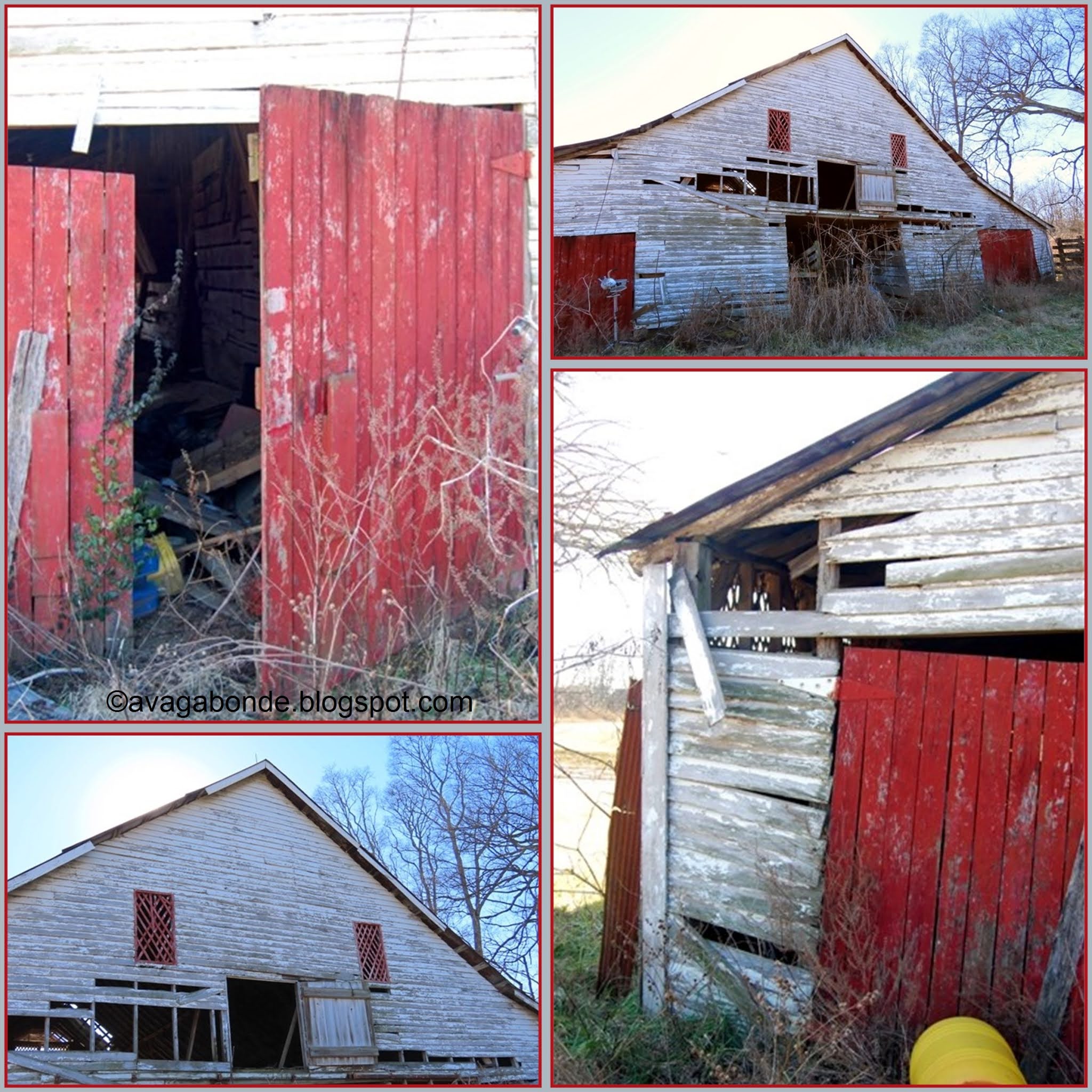
When my younger daughter and family moved from Columbus, Ohio to Brentwood, Tennessee in 2010, my late husband and I drove often from Georgia to visit them. An old barn was only two miles from their house. I always wished to take several photos of it, but it was facing a two-lane road with traffic and it was difficult to stop. I did take one picture from our car and even included it in a post about the huge pretentious houses being built in Brentwood; the barn was showed in the first collage of my post, look at the post here (that older photo is also in the collage below.) Two years ago my daughter and family moved to another house and this time the barn is only 1/2 mile away. (Click on collage to enlarge.)
The barn has suffered damages from the heavy winds and tornadoes that came through in the last couple of years. When about a week ago my daughter told me that the property, barn and house, was going to be torn down and to come and take pictures. I decided to do just that. People had been taking photographs she said, but the day I went there, I was the only one. It was sunny with mild weather. I came close to the barn and could see the damages time had done.
The main house was easily seen when turning around the barn. I walked over the property and took numerous photos. Once back home I was curious about its history. I'll share what I found while I show you my pictures. Originally, around 1806 Jabez Owen built a log cabin on the site. Dr. Jabez Owen was one of the wealthiest men in Williamson County, a physician and planter; he owned hundreds of acres of land and 58 enslaved people. Some of their antebellum cabins are still standing on the property now (shown in collage below.) "Antebellum" means before the war in Latin and usually refers to structures built in the American South during the 30 years before the Civil War (1861-1865.) Antebellum mansions and plantations homes don't have a specific style, they just date to a certain time and place in history that still triggers strong emotions today. (Below, front of slave cabins.)
In 1845 or so the house was expanded by Thomas Perkins Primm. It included a pair of log cabins for enslaved workers (shown above) with vertical board doors and a shared stone chimney. Later, in the 1920s and 1930s a stone springhouse, a frame barn with weatherboard siding, a frame garage and a frame shed were added. Those outbuildings are slowly collapsing now.
Then I could see the side of the house, which from a distance, still looked nice (maybe?).
Thomas Perkins Primm in 1845 expanded the original Owen log cabin into a two-story frame house in the Greek revival style, the classic Middle Tennessee style then, with four columns supporting the two-story porch. Nine years later there were considerable troop movement near this house when on December 1, 1864 an engagement took place between Confederate General Forest and USA General J. H. Wilson. As late as 2015 the house was still deeded to Charlie Primm, a descendant of Thomas Primm. Charlie McNairy Primm died in July 2011 at 88 years of age. He operated a very successful dairy farm in the area with his brothers (his 11 siblings died before he did.) As I came closer to the side of the house I could see how decrepit it now was.
I walked around to the front of the house. The green shudders were still attached, although one was weather beaten.
I was there after lunch in mid January 2021, and the place was very quiet and peaceful. This farm was located on a vast piece of land but in 2003 a great deal of the Primm Farm was sold to be turned into Montclair, an upscale house subdivision. More land had been donated to the city of Brentwood by the late Edgar Wilson Primm and turned into Primm Park, which encompasses an American Indian burial mounds and an early 2-story school,Boiling Springs Academy. Prehistoric Native Americans Mount Builders lived in the area between 900 and 1450 AD. Below is a photo of the early school with an Indian mound behind it, photo courtesy the City of Brentwood.
Boiling Springs Academy originally opened as a private school in 1833 for sons of wealthy plantation owners. Tuition was then $8 per semester ($10 if geography and English were added.) It has two rooms, one upstairs and one on the main floor. Now six schools in Brentwood have "A Day in 1845" for second and third graders. They sit in old-fashioned desks and use chalk, and McGuffey's readers for the day's lessons. They come dressed in period clothes loaned to them by the Historic Commission. They spend the day much like the children of the 1800s, now being taught by retired teachers. Their lessons include penmanship, arithmetic (using slate and slate pencils,) reciting of maxims, a spelling bee and more. Pictures below courtesy the City of Brentwood. (This school is just up the road from the barn and farm and I drive by them each time I visit my daughter.)
Coming closer to the front porch I could see a couple of old rocking chairs standing guard in the entryway surrounded by weeds growing through cracks in the floor. They stood close to the massive Doric columns with peeling paint. I could have sat in one of those, while gazing at the decaying porch ceiling, painted in light blue, as the old houses of Louisiana, to remind of the sky. But I did not, out of respect.
The house must have been deteriorating for a long time. The roof certainly needs replacement and I understand that there is termite damage as well as dry rot. But why was this historic house (with remains of the 1806 log cabin still there) left to crumble like this? If there were 12 siblings there should be plenty of heirs who could have obtained a grant from the Historic Preservation Fund to restore this property. The Owen-Primm house was listed on the National Register of Historic Places in 1988. To be placed on this Register is not that easy. You have to fill a nomination form with historical information on the site and why the property embodies distinctive characteristics of a type, period or method of construction, ect. Congress enacted the National Historic Preservation Act in 1966. Such buildings listed in the Register tend to not only include the building but the surrounding landscape. This act works to save historic buildings for future generations of Americans.
If structures are deemed important enough to qualify to be in the Register of Historic Places, then they should be followed up to ensure that they do not fall into disrepair. But no laws protect these historic buildings and they can be torn down without public notice. Unfortunately most of the financing come from the Historic Preservations Funds, and in this country, historic preservation is of little concern. The last time I checked, the USA is at the bottom of all western countries for the funding of the arts and humanities, which include historic preservation, libraries, museums, etc. In spring 2020, former president Trump unveiled the largest federal budget in history - $4.75 trillion. He wanted to eliminate the funding of the arts and humanities as non-important. The 2020 US budget still included $32.7 million for historic preservation (when the US tax payers paid, as of October 2020, $141 million for Trump's golf trips!) By comparison the 2020 French budget (a much smaller country the size of Texas) was 338 million Euros or $411,366,000 for their historic preservation alone.
In 2012 I started following more keenly the disinterest of most of the US public for historic preservation when I read that the owners of a historic mansion on Long Island, NY, that had inspired F. Scott Fitzgerald to write The Great Gatsby, had "allowed" it to fall into disrepair. This way it would be too far gone to rehabilitate and instead could be demolished so the land be sold instead to the highest bidder to build four McMansions (and getting more money for it, money being #1, of course.) You can read about it in my post "Why Long Island, NY?" where I explained why my late husband and I made a trip to Long Island to visit more historic buildings before they would also be demolished. I could not believe that the federal government, the state, county or city would not help this historic mansion listed on the Register of Historic Places. (Interior of the Owen-Primm house below, courtesy The Tennessean, Williamson Herald and Williamson Source.)
My blogging friends know that I was born and raised in Paris, France, where we respect our "patrimoine" or National Heritage, and strongly support it. The French Revolution was 50% against Royalty and 50% against the overbearing Church. Castles and churches were burnt or used as warehouses, including Notre Dame de Paris. Victor Hugo in 1831 wrote his book "Notre Dame de Paris" (in English "The Hunchback of Notre Dame") to help save the decaying cathedral. Years later, on December 9, 1905, the French Government passed a law that made all churches built before 1905 the property of the state, not the church (I guess because the French being so secular, no one would pay...) This is why when the roof of Notre Dame de Paris burnt down, people of all religions, no religion, as well as churches of all denominations, synagogues, Buddhist temples and Muslim mosques donated to rebuild the cathedral, not the Vatican. In western countries with the strongest reputation for the funding of historic preservation and the arts, culture expression is considered a universal right, like other basic needs, and not a privilege for just the wealthy.
Would the wealthy US tourists keep flocking to Europe if their historic sites had been bulldozed to make place for more subdivisions? Will future generations of tourists, domestic and international, come to visit Brentwood subdivisions or would they instead be interested in an antebellum farm where a realistic African-American museum had been establishedf in the authentic quarters of their enslaved workers? By the way as far as I can tell there is only one US museum dedicated to slavery in this country, in Louisiana - why? The 1860 Census counted about 4 millions enslaved people in the US, working 10-16 hours a day, six-days a week, with children as young as 3 being put to work. It would help future Williamson County's children, one of the wealthiest county in the US, predominantly white, to find out how the life of southern planters was eased by their enslaved workers who planted and harvested their crops, cooked their food, washed their clothes, nursed their babies, under inhumane conditions. This should not be forgotten or denied and a property like the historic Owen-Primm Farm could teach the way it really was. Walking back to the barn I passed gnarly trees that must have stood there for ages.
I took pictures of the back of the slave cabins. Up to ten enslaved people may have occupied them at the time but later they were used as storage. Considering their age, their exterior walls seem solid.
The back of the barn looked more dilapidated thant the front.
Then I was back facing the front of the storm damaged barn again.
Next time I come by will everything be gone? Demolition is planned for March. Below is the planned house subdivision we'll see in its stead.
Poet Maya Angelou said: "History, despite its wrenching pain, cannot be unlived, but if faced with courage, need not be lived again." It was lived in Brentwood, Tennessee, but will it become just forgotten history?
ADDENDUM: February 3, 2021 - My late husband talked about the barn every time we drove by it. I thought he would be sad if he knew it was going to be demolished. Then late last evening my daughter sent me a link to the local newpaper, The William Source. This was their breaking news: Historic Owen-Primm House Saved from Demolition - by Press Release - February 2, 2021 -
The threat of demolition of Brentwood's historic Owen-Primm is over. After developers worked with the Heritage Foundation of Williamson County, TN, the home is under contract to a preservation-minded buyer as of Feb. 1. The buyer has yet to be publicly announced but has committed to saving the house, five acres of the property and its barn. A demolition permit filed in mid-December endangered the existence of the historic house on Moores Lane near Wilson Pike, but a 90-day wait period, per Brentwood city code, provided time for the Heritage Foundation and the City of Brenwood to seek other options ..."
Yesterday would have been my husband's birthday, since he was born on a February 2nd. He must be happy about this outcome, wherever he is.
Monday, December 28, 2020
Cooking for the Holidays
After voting on December 17th, 2020, during the early voting days of the Georgia Senate runoff election, I felt I needed a reward to have driven back again to Georgia from Nashville to vote. I stopped at the local nursery and bought a pretty Christmas cactus (Schlumbergera.)
Back in the lonely Georgia house I placed the plant near the kitchen window close to a holiday gnome. It made a lot of difference to the atmosphere in the kitchen. My cat Mitsouko was in Nashville but there was still something alive with me as well. You can see the picture in the heading. In Nashville I had left another flowering Christmas cactus in the enclosed back porch, next to another little gnome.
I sorted and gave away another 5 bags of books to the Goodwill, at least 200 or so, and then I returned to Nashville on Sunday December 20th. There was no hurry because I knew that as for Thanksgiving I would be alone at Christmas. For years these were such busy times and now having no planning to do was a bit strange. So as not to feel aimless at Thanksgiving I had decided to cook some turkey and trimmings. With the help of my blogging friend Mae of Mae's Food Blog who provided me with a recipe for fresh turkey parts I proceeded to cook a tasty Thanksgiving meal with plenty of leftovers. In the plate below from top left: herbed bread dressing, corn casserole, roast turkey with fresh cranberry sauce, sweet potatoes with Bourbon pecan sauce, fresh spinach with Boursin cheese next to garlicky mashed potatoes with homemade gravy. I had received a surprise package from my daughter Celine - imported mince pies from Wales. It rounded the meal quite nicely. (I had leftovers for a week.) (Click on collage to enlarge.)
When I returned to Nashville I decided that to keep busy for Christmas I would also cook a special meal. First I had to attempt decorating the front of the house as most houses on the block had bright decorations and lights. Last year my daughter Jessica had decorated the house with many strings of light on the shrubbery, but I was not very good at this. Instead I used lights just on the handrail and decorated the front door and windows. Below is the way the house was decorated last year.
Below is the way I tried to decorate it this year. I was afraid to place lights on the shrubbery since I was not sure how to connect all the wires.
Now I had to plan what my Christmas meal would be. Years ago my mother would make a delicious canard a l'orange - maybe I should try roasted duck with orange sauce as she did. In Atlanta I would have known to buy a duck at the DeKalb Farmers' Market, but in Nashville I did not know where to get one. I called the grocery stores Kroger, Publix - no ducks. Whole Foods did not sell fresh or frozen ducks. Then I thought of the huge market not far away, K and S World Market and International Groceries. I always find fresh dandelion greens there and a whole lot of vegetables, fruits and other items I have no idea how to cook.
I was there early on Tuesday morning with just a handful of customers. They had frozen ducks, four types even! I decided on the Buddhist style duck. Because why not. It had Chinese writing and I think Vietnamese as well. At $19.99 for a 6 pound duck it seemed a fair price.
Now I was in a quandary. Should I attempt roasting a Buddhist duck with a French gourmet recipe? Or should I try an Asian recipe? What a dilemma. I decided to compromise and roast it with Asian spices and then make an orange French sauce. I checked some of my favorite French cookbooks and some of my Chinese ones while listening to Christmas music. Finally after also researching on the Web I came up with an original Franco-Asian recipe for my duck.
First the duck had to be defrozen; it would take two days in the fridge. I baked a couple of cookie recipes with my free time.
On Thursday afternoon, Christmas Eve, the duck was defrozen. I boiled it for 1 minute in a large pot of boiling water. Then I pricked it all over (to let the fat get out.) When it was cool I sprinkled salt all over it. Then I set it back in the fridge, uncovered, until the next day - this is to harden the skin so it will be crispy. That evening my daughter, son-in-law, four grandchildren and my son-in-law's visiting cousins and their children came caroling to my front porch. Then I gave them cookies and they gave me a small rum cake. This is why I could not attend their Christmas, as the gathering was too large.
There was no need to wrap gifts to wee hours as I used to since we were not exchanging presents on Christmas Day. (We will exchange presents in January, closer to Armenian Christmas of January 6th.) I had not planned to get up early on Christmas Day but was wakened up at 6:30 am by some noise. I thought it was a car backfiring. While getting my coffee ready I could hear many birds chirping in the back yard. Quite unusual as there are never more than a couple of birds there and this sounded like an aviary. I opened the curtains and could not believe my eyes. The tree at the end of my yard was covered with birds - so many that the branches could not be seen. Then as I watched, mesmerized, they suddenly flew to a closer tree while chatting, whistling and making a joyful noise. I had seen bands of starlings before flying as a pulsating cloud but at a distance, in the sky. As from a signal they all flew even closer and landed on my back deck, covering it. The wood disappeared and the deck looked alive with hundreds or even thousands of birds. As some perched on the rail close to my window I could see that they were not black, but had a metallic iridescent dark greenish sheen flecked with little white dots - quite pretty.
The European starlings were introduced in the US in 1890 when 100 of them were released in New York's Central Park (now there are more than 200 million in N. America.) The common European starling from the species Sturnus vulgaris is called "Etourneau" in French. When they fly in unison it is called "une nuée d’étourneaux" but in English it is called "a murmuration." It sounds French but it is not. A murmuration is the phenomenon that results when hundreds, sometimes thousands, of starlings fly in swooping, coordinated patterns through the sky, as in an air show. It is impressive how rapidly the murmuration can change direction and fly intricate patterns, all synchronized. Then in an instant the flock left my deck, as in a well choreographed ballet, and flew to trees further away. Below are a couple of ancient engravings of the birds.
I had never seen them so close and felt it was an early Christmas gift - that it would be a good day. Then I turned on the News ... and saw that what I thought had been a car backfiring at 6:30 am was in fact a huge explosion downtown Nashville, about 3 1/2 miles from my house. The explosion destroyed part of Second Avenue, known for its night clubs, galleries, shops and residences; at least 41 buildings were extensively damaged. In the map below I placed a red cross where it happened and a green cross where I live. (Pictures courtesy The Tennessean.)
The Second Avenue of Nashville is a National Historic District. In the late 1800s the street was called Market Street. From 1870 to 1890 many buildings were constructed as warehouses and shops that sold the goods coming from riverboats on the Cumberland River. This is a tragic bombing on Christmas Day. The police have identified the bomber who perished in the blast, but found no motive yet.
I kept working on my duck, covering it with a dry rub made of Chinese spices, and then placing an orange, celery and garlic in the cavity. (Having no ties to close it I had to improvise with metal clips.) While it roasted I made a Sherry Orange reduction sauce (made with Sherry, garlic, orange juice, bitter orange marmelade, Grand Marnier and spices.) It did not take long to roast really as I placed it in the oven around 4:00 pm, turned it over a couple of times and I was ready to eat at about 7:00 pm. It was delicious. That will last me at least 4 days with leftovers. (I rarely eat meat - did not have a steak since summer 2019 and only 3 hamburgers this year.) I found out that the Culver Duck Company was founded in 1860 in the Amish Country of Northern Indiana. The ducks are all natural with no hormones, no nitrates, and are Free to Roam. The company has received certification under the American Humane Certified program.
To keep with the Franco-Asian theme, dessert was a French buche de Noel, and a Fortune cookie. My fortune said "Your golden opportunity is coming shortly." Splendid! Things are looking up ... hope it will be the same for everyone.
Have a Happy New Year! Wishing you a better 2021!
Subscribe to:
Posts (Atom)


