Saturday, September 18, 2010

Art in the Park in Cobb County


Cobb County is located near Atlanta, Georgia. It was created in 1832 from the huge Native American Cherokee territory, northwest of the Chattahoochee River. This land was confiscated from the original Cherokee Nation following the passage of the federal Indian Removal Act. The Cherokee people were then forced to march to Indian Territory (present day Oklahoma state) on the infamous “Trail of Tears” where many perished (see my post on this here.)


Original extent of Cherokee Nation


We live in the west part of Cobb County and are about the same distance from 4 towns in this county: Marietta (the county seat) - Kennesaw (close to Kennesaw Mountain National Battlefield Park where the Atlanta campaign started during the Civil War) – Acworth and Powder Springs.


Last week-end we decided to go walking around Marietta Square in the center of Marietta. It has several alleys close by – some pretty – some, not so pretty, but beautiful flowers and tall shady trees in the square.


Click on collage to enlarge, then click again on any picture to bigify

It is a quaint, turn of the century square with Victorian era store fronts,


two theatres and several restaurants. One of our favorites is the Australian Bakery, owned by Australian folks.


A dance studio is also facing the square (I peeked in and took a picture.)


People like to take their pets to the Square – dogs, or birds.


The fountain in the center of the Square is an ideal place to take pictures. When we were there last we watched a colorful wedding party.


Lovely antique stores bordering the Square have intriguing and nostalgic inventories where we like to browse. Last time we walked there I had taken some pictures (you can see my reflection in the glass, next to my husband.) I believe I have that Doors album – is it an antique already?


We also went into the antique shops to have a look but mostly to get away from the hot sun (it was over 95 degrees F (35 C.) Below are some of the things we saw – how about the history of jolly old England?


Don't forget to click on collage to enlarge, then click again on any picture to bigify

My favorite item there was the little Art Deco blue lamp on the top right corner in the collage below… but I did not get it.


To get back to my story, on that Monday, Labor Day, everything was very quiet near our home but after we parked the car and started to approach the Marietta Square we could see crowds and the roads blocked. What was going on?


It was the yearly “Art on the Square” event, and we had forgotten it. I was pleased I had taken my camera. People everywhere – it was very warm again, in the mid 90s (35C +.) Dogs were happy to get some cool water and youngsters sat on the fountain taking pictures (as usual) or playing some music. Vibrant cardboard boxes, painted by kids, were on display on the ground.


There was a large array of beautiful art – painting, sculpture, jewelry and unusual objects – we could have spent a lot of money if we did not have a house already full to the brim with things of all kind. We went lazily around and I took pictures (when they let me.) Here is a sample of some paintings:


An artist was making brooms and an assortment of brooms with carved handles was for sale.


Many potters were there, too many to photograph. Here is a sample:


Lovely jewelry


I already have some nice wood pieces that I bought in Montana and Quebec but my husband and I were tempted…


I like this cat painted on tiles,


and also this glass window, reminiscent of Vincent van Gogh's "The Starry Night" - 1889.


What about these lovely sea grass baskets hand-made by an artist from South Carolina? This is a true African American art form which started during the end of the seventeenth century. The Sea Island basket weaving tradition came out of rice cultivation during the 1680’s.


I did not enter the handmade dresses and wraps booth as I only wear casual clothes nowadays.


I took so many pictures but I am running out of space on this post. Here is my last collage


The painting below is the painting that I would have liked to take home and hang where I could look at it and imagine that I was really looking out to sea. It is a nice trompe l’oeil as we call this type of painting in French. It means to deceive the eye, to make an optical illusion. I need more illusions.


Short Break - Post pre-programmed –

Friday, September 10, 2010

Norwegian Coastal Voyage


After having spent a great day in Kirkenes (see my posts here and here) we were ready for our “Norwegian Coastal Voyage” down the coast to Bergen. We were early going to the harbor and were the only ones there. I took a couple pictures of our ship.


Since 1893 there have been ships going up and down the coast of Norway to service the small communities there. They are more accessible by sea than by roads. Over 70 ships have been used in the last 100 plus years during the Coastal Express operation. The company is now called Hurtigruten. It has a daily departure from Bergen, crossing the Arctic Circle, and going all the way to Kirkenes close to the Russian and Finland borders. Travelers can take the classic voyage which is the 12-day roundtrip or select one portion only – the 7-day northbound or the 6-day southbound. Because of commitments in Oslo we decided to take the southbound voyage from Kirkenes sailing to Bergen. The ship taking this journey for our required date was the MS Lofoten, one of the oldest ships in the fleet. Below is a picture of all the Hurtigruten ships journeying on this Coastal Voyage.


The MS Lofoten is the ship on the bottom of the page below, in the lower right hand side corner.


The MS Lofoten and MS Nordstjernen are called “classic” ships. They are not “cruise” ships. They also call them “intimate” ships, reminiscent of classic steam vessels. They can accommodate 200 passengers. They stop often, at about 34 ports. Passengers can hop on and off from one port to the next. By the middle of the voyage there were only 60 passengers left on board our ship (maybe 6 Americans.) The Lofoten did not have elevators (my knees could tell…) no TV in the rooms. There was a dining room, snack room, a couple of enclosed lounges and a panorama room, a bar. I’ll show pictures in my future posts. Many passengers prefer this “old lady” to the newer ships. It has a lot of wood and brass. It reminded me of the ferries I used to take to go between Dieppe in France and Newhaven in England when I was a teenager – classic but not fancy.


Hurtigruten emphasizes that their ships are “working” and not cruise ships. They carry mail and cargo as well as passengers (animals and bicycles.) They make short stops at some ports – such as 20 minutes and some longer stops. Excursions are offered. You take the excursion out of one port and meet the ship down the coast at one of the next stops. We could not take advantage of many excursions as there were not enough passengers on our ship interested in them. Below is a map I found on the Web. It shows our flight from Oslo north to Kirkenes and some of the ports where we stopped on our way south. This is called “The World Most Beautiful Voyage” by Hurtigruten. It is indeed beautiful to go down the coast of Norway. Most of our time was spent on the deck watching the ever changing panorama.


My blogging friends have asked me in my earlier posts about Kirkenes why we went to such a remote section of Norway, or why we selected this area. I’ll answer all these questions now. I do not usually tell much about my feelings, but I’m going to, to give you a sincere answer and the two reasons we went. The first reason was to travel to a new place. I do love to travel, as those who have read my posts know. My love of traveling started early, as a wee child, when my grand dad would bring me a small suitcase full of postcards showing many cities of the world.


When I was about 6 years old my mother and I took a ship to Turkey to bring back my Armenian grandmother (my father’s mother) to Paris. I made my first trip, solo, at 13 ½ years of age – to England. Since then I have been to 49 countries so far (see description here and here.) Some people have a passion for playing tennis, others cannot stop writing, I love traveling. I have a budget, so I read a lot about the different ways to travel and will go when there is a good occasion. It’s more like “there is a fare sale to New York – let’s go” even though I may have preferred to fly to Washington, DC, at the time. The opportunity is often the destination.


The Departure Platform Victoria Station, James Jacques Joseph Tissot, French, 1836-1902


"Le voyage pour moi, ce n'est pas arriver, c'est partir. C'est l'imprévu de la prochaine escale, c'est le désir jamais comblé de connaître sans cesse autre chose, c'est demain, éternellement demain." - Roland Dorgelès, French novelist, 1885-1973

(To travel for me, it’s not to arrive, it is to go. It is the unexpected during the next stop. It is the constant desire, never fulfilled, to learn something new. It is tomorrow, the eternal tomorrow.) - Roland Dorgelès, French novelist, 1885-1973


The Departure, Henry Bacon, American, 1839-1912


Last October 2009 one of my blog readers, TorAa from the blog TorAa Mirror in Oslo, invited me to come to the Oslo Blog Gathering planned for August 2010. At the time I checked and realized that Norway was the most expensive country in Europe so I did not think we could manage it. However we had enough “frequent flyer” miles on Delta to get a free airline ticket so I kept my eyes open. Years ago I had read a travelogue on the “Coastal Voyage” in Norway and thought this would be a marvelous experience. I checked several travel agencies and received an attractive offer from a Norwegian agency in New York. In the meantime, Renny of the blog RennyBA’s Terella in Oslo, was organizing the Blog Gathering and explaining all the incentives – such as reduced rates in a local hotel and the “Oslo Pass” which paid for all local transportation and entrance fees to many museums and other places in Oslo. Everything worked out and we decided to take the Coastal Voyage and attend the Blog Gathering. We went and we loved it. I’ll have more posts in the future on this trip. As you see, blogging had a lot to do with our trip to Norway since this is way I met both TorAa and RennyBa of Oslo. Now to answer the first question: traveling makes me happy. While traveling anywhere - I find happiness - and this was a great opportunity not to miss.


Picture taken from the back deck on ship


The second reason is more difficult to explain. When I left Paris and came to this country in the sixties – to travel – I lived in San Francisco for about ten years. This was a great city where I made many friends. There was always a lot going on. (I talked some about it in this post here.) The sixties were a decade of great changes. I loved San Francisco and the freedom I had there (away from my very strict father.)

I was already taking photos in San Francisco in those days


Having fun on the beach in San Francisco


When my mother was widowed I started to go to France more often and as she became ill with Parkinson’s disease I tried to visit her twice a year in Paris, for decades. Here in Georgia my work as a customer liaison between our foreign trainees and our company kept me very busy. I worked with trainees from all parts of the world. When I went to visit my mother in Paris I would often take an extra week and visit some trainees’ homes, like Indonesia, Italy or other places.


A lighter moment with some advertising characters in the Lausanne railroad station, Switzerland

During those years I did not have much contact with American people; most of my work was with the foreign trainees. My mother died in 2002 and I retired about three years ago. Suddenly I did not travel as much and had no foreign trainees or foreign customers around to talk about international affairs. I realized that America had taken a sharp turn to the right and become much more religious and some even preached extremism in their tax-free churches. In Georgia we did not have many friends. We are in Newt Gingrich’s county where most of the people are very conservative. Dialogue is difficult if you are not an adherent to the “Tea Party” or member of one of the many “conservative” churches.

“Collective fear stimulates herd instinct, and tends to produce ferocity toward those who are not regarded as members of the herd.” - Bertrand Russell, British philosopher, historian, social critic, 1870-1972


A Shepherd and his Flock, Wright Barker, American 1891-1941


I started blogging last year and find it terrific to be able to visit friends virtually all over the world. But it is not the same as travelling. Traveling for me is a way to get away from the prevailing pessimistic atmosphere in the US right now. I was raised, to paraphrase Martin Luther King, Jr., to judge my friends by the content of their character and not by the color of their skin. I watch with dismay the hidden racism which is still within the old majority and the ugly denial of freedom to people of different sexual orientation in a country which claims that everyone is free. Intolerance makes me sad as typified by the rejection of other religions than Christianity or of people with no religion. It seems that people have changed since the 60's – what a decline – ignorance, prejudice and resentment are blanketing the land in many areas (I did not say all areas as, I hope that in some parts of the US, it is not the case.) Greed is omnipresent on many levels. The religiosity is oppressive. The hate coming from talk-radio hosts and some TV channel is palpable. I feel uncomfortable with Glenn Beck’s and Sarah Palin’s narcissism and their speech tying religion to politics to the disoriented white mob following them. So I travel to stay happy, to get oxygen from other parts of the world, to have intelligent conversation with kind citizens of foreign lands. That is my second reason – and if I have to go past the Arctic Circle to find that, then I go – no problem.


Postcard of the North Cape, the northernmost point of Europe

“And as I've gotten older, I've had more of a tendency to look for people who live by kindness, tolerance, compassion, a gentler way of looking at things. “ – Martin Scorsese, American film director born 1942.


Photo taken aboard the MS Lofoten in August 2010


Saturday, September 4, 2010

Huskies in Kirkenes, Norway


In my last post, Norway – Arriving in Kirkenes, I wrote about this town where east meets west – the most northeastern town in Norway, 240 miles (400 kms) north of the Arctic Circle.

Below is a map, looking south, showing the location of Kirkenes.


In the afternoon we made arrangements to go on the “husky hike with local lunch.” The brochure said that close to Kirkenes was a husky dog farm housing about 40 husky sledge dogs. It said we would come in close contact with the dogs and get an opportunity to give them snacks, take pictures and cuddle them.


Click on any picture to enlarge it

The brochure also said that we would go on a short hike to a nice viewpoint, where we could look into Russia. A couple of dogs would accompany us and the guide would explain the history and life of the dogs. The trip would end with a “delicious local lunch.” A young guide came to fetch us in his Jeep. He was called “Meeka” he told us, after a cartoon character who is a speed driving maniac. This kind of scared me as I could see us roll into that Russian river! He did drive us first to Storskog, the border station between Norway and Russia. I took some photographs. There was no one around – no long queue waiting to come into either country.


The kennel was on a hill. Arriving there we could hear the dogs barking. Meeka escorted us to meet the huskies.


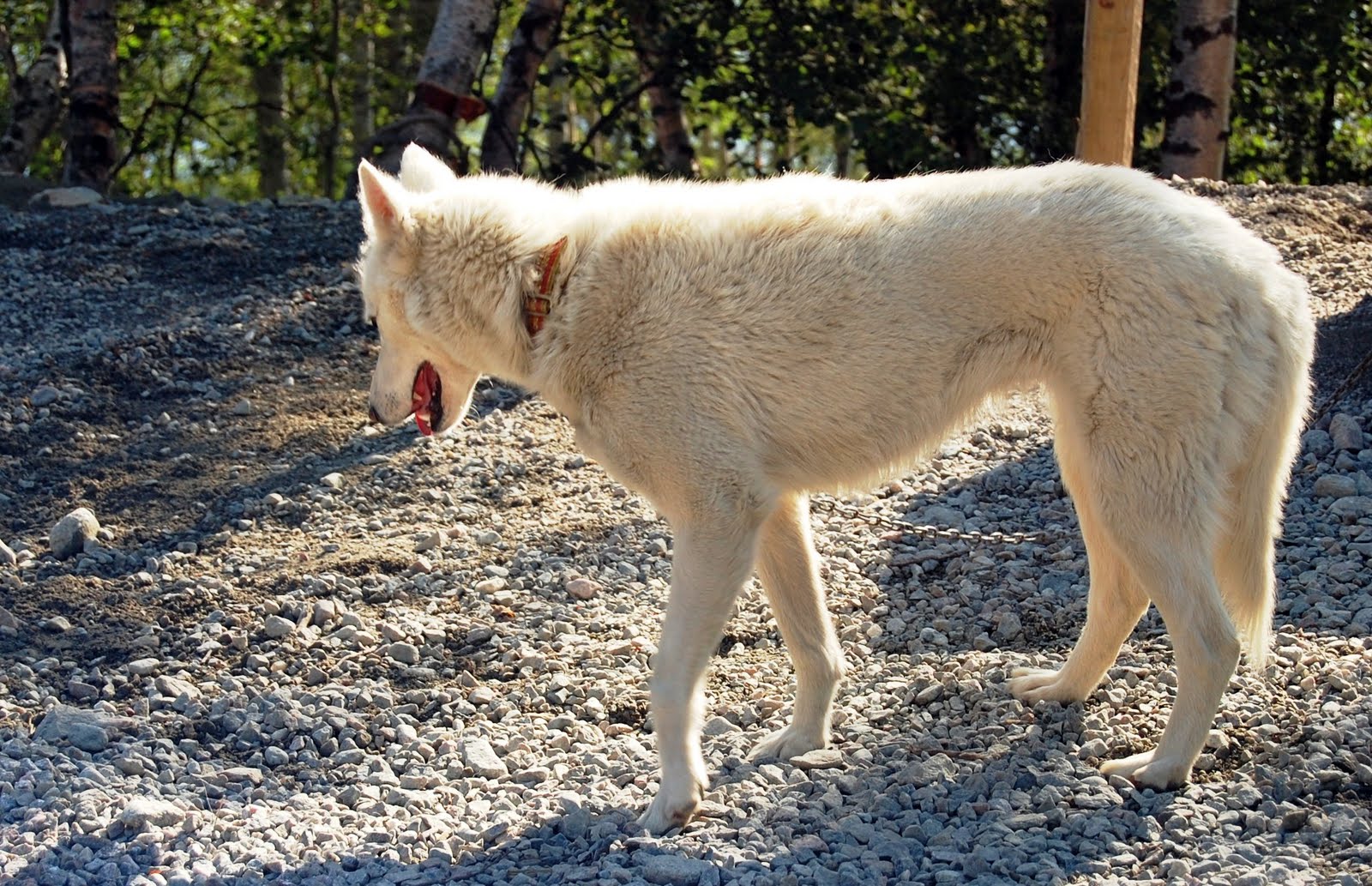
He told us their names and gave us a brief resume on many of the dogs. Some were shy, some were exuberant, but all were friendly and in great shape. Some were inside or on top of their houses, some waiting outside calmly and some barking enthusiastically ready to receive attention.


Click to enlarge collage, then click on any picture to bigify

My husband was eager to give them a cuddle.


Their coat was so soft. It was a lovely feeling to pet them.


Meeka told us that their huskies were mostly Siberian Huskies, but that the race had been thoroughly mixed, with Alaskan Malamutes, Eskimo dogs, Greenland dogs and others. They are bred for endurance racing and not for looks. Years ago sled dogs were the main mode of transportation in arctic areas. Life would have been very hard to impossible without these dogs. They were also used as guard dogs (against brown bears in the Pasvik Valley here) and to help herd reindeer. Meeka told us that he starts placing a halter on the pup at about 3 months of age for short periods to get him used to it. After 6 months they are ready to be introduced to a sled. They are taken on short trips. By the time they reach 2 years old they are reading for a big race.


The dogs are always eager to run with the sledge. Meeka said that it was easy to steer them. They are hard working dogs but they love to play too and can be big babies.


Meeka selected a couple of dogs to go on the hike with us. The Danish young woman working with the dogs came too. We walked up a hill, steep at time, which was covered with boulders, moss, heather and wild blueberries. There were many mushrooms too.


Close to the top of the hill we saw an old German “pill box/fortification.” From this hill it was easy to view the border during the war.


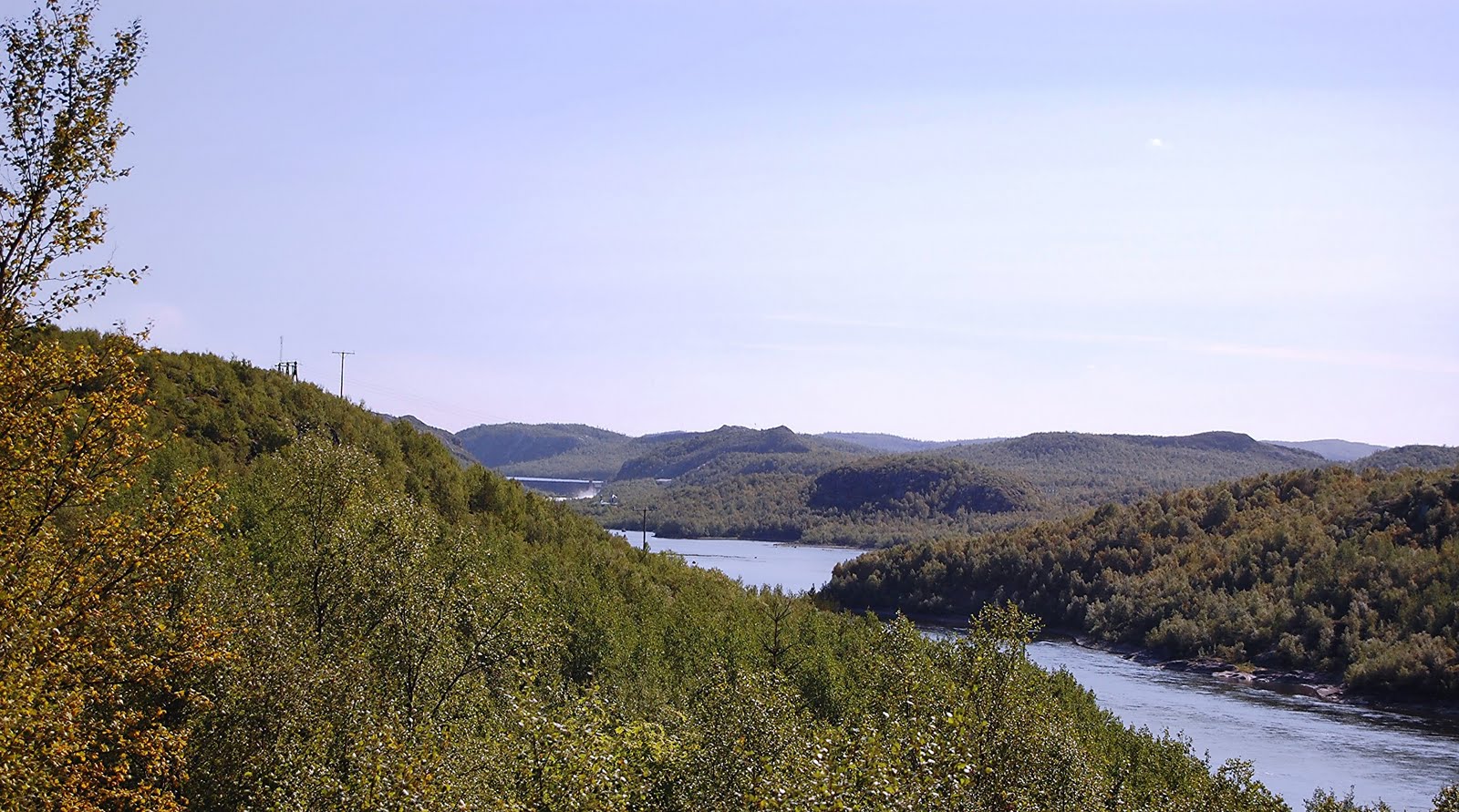
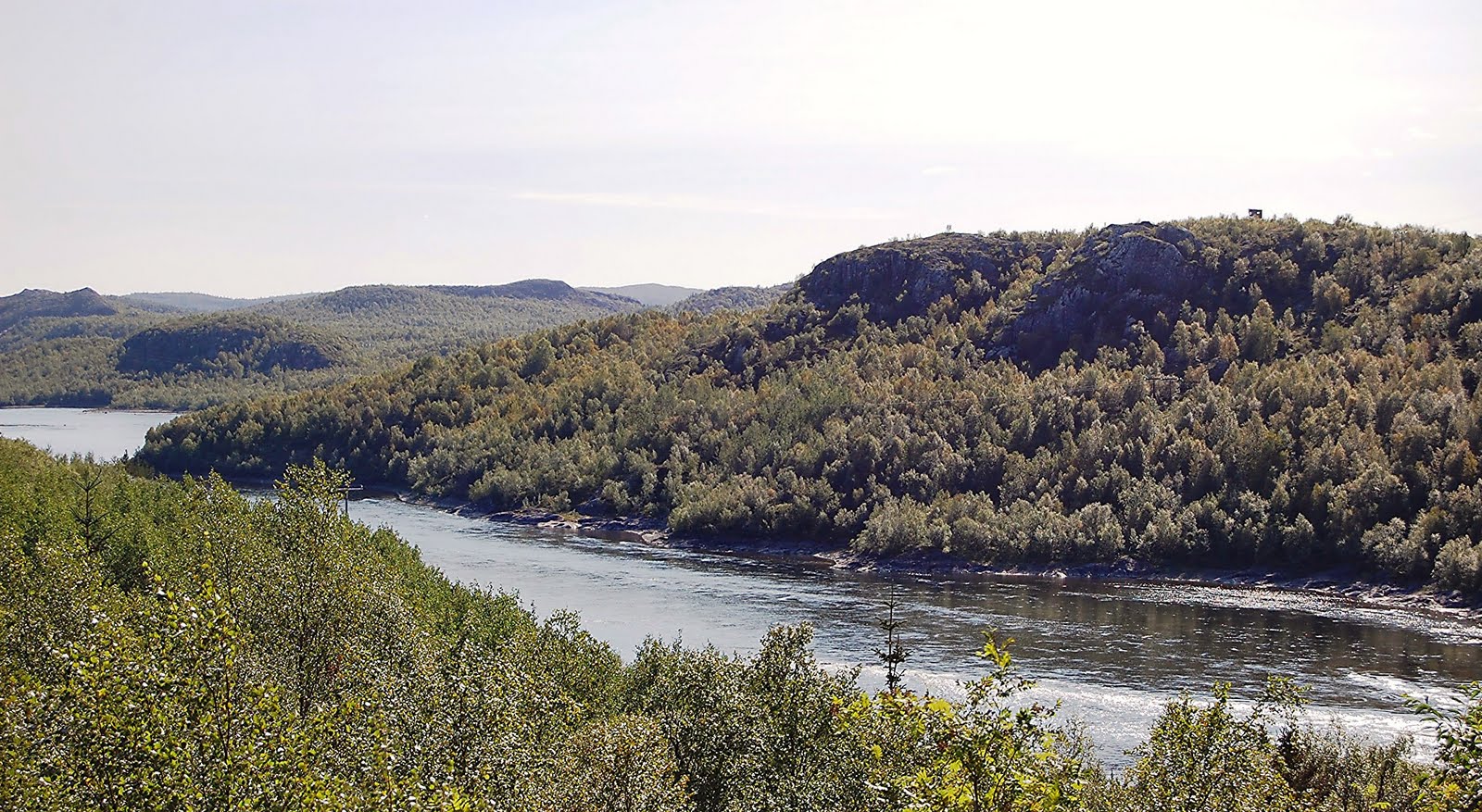
Once on top of the hill we had a stunning view of the Pasvik River. For about 196 km this river runs between Finland in the west and Russia in the east. The river is the border between Norway and Russia. It has many species of plants and birds found nowhere else. The largest population of bears in Norway lives in the Pasvik Valley.


Kirkenes brown bear (from the Internet)

Meeka said that he has also seen some wolverines, lynx and the occasional wolf. No such animal were in sight unfortunately but with a beautiful sun it was a lovely day to take pictures anyway as looking in any direction was a breathtaking landscape.


The dogs were happy playing around us


and I was busy taking photographs. Below, the red building on the left is in Norway and the gray-blue building on the right is in Russia.


I switched to my Sony telephoto lens to take some closer views of the border.


Norway


Russia

Meeka pointed to a far distant spot, close to a dam. He said that this was the Russian Orthodox church of Boris Gleb. It is hard to see. It is below a road on a dam in the center of the photo below.


Here is a close-up


I found out on the Internet that Prince Boris and Prince Gleb are saints in the Russian Orthodox Church and many churches bear their names. Click here for more information on them.

Saints Boris and Gleb (courtesy the Russian Center, New Delhi, India)

Here is a vintage postcard of this church.


It was time to leave this beautiful and peaceful spot and walk back to the kennels to say goodbye to the dogs and give them a last friendly pat.


Meeka drove us to the Gapahuken restaurant for our (late) lunch – it was almost 4:00 pm. The restaurant was on the edge of the water, very modern. It was facing the border station.


While we were waiting for our meal Meeka showed us a beautiful book illustrating one of the winter races they enter with the dogs. He said that they conduct winter safari for clients, but that their training is geared for the dog races.


The Arctic Barents Race has drivers from Norway, Sweden, Finland and Russia competing against each other. Next year, in 2011, the Arctic Barents Race will start in Murmansk, Russia and will take 25 days – 3000 km (1864 miles.) It will cross all the Scandinavian countries (Norway, Sweden, Finland) and Russia. It will be entered into the Guinness Book of world Records.


Meeka told us that after this long race the Iditarod will look like a “warm-up” race. The Iditarod in Alaska, which is called the longest race of its kind, only covers approximately 1,868 km (1,161 miles.) In the Arctic Barents Race the mushers will drive the dogs about 120 km a day (75 miles.)


The race organizers are planning a large purse for the race winners – about 300,000 Euros ($385,000 at today’s rate.) The mushers (drivers of the dog teams) have to be in great shape I would think, physically and emotionally. It is not everyone who can ride thousands of miles in the snowy wilderness with a pack of dogs. The mushers assist the dogs by running behind the sledge or peddling on the side and climbing hills. They have to care for the dogs whether healthy or injured. Just as sport athletes the dogs have to keep their training all year long to be ready for the winter competition.


(The 3 sets of pictures above were taken from the Internet)

Below is a clip showing the start of the 2010 Pasvik race.


Our “delicious” lunch as advertized was ready. It was reindeer stew with fresh vegetables. I had never had reindeer and did not know what to expect. We do not eat meat often at home – we are not vegetarians but almost. It was really delicious, quite tender with no fat. I understand that it is a high-protein, low-fat, high-mineral meat. No fat marbling or gamy taste. The original settlers of the area, the indigenous Sami people, tend herds of reindeer for meat in ranches, just like beef ranches in the west of the USA.


After such a long day – waking up early in Oslo, then visiting Kirkenes, the dog kennels and hiking up to the viewpoint, we had quite an appetite. It was strange in a way, eating reindeer while gazing at Russia across the river. I could really say that I was looking at Russia. Last summer in Alaska, while in Wasilla, I really tried to see Russia, as Sarah Palin (ex-governor of Alaska who quit in mid-term) declared she could see. But I never saw any Russian hills from Wasilla. Here outside of Kirkenes, Norway, either from this restaurant or from the viewpoint on the hill I had been indeed looking at Russia.


I was going to explain why we flew to Kirkenes, but this is already a long post. So I’ll get back to it in my next post.