
In my last post we were starting our short stay in Savannah, our historical city in the south of Georgia. It is recognized internationally for its beauty – it is a classic city. We continued our stroll through its many elegant garden squares. We parked our car close to Lafayette Square.

Lafayette Square was laid out in 1837. It was named in honor of Gilbert du Motier, marquis de la Fayette (1757-1834), who had visited Savannah in 1825. The Congress of the United States had invited him to America. He came and toured twenty-four states between 1824 and 1825.
 “1837 – So named in grateful recognition of the aid given the colonists by Gilbert Motier, Marquis de LaFayette, the friend of Washington”
Lafayette Square is bordered by stately houses as are most of the squares in Savannah. We wished to visit the Andrew Low House as I had read that it had beautiful antique interiors. William Makepeace Thackeray (1781-1815), the English novelist, was a good friend of Andrew Low who invited him to Savannah several times. The desk where Thackeray worked is in one of the bedrooms. This house was built in 1849 by Andrew Low, a Scot by birth, who had come to Savannah in 1830 to join his uncle. Andrew Low became one of the wealthiest men in the British Empire. He remained a British subject; he also had a house in Liverpool. He died in 1886 several months before his only son, Willie, married Juliette Gordon. Juliette Gordon Low founded the Girls Scouts of the USA in March 1912 in the Reception Room of this house.

Andrew Low House facing Lafayette square
As we came closer to the house we could see a small sign on the door. The garden gate was opened so we went in. The sign said “closed during renovations.” Disappointment! I walked around the well maintained garden and took some pictures. The two sitting lions by the front stairs seemed to sympathize with me.

Click on pictures to enlarge them
In a book I had seen the front parlor of the Low’s house and other rooms. At least that gave me an idea of the furnishings – see below.

We went back into the park to sit under the giant oaks. We could see another mansion on our left.

This was the Hamilton-Turner house. It was built in 1873 for a former Savannah mayor at the exorbitant (at that time) price of $100,000. In 1883 the house had electricity, the first house in Savannah. It used to be open to the public for guided tours but it is now a luxury bed and breakfast. Both Andrew Low’s house and Hamilton-Turner B&B are reported to be haunted.

In the center of Lafayette Square is a lovely fountain which was erected to commemorate the 250th anniversary of the founding of the Georgia colony. It was donated to the city in 1984 by the Colonial Dames of Georgia. The last time I saw this fountain was in November 2005 during the marriage of younger daughter. I remember it fondly as many lovely pictures of the wedding party were taken there – all of them now in a nice album. I took some quick snapshots with my old film camera at the time and will show them below.
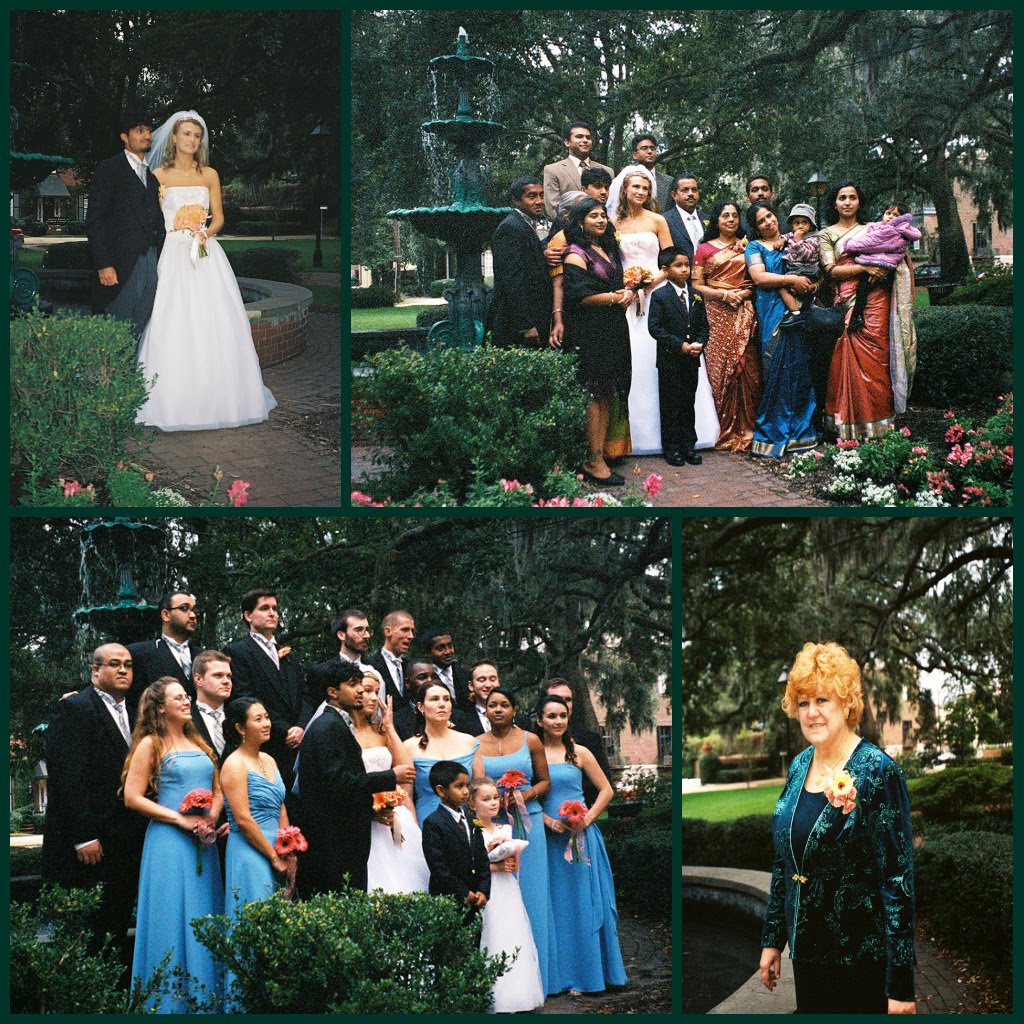
This time I took many pictures of the fountain, from many directions and close up. The weather was warm. In November, at the time of the wedding, it was quite cool, although dear daughter said she did not feel cold. Most of the photos were of family members, not the fountain alone.

As I mentioned in my last post – when I was listening to Ray Charles in Paris I did not know that I would live in Georgia and that one of my daughters would be married in the Savannah Cathedral. Daughter and her fiancé were attending the Medical College of Georgia in Augusta, which is about the same distance to Atlanta or to Savannah.

After I took all the fountain pictures we walked toward the cathedral but I still stopped looking down for flowers in the square then looking up toward the live oaks.

Just a few steps and we were close to the Cathedral of St. John the Baptist. It is very large. I have a vintage postcard of the cathedral – it looks about the same as now.
 Vintage postcard of the Cathedral of St. John the Baptist, Savannah (circa 1902)
Shortly before the end of the 18th century French Catholic émigrés established the Congrégation de Saint Jean-Baptiste, Savannah’s first parish, in a small church on Liberty Square. The congregation grew and in 1876 the present cathedral was inaugurated near Lafayette Square.

The cathedral is of French Gothic style with imposing nave and transepts. Groined arches are supported by columns. The altar is crafted of Italian marble. Stained glass windows were installed in 1904. They were made by the Innsbruck Glassmakers in the Austrian Tyrol.

I enjoy visiting historical religious buildings, not to worship, but for their aesthetic and their architecture – they are good places for reflection, not in a religious sense, but in a meditative way. When in France I like to attend classical concerts given in churches as they have good acoustics and beautiful organs. But I usually am shy about going inside them unless I can see striking stained glass windows. Below is St John the Baptist Cathedral organ.

Here are pictures of the interior of the cathedral which I took on our last visit.

Below is the cathedral as I took it in November 2005 after the rehearsal for the wedding. The lighting is different because it was at night.

I was pleased that there was a rehearsal for daughter’s upcoming wedding because, since we are not Catholic, I hoped that we would not make any mistake during the ceremony. There were 200 guests, only about 20 from our side of the family and the rest from the groom’s side. Their guests came from various US states, Canada, Europe and even from the state of Kerala, India. It was lovely to view all the beautiful silk saris in the decorated cathedral. For the rehearsal dinner we went to the Lady and Sons, Paula Deen’s restaurant. I did not know much about her then (as I don’t watch much television.)
 Paula Deen, Savannah restauranteur (courtesy of Food Network.)
The cathedral is of French Gothic style with imposing nave and transepts. Groined arches are supported by columns. The altar is crafted of Italian marble. Stained glass windows were installed in 1904. They were made by the Innsbruck Glassmakers in the Austrian Tyrol.
I enjoy visiting historical religious buildings, not to worship, but for their aesthetic and their architecture – they are good places for reflection, not in a religious sense, but in a meditative way. When in France I like to attend classical concerts given in churches as they have good acoustics and beautiful organs. But I usually am shy about going inside them unless I can see striking stained glass windows. Below is St John the Baptist Cathedral organ.
Here are pictures of the interior of the cathedral which I took on our last visit.
Below is the cathedral as I took it in November 2005 after the rehearsal for the wedding. The lighting is different because it was at night.
I was pleased that there was a rehearsal for daughter’s upcoming wedding because, since we are not Catholic, I hoped that we would not make any mistake during the ceremony. There were 200 guests, only about 20 from our side of the family and the rest from the groom’s side. Their guests came from various US states, Canada, Europe and even from the state of Kerala, India. It was lovely to view all the beautiful silk saris in the decorated cathedral. For the rehearsal dinner we went to the Lady and Sons, Paula Deen’s restaurant. I did not know much about her then (as I don’t watch much television.)
 Paula Deen, Savannah restauranteur (courtesy of Food Network.)
The food was of the Southern “comfort” type. We had a reserved room and went to the buffet to help ourselves. I think there were the usual fried chicken, creamed potatoes, collard greens, yams, lima beans, macaroni and cheese, rice and some sweet dessert. Here is the picture I took of one of the buffet tables.

This time we went back to the Lady and Sons, not to eat (because you have to go there early in the morning to queue up to be assigned seating times for later in the day) but to have a look. The restaurant was the same but, adjacent to it, was now a gift store called Paula Deen Store. The store was stocked with many gourmet cooking items, pots and pans, a great variety of Paula’s cookbooks and magazines.

This time we went back to the Lady and Sons, not to eat (because you have to go there early in the morning to queue up to be assigned seating times for later in the day) but to have a look. The restaurant was the same but, adjacent to it, was now a gift store called Paula Deen Store. The store was stocked with many gourmet cooking items, pots and pans, a great variety of Paula’s cookbooks and magazines.


Looking at all these cookbooks and gourmets food in the store pantry made us hungry. We decided not to eat Southern food this time but to sample some traditional English pub food at Churchill’s Pub and Restaurant, which is British owned and operated. But we’ll talk about this meal in a future post.

“I stood agog in Lafayette Square in Savannah, amid brick paths, trickling fountains and dark trees hung with Spanish moss. Before me rose up a cathedral of linen-fresh whiteness with twin Gothic spires, and around it stood 200-year-old houses of weathered brick, with hurricane shutters that clearly were still used. I did not know that such perfection existed in America.” - Bill Bryson, American author born in 1951


