Sunday, September 8, 2013

John Lewis and Richard Blanco at the Decatur Book Festival

The 2013 Decatur Book Festival took place during the Labor Day weekend - we drove there on Saturday morning, 31 August, 2013.  The biggest attraction for me was to see Congressman John Lewis, who was going to sign his new book "March: Book One" and to see and hear the poet Richard Blanco.  Decatur, Georgia, is about 6 miles east of Atlanta and a 55 minutes drive from our home northwest of Atlanta.  Decatur is a progressive city with a trendy mixed-use downtown area that still retains a small town feeling.  First we drove by Agnes Scott College - a private liberal arts college for women founded in 1889 and one of the sponsors of the festival.  The campus is listed on the National Register of Historic Places.  Below are some vintage postcards of the college and one of their information boards at the festival.

The Decatur Book Festival is the largest independent book festival in the US and one of the five largest overall.  Since it started, in 2006, more than 1,000 authors have taken part in the festival.  This year 85,000 people attended this annual event on the Square in downtown Decatur.  There were book signings, author readings, parades, live music, cooking demonstrations, poetry slams, interactive children's areas, panel discussions, writing workshops, etc.  More than 50 authors launched new books and interacted with readers this year.  (Click on collages twice to enlarge.)

After parking our car close by, we walked to the Square and stopped by a large sculpture.  It was purchased by the city to honor their first African-American mayor, Elizabeth Wilson, on her retirement in 1999.  A quote from the artist, Gary Lee Price (American, born in 1955) inscribed on the base of the 22-foot sculpture defines its meaning and also Ms. Wilson's vision for Decatur: "Imagine a world without limits, without boundaries, without prejudice and blame.  Imagine an existence full of self-confidence, self-esteem and not only tolerance but love for others regardless of color, socioeconomic or any other standing.  To me that is what the future holds.  That is what children represent and that is the type of world I would like to help others imagine can come to pass."

I had read the festival program - there was so much going on, it was difficult to choose where to go first.  There were several stages with a variety of activities.  For example, at the Cook's Warehouse Stage, Nathalie Dupree and Cynthia Graubart would present their latest cookbook "Mastering the Art of Southern Cooking."  Then Patricia Moore-Pastides was to present her "Greek Revival from the Garden" and then Sandra Gutierrez her book "Latin American Street Food."

Many books were on sale at a discount.  Publishing companies were displaying their latest editions.

There were also second-hand books for sale, and free books for kids.  Could we stop at all these booths in one day?

My printed schedule showed that we could go and hear about self-publishing in City Hall Stage, or listen to Chai Tunes by the Emory University A Capella Group at the Community Bandstand.  At the Decatur Library Stage we could listen to "The Storied South: Voices of Writers and Artists" featuring William Ferris.  At the First Baptist Decatur Sanctuary Stage Henry Wiencek and Mac Griswold would be discussing "Slavery" New Investigations and Discoveries."  At the Decatur High School Stage Amanda Ripley was explaining her book "What American Parents can learn from Overseas."  So many choices ... But it was getting time to walk back to the Decatur Presbyterian Sanctuary Stage, No. 13, where Richard Blanco would be at 11:15 am.  My handy map helped us get there.

We arrived early for Richard Blanco's poetry reading and were able to sit in the second row of the church.  I enjoyed looking at the beautiful stained glass windows of this historic Presbyterian Church, organized in 1825.

Richard Blanco came and first talked about his background, childhood and family.  His family fled Cuba and, on their way to the United States, stopped in Madrid, Spain, where Richard was born in 1968.  Blanco grew up in Miami and received a degree in Civil Engineering as well as a Masters in Creative Writing.  President Obama chose his poem "One Today" to be read at his 2013 inauguration.  Richard Blanco said that to be selected as the inaugural poet and join such famous poets as Robert Frost and Maya Angelou was one of the greatest experiences of his life.  He read some of his poems in between recalling his childhood and the complexity of living in the Cuban community in Miami.

I liked his voice and to hear his poems read by him, instead of reading them myself on paper, was so much more meaningful.  Below is the first two parts of his poem "El Florida Room" - I could see the room in my mind from his description. 

El Florida Room

Not a study or a den, but El Florida
as my mother called it, a pretty name
for the room with the prettiest view
of the lipstick-red hibiscus puckered up
against the windows, the tepid breeze
laden with the brown-sugar scent
of loquats drifting in from the yard.

Not a sunroom, but where the sun
both rose and set, all day the shadows
of banana trees fan-dancing across
the floor, and if it rained, it rained
the loudest, like marbles plunking
across the roof under constant threat
of coconuts ready to fall from the sky.  ...

I really like this poem as well as "Looking for the Gulf Motel" which he also read as well as other excerpts from his book For All of Us Today: An Inaugural Poet's Journey.  I enjoyed listening to his evocative words about the memories of his childhood and what it meant to be an immigrant in America.  He ended his poetry reading with his inaugural poem One Today.

As we walked back toward the festival on the Square we passed another poet happily typing on his manual typewriter.

We passed booths with authors and their books and publishing companies with piles of books for sale.

We also passed by people singing, vote registering, offering free Qurans,

and children listening to storytelling or playing with blocks.  It was a busy place.

From a distance we saw people queuing at the AJC Pavilion for John Lewis' book signing and we joined them.  For my friends overseas who do not know who John Lewis is, he has been a State of Georgia Congressman since 1986 and is 73 years old.  He is an American icon, one of the key figures of the civil rights movement.  John Lewis is the only person still alive who was with Martin Luther King, Jr. and spoke at the 1963 March on Washington in front of 200,000 persons.  Then on March 7, 1965, he led 500 marchers in a peaceful march across a bridge in Selma, Alabama, in support of the Voting Rights Act.  John Lewis was gravely injured to the head by Alabama state troopers.  During his life he was arrested 40 times and severely beaten several times.  Because of his commitment to justice and non violence he has been called "the conscience of the U.S. Congress" by his peers.  John Lewis gave the keynote address on Friday evening, August, 30, for the Decatur Book Festival.  Tickets were free and gone in an instant.  I watched part of his address on my computer but the reception was not very clear.

John Lewis has been awarded 50 honorary degrees from some of the top universities in the US, including Harvard, Brown, Princeton, Duke University and more.  A while back, a member of John's staff, Andrew Aydin, was going to a Comic-Con in San Diego - an annual convention of comic book fans.  As his colleagues made fun of him he responded that Martin Luther King, Jr. had written a comic book in 1956 on the philosophy of nonviolent resistance.  John Lewis had read this book too so Andrew suggested that a new comic book should be written on John Lewis' lifelong struggle for civil and human rights.  The graphic or comic style book came out in August and is titled "March: Book One."  It is written by John Lewis in collaboration with Andrew Aydin.  The graphics were done by best-selling artist Nate Powell.  This is the first book of a planned trilogy, published by Top-Shelf Productions, of Marietta, Georgia.

There were many people waiting in line as we arrived but many more came after us.  We slowly inched our way toward the tent were Nate Powell, Andrew Aydin and John Lewis were sitting.  I kept taking pictures as I slowly walked up to the signing table.

Then it was my turn.  First artist Nate Powell signed the book, then Andrew Aydin and finally John Lewis.  I talked with him a brief moment - he asked me how long I had lived in Georgia and where, and he got up and shook my hand.  Below is page 64 from the book.

March: Book One is number one on the best seller list of the New York Times and the Washington Post under the section Paperback Graphic Books.  It has received many good reviews such as "This is superb visual storytelling that establishes a convincing, definitive record of a key eyewitness to significant social change, and that leaves readers demanding the second volume."  the School Library Journal.  It is suitable from tweens through teens and adult readers.  My husband is holding my autographed copy of the book, below.


I'll end our visit to the Decatur Book Festival in my next post, as this is getting too long.  More to come ...


Monday, September 2, 2013

Marietta Art in the Park

There are many Labor Day weekend festivals in the greater Atlanta area.  We went to two of them.  On Saturday August 31, 2013, we went to Decatur, Georgia to the Book Festival - and I'll have a post on it soon.  Yesterday, Sunday September 1, 2013, we went to the Marietta Square Art in the Park.  I wrote two posts on this art festival already, one in 2010, explaining about Marietta and the area, click here to read it, and one in 2012 - click here to read it.

But first, thank you to all those who read my last post and gave their opinion on whether a movie "based on a true story" should be more than half true or not.  There were different viewpoints and I like that.  I do respect everyone's opinion and feel good that my blogging friends felt they could agree or disagree freely on my blog.  Now back to the festival.  We arrived at the park before it opened at 10 am.  There were few people then.  By the time we left around 12:30 pm there was a good crowd of people, children and dogs.  (Click on collage twice to embiggen.)

As I mentioned in my earlier post the Art in the Park festival in Marietta has been an annual event each Labor Day weekend for 27 years now.  The first festival included 32 artists and now there are 175 artists chosen from many areas of the US as well as from Marietta and greater Atlanta.  All the pieces exhibited are handmade originals  It is a pleasure to walk in all the booths and look at the extremely varied art and talk with the artists.  First my husband stopped at a wood carver, Lee Smith from Landrum, South Carolina, and admired the toothpick holders with the bearded old man hand carved on them.  I purchased one for him.

Some handsome rocking chairs were shown with the proceeds of the sale supporting charities.  The chopping blocks shown on the bottom right hand side picture below are handcrafted by Roger Grimes of the Kennesaw Woodpecker.

I talked for a while to a professional photographer but forgot to take pictures of his booth - many artists actually forbid picture taking.  There were several outstanding art photographs on display like the Mississippi Delta & Blues Collection by Ron Anton Rocz.

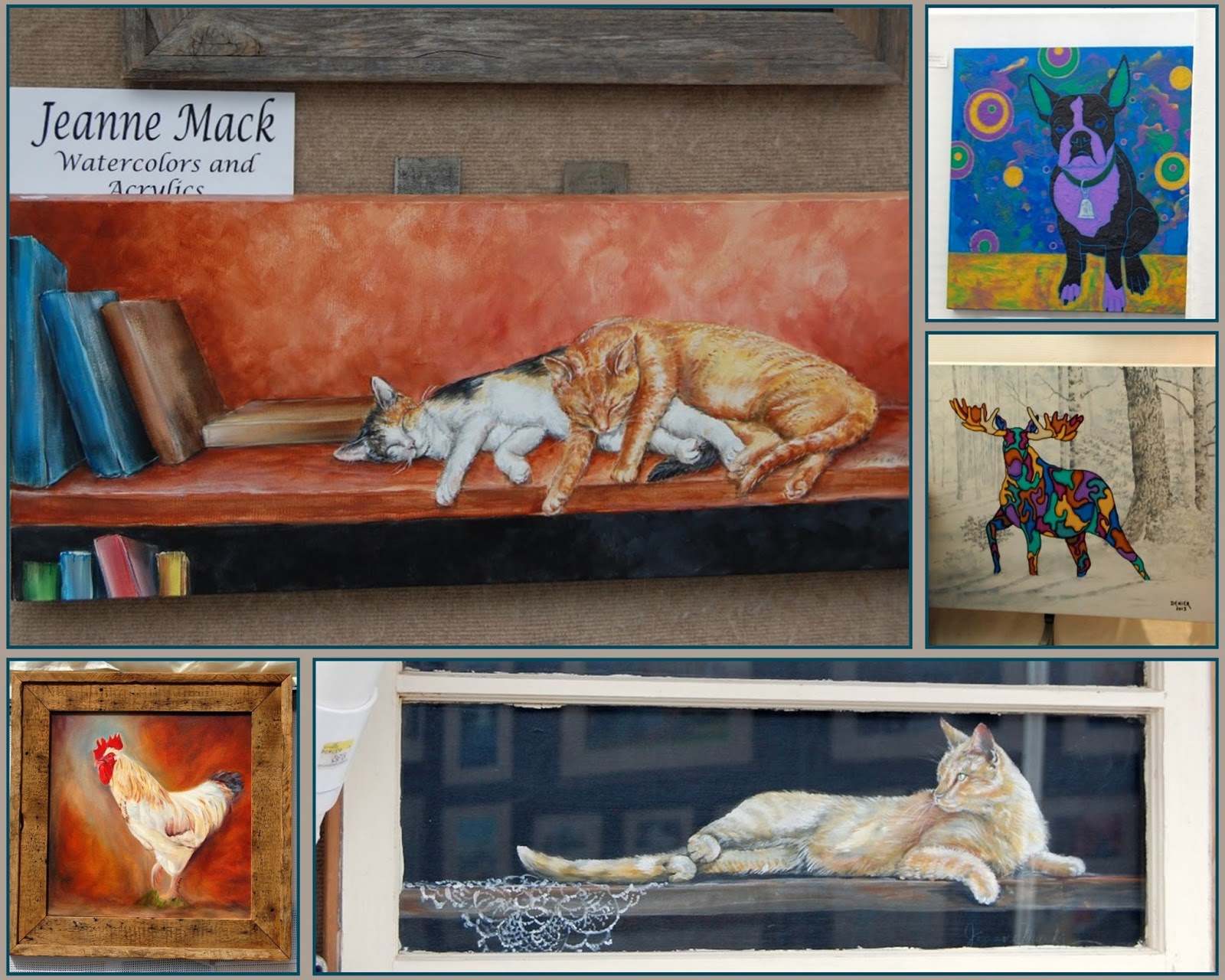
 Different styles of painting were shown - abstract, landscape, animal, fantasy, etc.


So many art pieces to enjoy!  Entering the booths the eyes don't know where to look ...

When we arrived at the square most people were still eating breakfast in the restaurants facing the square.  But after a while the ladies started coming into the clothing booths

and the jewelry booths.

I stopped and admired the work of a husband and wife team of glass artists from Waynesboro, Georgia - Mickey and Madeline Art Glass.  Their glass pendants are unique in shape and color.  I talked with Madeline - she told me her husband is the glass blower.  They craft their pieces in rural Georgia among their goats, chickens, dogs and garden.

Oriental art was exhibited too - in watercolor as well as in nature with gorgeous Bonsai trees.

It was quite sunny and light reflected through the beautiful stained glass pieces hanging in several booths.


We were certainly short of eyes to look at all this wondrous and varied art festival.


Lovely pottery dishes, bowls and mugs were tempting - but we already have so many pieces at home.

Tom Chambers brought his unique wood creations using material in nature, see vertical tree below on the bottom left.  (Don't forget to click twice to enlarge and see better.)

In the distance I could hear a strange low and vibrating sound - such as the wind instruments from Australia.  I approached and listened to a gentleman demonstrating his didgeridoo.  Afterwards he explained that he was using a special breathing technique to blow into his instrument and obtain the continuous sound.  Deborah Martin and Preston Scott from Carrollton, Georgia, is a team cutting, harvesting the raw material and handcrafting flutes, didgeridoos and keyboards.  They use traditional methods working with native bamboo and agave cactus.  Each handmade didgeridoo is individually decorated and hand-tuned.

Last year I took a picture of some bicycle prints.  One of my blogging friends, Jeanie, asked if I knew the artist who made the prints, but I did not.  As I was walking I saw a booth with painting of various sports.  I stopped and talked with Michael L. Lee of Alpharetta, Georgia.  He is a former illustrator and graphic designer who works in fine arts.  I noted his name and took pictures of some of his paintings which can be purchased as individual art design or prints.  Click here for a link to his web page (michaelleedesign.net.)

Then as I walked a bit further I saw another booth with bicycle prints, some of the same I saw last year.  I stopped and chatted with the artist - Sally Evans.  She was born in Chiswick, England, studied at the Amersham College of Art and also lived in Italy.  Now in Alpharetta, Georgia, for the last several years she was elected President of the Georgia Watercolor Society in 2009.  She sells her original art work and also prints of the same size.  In addition she offers Christmas cards and other prints on her website.  Click here for a link to it (artpainted.com.)

After seeing most of the art shown in the festival we walked to the Chalkfest which is held in conjunction with the art festival.  I'll show the photos I took at the Chalkfest in a future post as I believe eyes need to rest after so many colorful pictures.


Tuesday, August 27, 2013

Return to San Francisco and more...

Even though I may already know the subject I'll write about in my next post, by the time I write it I have thought about so much more, that I usually go on a tangent and end up with an "eclectic" and longer post - this is another one.  I'll start then with the "more" from my title.  Let me hasten to say that the day after I published my last post, on the rain in Georgia, it stopped raining.  It has been sunny every day since with mild temperatures and low humidity.  This morning it was 65 degrees F (18 C) and now, in the afternoon, it is only 78 degrees F (25 C.)  It is not warm enough for my figs to ripen on our tree but our potted plants are flowering more than usual.  (Click on any collage twice to enlarge.)

Since I am not sure if there will be enough figs to make jam this year I went ahead and made peach jam - but with a difference.  I used a large mango, ripe Georgia peaches and finished with two tablespoons of "Safari" liquor.

I bought this liquor in Amsterdam a couple of years ago because the label said "Safari - Exotic liqueur spirit with tantalizing flavor of exotic fruits - maracuya, mango, papaya, lemon and lime."  It is produced in the Netherlands.  I thought an "exotic" touch would do well in my peach jam.  I was not sure what "maracuya" was and saw on Google that it was "Fruta de la Pasión o Maracuyá" and is also called Passionfruit, Pasionaria or Grandilla (Passiflora Edilus.)  The fruit is either yellow or purple at maturity.  It is a climbing plant originally from Central America but produced in many countries.  Photos below courtesy Wikimedia.

The Sunday before I wrote my last post, Sunday 18th August to be exact, it was raining so we decided to go to the movies.  We had not been since last November and there was a film I wished to see called "Blue Jasmine."  It was playing in Atlanta.  Early in the afternoon we drove there and saw that another film I had seen advertized on TV, called "Lee Daniel's The Butler" was also playing.  We purchased our tickets for Blue Jasmine but saw that the film The Butler was sold out until the evening show.  We were early for Blue Jasmine so we peeked in the theatre where The Butler had started.  I did not know that the 5 minutes or so we stayed there would create more time spent on the computer for research.  I'll explain below.

First - Spoiler Alert! for The Butler film.  As we started watching the movie I thought that it was telling the story of the butler's ancestor - it was a scene in a cotton field.  A boy was there with his parents - I thought it must be the butler's great grandfather on a plantation.  The mother is taken in a shack by the overseer and I guess, raped, as we hear her screams.  The boy asks the father if he will say anything about that, the overseer comes out, the father gives him a bad look, and the overseer shoots the father in the head point blank and kills him.  That's it, that's all we saw - we left to see our movie.  But I wanted to find out later what time period this scene was.  I did find that this scene was supposed to be in 1926 when the Butler was a boy and this tragedy happened to his family, on a cotton plantation in Macon, Georgia.  There are many fields of cotton in Georgia now but I rarely see any people working in them as production has been mechanized.  Below is a field of cotton I photographed last autumn, about 15 miles from my home.

Since I like history and research I read more on the movie and The Butler himself.  I found out that the original Butler was named Eugene Allen, that he was not born in Georgia on a plantation, but on a farm in Virginia.  His parents were farm workers but his mother was not raped and his father was not murdered.  Seeing on the poster (at the very top) that it says "Inspired by a True Story" I wondered what was authentic.  I found out that in the movie the Butler, re-named Cecil Gaines (I guess to avoid
slander) has 2 sons and one of them died in Vietnam.  In truth Eugene Allen only had one son and he came back from Vietnam alive.  In the movie Cecil's wife is an alcoholic and has an affair with a neighbor.  In truth Allen's wife of many decades was a lovely woman.  I wondered what else is not true and I guess about 95% of the movie is fiction.  In the movie the other fictional son is an activist, joins the Black Panther, is roughed up several times and spends some time with Martin Luther King, Jr.  He also pushed his father to quit his butler job - none of it true.  Actually I found out that the real Butler was a Republican (!)  Below are more photos of cotton fields but in vintage postcards from 1905.

All this research has brought many conversations with my husband.  He feels that if a film says based on or inspired by a true story or true events then only 2% needs to be true.  I disagree and feel that if the studios advertize the film this way, at least 60% should be true.  I understand that there is poetic license and that to make a film more dramatic some liberty can be taken with the story.  To me it shows not much respect to invent a promiscuous drunken wife to this real butler.  It cheapens the story and hurts the reputation of the true butler.  I think the audience is owed more "truth" if the studios market the movie as such - I saw TV interviews saying that most of this film was true.  I am also afraid that young people in this country, and other countries where this film will be shown, may not take the time to research the story as I have and believe the plot to be a true rendering of what happened to this American butler and his family (with all the African-American stereotypes) - then will see the word "true" in there and will believe it is.

When I go and see a movie founded or based on a true story I don't expect to watch, for more than two hours, mostly fiction and lies freely added to manipulate and rile up my emotions whether the actors are good or not.  Forest Whitaker is one of my favorite actors - I am sure he gives a strong and moving performance in this movie but I would enjoy it more knowing that it is a fictional tale showing the history of race in America, even if the idea for this film came at first from a butler's life in Washington, DC.  Any thought on that?  (Picture below of Forest Whitaker courtesy Entertainment Weekly.)

I really liked the film we went to see - "Blue Jasmine."  The main character, Jasmine, is played by Cate Blanchett.  She shines in this Woody Allen movie.  Her performance as a fragile emotional socialite is flawless.  The rest of the crew were well chosen and give great performances too.

As you can see from the poster above Blue Jasmine takes place mostly in San Francisco.  This brings me back to the subject of this post.  When I finished my 3rd post of San Francisco in the 1960s (click here to read it) we had left on the last day of 1969 thinking we would be back.  We never went back until this last June, and 43 1/2 years had passed.  The main reason I did not go back is because I had to go to Paris at first once a year then twice to three times a year to visit my mother as she became ill.  San Francisco was not on the way - it is in the opposite direction.  My mother passed away in 2002.  Last February I saw flight sales to San Francisco from Atlanta.  Tickets were bought - a hotel was found, and we went.  By air the distance from Atlanta to San Francisco is 2,138 miles or 3,440 kms (driving distance is 2,472 miles and 3,977 kms.)

To give some perspective I tried to see which town is about 2,138 miles from Paris.  I was surprised to find out that the flying distance between the capital of Armenia, Yerevan, and Paris, France is exactly 2,134 miles.  During that flight one does not fly over several states like in the US, but over separate countries, such as Austria, Hungary, Turkey and others.

It was raining as we left the Atlanta airport on May 30th, 2013, but sunny when we landed in the San Francisco airport.  I took many pictures from the aircraft along the way,

When landing into San Francisco airport you feel that you will land in the bay as it is close to the water, but everything went fine.  The airport did not look like it did in the 1960s.  It has been much improved.  We had never been on the BART rapid transit either.  We used it to get to downtown San Francisco.  Below at the top of the collage is a vintage postcard of the airport in the 1950s or early 60s, and the way it is now.

The five hour flight had gone by quickly.  It was only about 2:30 pm when we arrived downtown so there was still time to walk around the city after we checked into the hotel.  That will be in a future post.