Sunday, June 6, 2010

Recollection: Mother’s Youth (second part)


In my last post about my mother’s youth I mentioned how much she liked hydrangeas. She also loved roses and many other flowers. The rose above is called The McCartney Rose and it has a lovely fragrance. I planted it this year and have seen several beautiful blooms already. I cut a couple of stems today and placed them in a vase in the kitchen. I can’t resist smelling them every time I come close to the vase.


My grandmother had a predilection for roses also. My grandfather sent her many postcards showing roses, like the one below. My grandfather had sent so many rose postcards that it was hard to select just one.


Here is a pin below showing a picture of my grandfather when he was young. My grandma cherished it.


My grandmother was so well versed in chemistry, herbs and plants that she made her own skin lotions and creams. I remember a small bottle where she had a special mixture of mysterious things and rose petals – it smelled divine. My younger daughter inherited this interest because when she was a small child she constantly liked to mix very strange liquids for her “special experiments.” My grandmother had flawless skin and kept all her teeth, which in those days was quite amazing. She wrote many treatises on her findings but unfortunately I do not have any. Below is my grandmother at her desk.


My grandmother gave courses in chemistry but I do not know more than that. Whatever she did, it had been very appreciated because the French Government awarded her with the order of the “Palmes Académiques” (Order of the Academic Palms) which is a decoration bestowed on her for her contribution to education and culture in France. She was very proud of this decoration and wore it on her lapel during official occasions. She gave it to me later in her life. This order was founded by Napoléon Bonaparte in 1808. He appreciated how important education was and wished to recognize French people in academia, education and culture who had helped the citizenry in these spheres. It is amongst the world’s oldest orders of chivalry – here it is below.


Because my mother wrote her memoirs before she passed away I have information on her life to supplement what she already told me, but not so much on my grandparents (her parents.) Below is a picture showing mother on the left, grandmother, great grandfather and grandfather. Notice how tall my grandfather was. He was at least 6 ft 4 ( 1m 95) which was quite tall for a Frenchman in those days. My grandma always called him “mon grand” (my tall one.)


During that time my grandfather was busy with his own career. He was a civil engineer for the French Air Force – working as a civilian. He was also very active in politics, being the director of the city council in his town of Courbevoie, a suburban town near Paris, about 5.1 miles (8.2 kms) from the center of Paris. Below is a photograph of my grandfather with members of his political council.

Grandfather is first on the right, sitting.

Mother wrote her short memoirs long hand and a nurse in the retirement home where she stayed transcribed them into a document. This nurse gave me the document after my mother died in 2002. I was not aware that she had written her memoirs and was very happy and grateful when the nurse gave me an orange folder containing the document.


In my last post I published some of my grandfather’s postcards on the 1910 floods in Paris. A blogger friend remarked that it was strange to publish postcards of a flood. What happened is that the Parisians would write to their families in the provinces and mention the floods. No one could believe that “la ville lumière” (the city of light) could be paralyzed by a flood. An enterprising printer had the idea to take photos of the streets of Paris under water. He then published them as postcards.


Place St Charles in the XV quarter of Paris

It became a very successful business because people jumped on the cards to send to their relatives and to keep as mementos. Even after the water receded postcards were made showing “after the flood” pics and then of people helping to rebuild houses and so forth. The habit of sending postcards had started and continued past 1910. Actually in France you can find current postcards everywhere. In Paris there are shops selling postcards only on all kind of subjects. Everyone sends postcards to family and friends during their vacation or whenever they take a trip. I surely do. Below is a 1910 postcard showing the Alma Bridge with the water almost reaching it.


Pont de l'Alma (Alma Bridge)

Below is a postcard, maybe from the 1920s, showing a panorama of eight bridges in Paris. The Seine had calmed down by then.


Panoramic view of 8 bridges of Paris above the river Seine

In my last post we left as my mother was working for the House of Worth, a high fashion couturier where she started as dressmaker and went up all the way to Première d’Atelier (top person in the high fashion studio.)


The Seamstress by Joseph Rodefer de Camp, American, 1858-1923

She had gone south to the Riviera where she worked in Juan les Pins for six months.


She told me that she learned the Charleston – one of the roaring twenties favorite dances made popular by Josephine Baker.


Mother

Josephine was an American expatriate beloved by the French people – all her life.Click here for more on Josephine Baker.


Poster of Josephine Baker performing at the Folies Bergères, Paris

I had written quite a lot more but I felt this was getting too long. So, I’ll stop here and my next post will be about mother and the tango.


Saturday, May 29, 2010

Recollection: Mother’s Youth and the House of Worth


Sunday May 30th is Mother’s Day in France. On this occasion I used to give my mother a hydrangea plant (hortensia.) One year it would be a white plant, the next a pink then a blue.

Click on any picture to enlarge it

She liked this flower, in any color, and planted them later in the back yard.


This year would have been her hundredth birthday as she was born in May 1910. Last year, on her birthday, I wrote a post on my grandparents and my mother’s childhood. This is a continuation of that post – you can read it here.


Avenue de l’Opéra, Edouard Léon Cortes, French 1882-1969

1910 had not started as a good year for Paris. After much rain in the fall the river Seine in Paris flooded in January 1910 its height raising to 8 meter 68 (28.30 feet.) The city as well as many suburbs were paralyzed. Twenty thousand buildings were flooded and 150,000 left homeless. The metro, trains and public transport stopped; people used boats. There was no clean water, electricity, gas or telephone. My grandfather who collected postcards gave me about 16 postcards on the Paris flood. Below are some of them:


From left to right: Porte de Bercy, Gare St Lazare, Quartier de Javel, Rue de Verneuil, Bois de Boulogne, boat ferrying passengers for 5 cents between Rue Alboni and Pont de Passy. Click on the pictures, and click on each picture again

My mother was born in Paris about 3 months after the water receded. My grandmother, as it was done in those days, sent the baby to Normandy to stay with a wet nurse. Mother is with her wet nurse in the picture below.


She rejoined my grandparents when she was about 15 months old. She had pale red hair and light blue-green eyes, a shade of aqua. Here is a picture of mother when she returned to Paris.


Last year on her birthday I talked about mother’s childhood until she was attending school in Paris. Her parents would have liked her to keep studying but after receiving her Certificat d’Etudes (a primary school certificate abolished in 1989) she decided to go into apprenticeship to become a dressmaker. Because of World War I my grandmother had lost her dry cleaning shop and my grandfather’s job was not paying much. My grandmother dreamed to have a small house built and saved on everything to that end. Mother, an only child, loved sewing and wished to help her mother achieve her dream. My grandmother had started to work as a drycleaner specialist in the clothing department of the Galeries LaFayette, a large department store in Paris. She had a degree in chemistry which helped as at that time there were not many dry cleaning products available. Below is a picture of grandmother in 1925.


Both my grandparents liked politics and grandmother joined the French suffragettes. Her group organized a strike in front of the Galeries LaFayette in 1925 to demand voting rights as shown in the picture below. It was not until 1944 though that French women obtained the right to vote.


Grandmother and her suffragettes on strike, grandmother is in the middle, second row, feather on her hat

Mother started her sewing apprenticeship as a “petite main” (little hand) in a high fashion house in Paris. She explained to me that at first the only thing she did was to pick up stray pins. She then went on to learn how to cut, apply trim, beads and laces, sew a variety of styles with different fabrics, how to drape and finish. She worked her way up in the workroom to hand finisher and then Première d’Atelier. (Top person in the high fashion studio.)


Atelier de Couture, Brindeau, French, 1867-1943

Not all designers know how to draw, cut and sew. The Premiere d’Atelier, who heads the studio, is the designer’s right hand and the link between the workroom and him. It is a very important position as it is her job to take the designer’s original sketch and translate it into a prototype pattern that can be made by the dressmakers in the workroom. She must know all the techniques required to execute the design and have the ability to translate the designer’s idea into the right fabric, buttons, etc. Mother worked hard but she also went out dancing often with her friends.


1920s’ flapper (from the internet, unknown author)

Mother worked for the House of Worth, one of the top high fashion houses in Paris at the time. Charles Frederic Worth came from England and in 1858 opened a high fashion house in Paris. His original idea was to present his collections to his clients by having models wear them in a live show. The fashion from his house was identified by his name. He had a new fashion show each year. Since then almost every high fashion house has continued to organize their business like Worth. He is known as the “Father of Haute Couture.” Frederic Worth’s clients included Queen Victoria, The Russian Tsarina and many high celebrities. By the 1920s, when my mother worked there, the House of Worth was operated by Worth’s grandchildren, Jean-Charles and Jacques. The clientele still included the international nobility, celebrities and wealthy high society of the time.

Below are some of Worth’s creations from the ‘20s. Drawing by George Barbier.

The House of Worth's creations were dramatic, elegant and superbly crafted with a high quality finish. They were works of art that could be worn.


With mother’s help my grandparents were finally able to have “un petit pavillon” (a small detached house) built in Courbevoie, a small suburb then 5.1 miles (8.2 kms) from the center of Paris. Below is the house upon completion. Later on when I visited my grandparents there were many shrubs and plants around the house. But years later, their house was condemned by the government as was the whole neighborhood to make a business park. Later on the Arche de la Defense was built close to where their house once stood.


Mother went to the French Riviera, in Juan les Pins, at that time (the late ‘20s) on a special high fashion assignment. There were many wealthy patrons living there. The designs were created on the human figure to fit the client’s measurements and then manipulated for a perfect fit. She still had time to go to the beach and dance the tango some afternoons.


Mother is on the right


My grandparents drove south to visit her.


I believe she stayed on the Riviera for 6 months, then came back up to Paris and to her parent’s home.


She loved her job but she also had fun with her friends. She would go with them to the “Thé Dansant” (tea dancing.) These took place in many dance halls in Paris for a couple of hours in the afternoon and were quite popular. The king of tango from Argentina, Carlos Gardel , had played in Paris several times and become very successful. Everyone danced the tango. In my next post I’ll continue on mother’s youth – and tango.


Mother with one of her friends (mother is on the right)

Paris was a wonderful place in the early 1930s for a young woman. It was a time of freedom and many experiences. Mother was surrounded with sophisticated people, the jet set as well as the little Parisian dressmakers. Everyone had fun. The radio and cinema were popular. Jazz had arrived from America accompanied by many American expat writers. Paris had become the capital for freethinking intellectuals and avant-garde artists.


Arc de Triomphe, 1932, by Tavik Frantisek Simon, Czech, 1878-1942

-o-o-o-o-o-o-o-o-o-o-o-o-o-


The hydrangeas on this post were photographed two days ago in LaGrange in Georgia. There are many types and colors of hydrangeas in this town which will celebrate its 10th year Hydrangea Festival the second week-end of June as explained here.


Saturday, May 22, 2010

Returning home through Alabama


On a clear sunny morning, we left our friends from the ‘60s in Tennessee -see my last two posts here and here - and decided to get back to Georgia through Alabama. We did not take the big highways so we could stop anytime to look at the scenery and take pictures.

click on any picture to enlarge

Some friends left comments on my last posts saying that the '60s and ‘70s had not been agents for change. But my reply is that if there had been more of us we could have taken responsibility for the ‘80s and ‘90s but we were a minority, even though the media made much fuss about the movement of peace, love and universal good. The “Silent Majority” was the numerical majority in this country and they took over along with the “establishment” and the large corporations. Instead of more understanding, they created more polarization and instead of a lasting peace, more wars. There is more division now - a world study last year found that the US has the largest gaps of inequality between rich and poor compared to all the other industrialized nations – the top 1% receives more money than the bottom 40% and the gap is the widest in 70 years. The ‘60s conservative boomers did not want social change and they won. Unequal societies create more tension, unhappiness and crime. Money is powerful and has been changing the country. It will continue to do so. I read that Karl Rove, President’s Bush top adviser, has helped in the creation of a new soft money organization which has already received commitment of $30 millions. They are seeking to raise more than $60 millions to quietly alter the next elections in favor of their chosen more conservative candidates, using dirty tricks if necessary. So, money and big corporations will continue to be all powerful. But this is not a political blog, just my observations, so let us return to our trip through Alabama. Luckily we left Tennessee before the terrible storms which caused so much flood and misery.

We drove by peaceful country scenes like the one on the little rural road below.


Click on this picture, when enlarged, click again

I stopped for a few minutes to take some pics of the soft bovines looking at me.


Then we rode along the beautiful Guntersville Lake located on the Tennessee River in Alabama. It received its name from John Gunter, an early Scottish settler who was an adopted member of the Cherokee tribe. The town was established one year after the American Revolutionary War ended.


In Scottsboro, Alabama, we went back to visit Unclaimed Baggage Center. We had been there a couple of times and stopped by to see if there was anything new of interest. Their merchandise comes from unclaimed baggage. When the airline cannot track the owners, the baggage is declared unclaimed. You can see more information on this here


Last year I purchased a Chinese watch, with Chinese characters, for $10. It works like a charm. I also like to look at their books as they often have cheap mysteries, bestsellers or foreign books. They also sell lost freight I think because they sell linens, dishes, etc. Here are a few things I purchased there –


Apart from the books all this merchandise was brand new

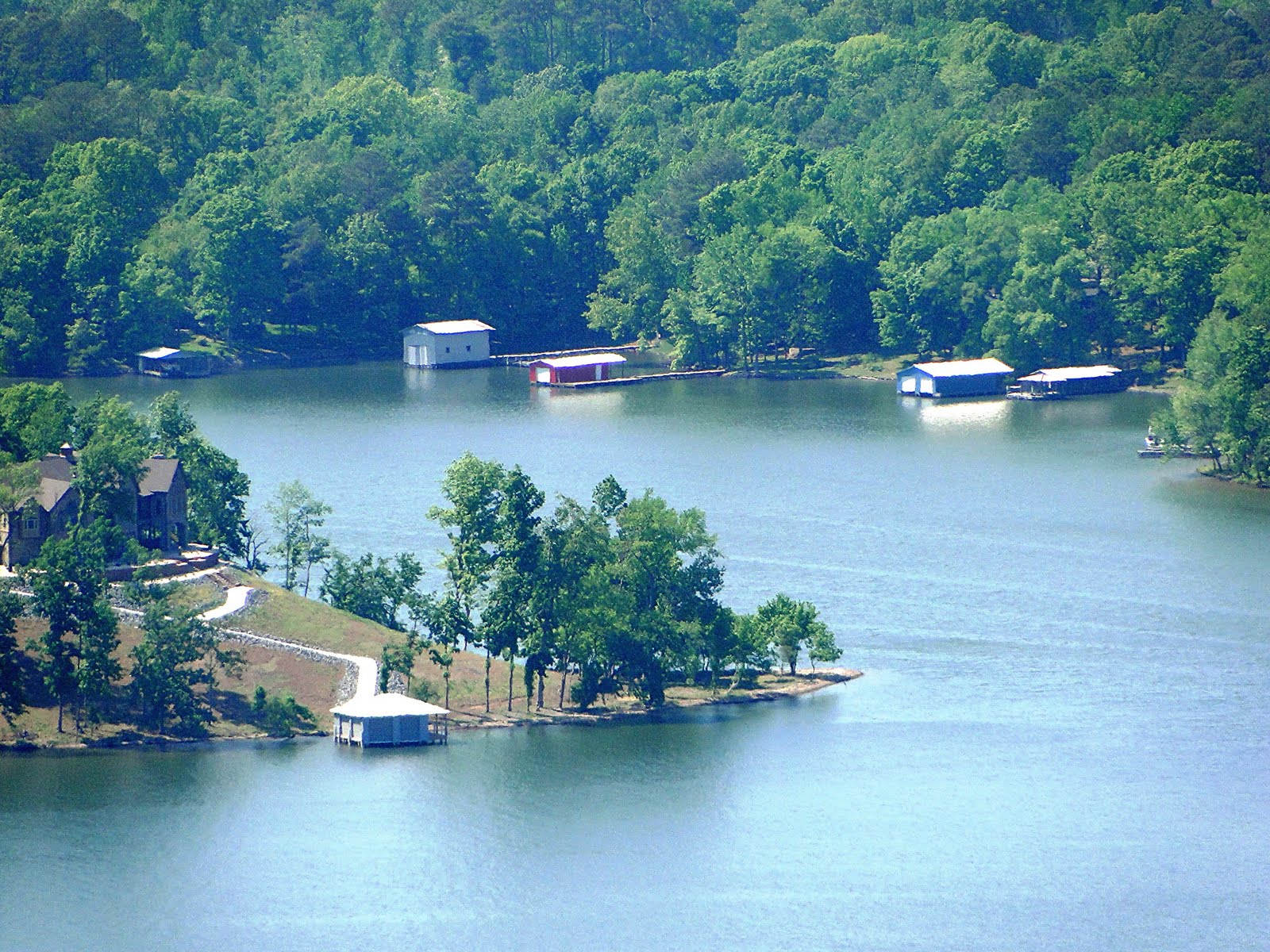
After driving up a curving Appalachian Road we found a spot to admire a pretty view of Guntersville Lake and took some more pictures.


From our vantage point we could see how long this lake is – the shoreline measures close to 950 miles and the lake is spread over 70,000 acres.


Many visitors come to these clear waters for good fishing, camping or picnicking in the beautiful Appalachian Foothills.


Twenty five miles further on, towards Georgia, we crossed the bridge over the Little River Canyon. It was such a sunny afternoon and we were in no hurry so we decided to park and get down closer to the river.


The Little River Canyon is a National Preserve, part of Alabama’s DeSoto State Park. It is 14,000 acres in size and very scenic. It actually begins at a 45 ft waterfall which has been a landmark for thousands of years. Centuries before European pioneers entered the area Native Americans knew of this fall. During the Civil War both Union and Confederate troops passed through this area.


Many millions of years have cut into the heart of Lookout Mountain to create this canyon, one of the deepest in the Eastern USA. The canyon is about 11 miles long and more than 700 ft deep. It features sandstone cliffs, forests, caves, boulder fields –


crystal-clear waters,


diverse forests, rock cliffs, caves, and boulder fields.


During the late 19th and early 20th centuries a mill was built above the waterfall and the rushing water was used to create power. The Edna Hill Community as it was known then also comprised a store, a church and several homes. But they are all gone now.


A steep scenic drive runs close to the canyon and allows visitors to stop by and admire the splendor of this canyon in a series of overlooks. We did not take this drive. We walked on a trail along the canyon for a while before returning to our car.


When we arrived home we saw that one of the little squirrels in our yard had eaten all the bird seeds.


He was showing no sign of remorse as he kept munching on a sunflower seed and letting me take its picture.